
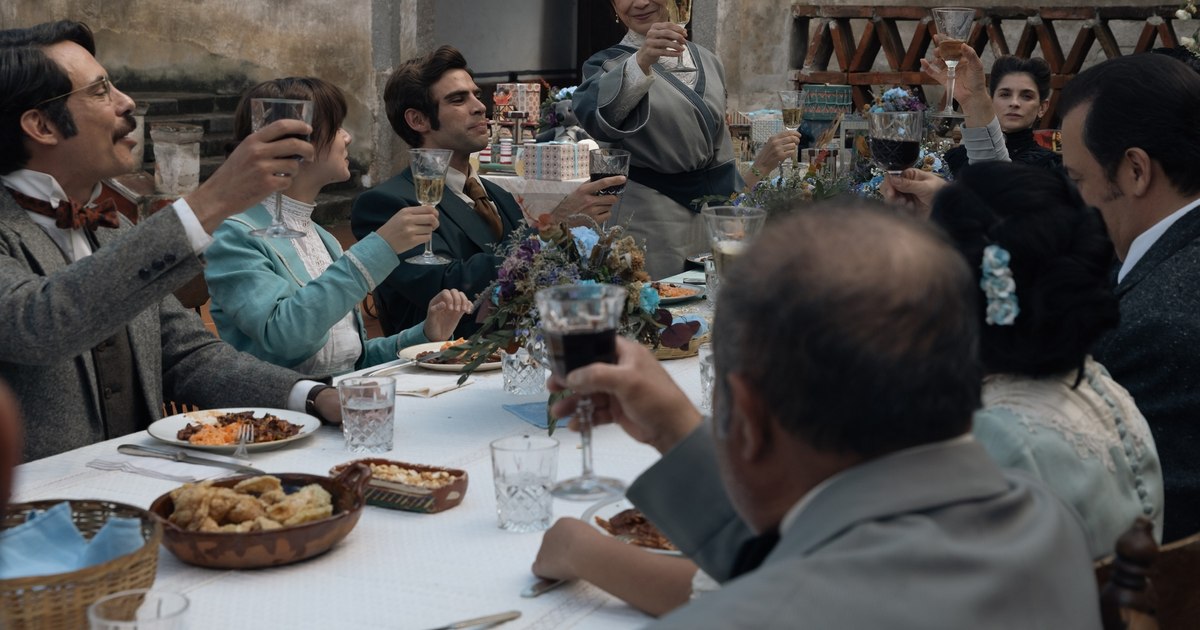
In a journey between cinematography, books and plates, director Julián de Tavira and actress Azul Guaita show how Mexico lives its identity through gastronomy and magical realism.
In the world of Latin American literature, few stories have managed to transform the senses into narrative as intensely as “Como agua para chocolate”, the novel written by Laura Esquivel and published in 1989. On the border between love, gastronomy and magic, the book quickly became a global phenomenon – the Spanish newspaper “El Mundo” later classified it among the hundred best Spanish-language novels of the 20th century.
Later, the book was translated to the screen – first in a famous film in 1992, and recently in a series produced by HBO, which reinterprets the story for a new generation. The action takes place in Mexico at the beginning of the 20th century, against the background of the Mexican Revolution (1910-1920), a period of radical social transformations, in which the old family structures and rigid norms are called into question. At the center of the story is Tita, a young woman condemned by family tradition to never marry, being forced to take care of her authoritarian mother. Her impossible love for Pedro becomes the engine of a narrative where emotions are not only lived, but literally cooked and passed on through food. Esquivel’s novel is often cited as an emblematic example of magical realism: tears that transform food, desires that seep into recipes, passion that becomes contagious. But beyond these poetic elements, the book talks about the conflict between tradition and freedom, between duty and desire.
In an interview for “Weekend Adevărul”, director Julián de Tavira and actress Azul Guaita talk about the challenge of translating magical realism on the screen – “more poetry than images”, but also about how the Mexican Revolution becomes a metaphor for inner change. From rediscovering Mexican identity through the kitchen to exploring different loves, the two outline a story that, although set in the past, continues to speak surprisingly current about freedom, tradition and the power of emotion. The two seasons of the series “Like water for chocolate” can be seen on the online streaming platform HBO Max.
“Weekend Truth”: What did you learn or rediscover about your native Mexico while filming?
Julián de Tavira: I learned a lot because I was born here in Mexico, but I grew up in the Dominican Republic and I came back when I was 17. There are many things, of course, that I did not know about Mexico – many dishes that I had never tasted, many aspects of history. Because I studied there all my life, I know the history of the Dominican Republic, but not so much of that of Mexico, so I learned a lot. I even had lessons dedicated to history, and it was very interesting to learn more about this country. For my part, I can say that I studied the Mexican Revolution, which is a fundamental stage in the history of Mexico and which you study a lot since elementary school.
Delving into the conflicts and the period related to the beginnings of the revolution, I came to know more about northern Mexico, which is very different from the capital, my hometown. We tend to think that everything revolves around Mexico City. But this movement started precisely in the north. There were many historical lessons, but what connected me most deeply is the relationship we have with the kitchen, with the preparation of food. It is part of our identity as Mexicans. And it brought us so much joy.
What part of the book did you most want to adapt in this second season? What did you really want to play?
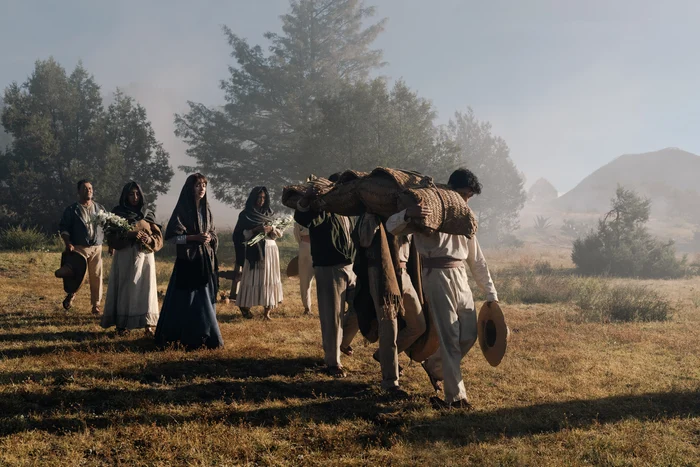
Julián de Tavira: For me, the big challenge – or one of the unique challenges of this novel – was how to translate or render what Laura Esquivel wanted to show. How can I bring to the screen the relationship with nature and those elements of magical realism, how to translate them into images, because we have more poetry than images. That was, for me, one of the most attractive and fascinating aspects. And after that, to deepen and analyze the relationship between the two young adults, where the passion gradually turns into a more mature love.
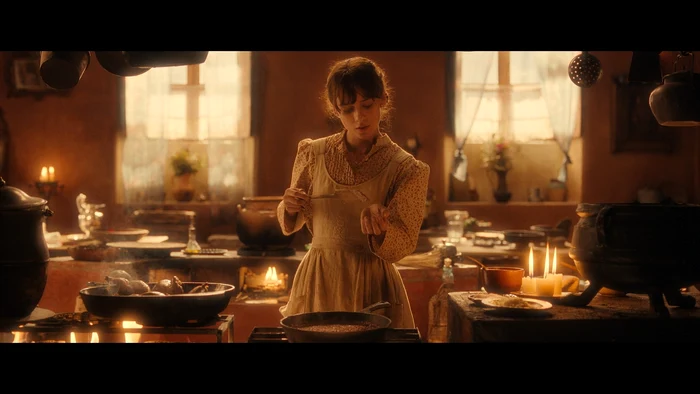
Azul Guaita: And for me, the fact of reading the recipes from Laura Esquivel’s book and turning them into something concrete, having them in my hands, being able to taste them, experiencing everything in the kitchen – these sensations, these tastes. Because it’s one thing when you read and it’s completely different when you see and feel. That was really exciting for me. It was one of my favorite parts of the whole process.
“Now I’m in love with the kitchen”
You had to learn to cook to play your character. How was that experience in the second season?
Azul Guaita: Yes, I had to learn to cook from scratch. I didn’t know how to do anything at all. Just, you know, eggs and bacon, cereal—the bare necessities to survive. I was very nervous to enter this world of cooking without any experience. I’d been watching recipe videos on social media, but had never gotten around to actually putting them into practice. Learning to make very complex recipes and trying to show that I have always cooked was not easy at all. But after some of the courses I took, now I’m completely in love with the kitchen, with cooking. And I try to do it as often as possible.
Azul, in the second season you experience two very different loves. What does this mean for your character?
Azul Guaita: What Tita is experiencing, I think many of us have felt it at some point. Toxic, passionate love, and healthy, peaceful love. There is this permanent duality between what your mind wants and what your heart demands. We always live between them. The idea is to be able to simply live, to go through these different kinds of loves and learn from each one. And to me, it’s incredible that even though this story is so old, we continue to recognize in it something profoundly current.
INTERVIEW Jean Marc Vallée, director of the HBO series “Sharp Objects”: “The material was scary for me. It was the most difficult show”
“Revolution means change”
The story takes place during the Mexican Revolution. How did that historical moment shape the emotional conflict within the family?
Julián de Tavira: The word “revolution” carries with it the idea of change. This is a transforming country that wants to shed a privileged society and build a fairer and more equitable place for everyone. And somehow, the conflicts between mother and Tita have to do with just that—conflicts with tradition, with the legacy of bygone times, and with how life can be transformed and lived differently. This is the connection between the revolution and the lives of the De la Garza family, who find themselves in the middle of a war while trying to live their own story.
What was the biggest challenge in bringing magical realism to the screen? Where do you draw the line between magic and fantasy?
Julián de Tavira: When you are face to face with magical realism, I think the most difficult thing is to really understand it. Because it’s one thing to know what it means, and quite another to be able to perceive it from a different perspective – when you live it moment by moment and don’t want it to be perceived as something fake, artificial. It’s something you have to go through in person to understand. Someone explained this to me countless times and I still couldn’t get it until I went through the whole process myself.
Azul Guaita: I guess I couldn’t say there was anything negative. We had to set some clear boundaries and find the rules to guide ourselves. That was the essential thing. Laura Esquivel describes what she does as hyperbole, not magical realism proper. So it was important for us to understand the meaning of this distinction and not slide into fantasy, because that was our limit. It couldn’t be seen as fantasy, otherwise it could have become a whole other story – one with magicians. The reality is that it is something different, more subtle: a reality that expresses itself. The clearest example can be found in the emotions that Tita cannot keep only to herself and that are transmitted through food. This is, for me, the most beautiful example of magic.
Julián de Tavira: Finding the right way to render magical realism was neither easy nor quick. But after we all went through it, we were able to really understand it and discover all the opportunities it offers. The point, after all, is to create poetry through images.
Heritage: “using the past as a starting point”
How was it to say goodbye to Tita? What do you remember from the last day of filming?
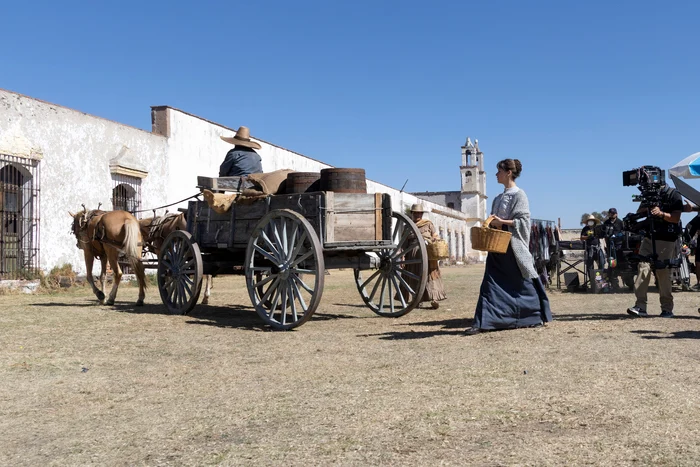
Azul Guaita: It was hard. I was in Tlaxcala, at the hacienda (trans. – homestead, farm in Latin America), and then I finished the series shooting on set. But saying goodbye to Tita at the hacienda was very, very hard. I didn’t want to leave, but at the same time I felt so many strong emotions, both for everything Tita had experienced and for myself. I remember crying a lot and taking countless pictures, saying, “God, this is the last time I’ll ever see this. I don’t know if I’ll ever come back here.” It was the moment when I really felt like I was saying goodbye to Tita. And yet, we had to go back to Mexico and continue filming. When I finished here, it was a little different, but in the end I think the real goodbye happened at the hacienda.
I saw a video of Laura Esquivel talking about the differences between the book and the series, related not only to her original intention, but also to how the revolution and Mother Elena are treated. Julián, how do you manage the tension between faithfulness to the book and the need to put something of yourself into the story?
Julián de Tavira: Taking a book and adapting it into a series or movie means, first and foremost, finding the story you want to tell and expanding it in such a way that it comes to life over the course of two seasons, turning it from a book into a drama. They are tasks that we constantly face. It is very natural for the author to be possessive of her work, just as I can be possessive of mine. It doesn’t mean that she agrees or disagrees with every decision – what we did was to “revisit” the novel, to re-adapt it with a different perspective. We wanted to tell the story from another side of it.
The book tells a single, continuous story, but you split the series into two seasons. How did you decide where to leave off the first season? What legacy do you hope to leave?
Julián de Tavira: For me, it was very natural to split the season there. It is a moment that, for Tita, represents a before and an after, because of all the tragedies she goes through: something breaks in the relationship with her mother, the adopted child dies, she has to reinvent herself, and a new man enters her life. The novel has a first part in which she is young and a second in which she is much more mature, so the division came naturally. As for the legacy: the aspiration is to connect with whoever watches the show and think together about life today, using the past as a starting point. Beyond love itself, the way we live it, the relationship with one’s country – this is heritage.
