
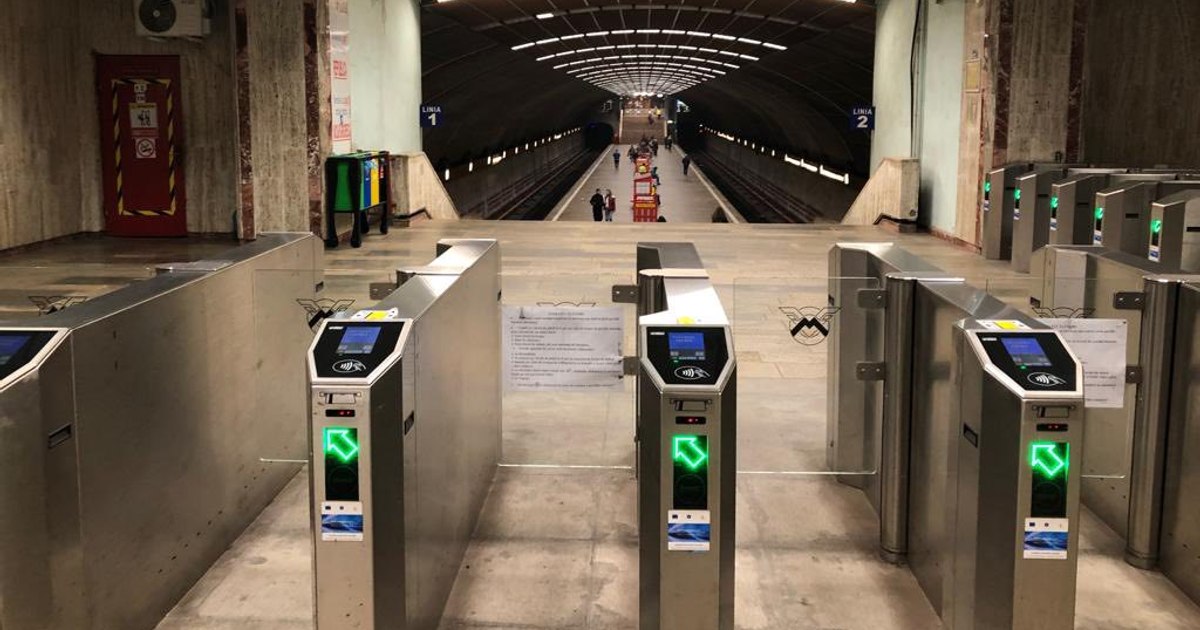
Economic analyst Adrian Negrescu categorizes as “controversy“Metrorex’s decision to make metro travel more expensive. He believes it’s about “an unprecedented successive price increase on the passenger transport market in Romania”. His comment comes after the company announced increases in the price of tickets and season tickets. The price of a 24-hour subscription to the subway will be 23 lei, for a month – 196 lei, and for a year – 1770 lei, according to a document obtained by “Adevărul”.
The price of a metro trip will be increased from 5 to 7 lei, starting on May 1, 2026, according to a decision adopted by the Board of Directors of Metrorex. The price of a 24-hour subscription to the subway will be 23 lei, for a month – 196 lei, and for a year – 1770 lei, according to a document obtained by “Adevărul”.
“Metrorex wants to increase the price of a metro ride from 5 to 7 lei. This highly controversial decision comes only a year after the fare was suddenly increased from 3 to 5 lei.
We are talking about a successive price increase without any precedent on the passenger transport market in Romania. All these decisions happen under the seemingly passive eyes of the Ministry of Transport”, declares Adrian Negrescu in a post on Facebook.
The analyst says that the increase in price is not justified by the improvement of services, which remain poor (congested, old, with delays).
“Travellers face daily overcrowding, old trains without air conditioning and major delays in the delivery of new gaskets from public contracts. Thus, the only explanation for the price increase seems to be to cover the wage level within the company.
The income derived strictly from the sale of tickets and subscriptions is totally insufficient to sustain metro in motion. In order to operate, the company relies year after year on massive subsidies pumped directly from the state budget. These government financial aids frequently exceed the huge threshold of 700 or even 800 million lei.”
“Salaries and allowances represent the largest category of expenses”
It states that official budget data from 2025 “it shows a huge discrepancy in the management of funds.”
“Salaries and bonuses represent the largest category of current expenses. More precisely, personnel expenses came to represent 37.95% of the total budget. This means a financial effort of approximately 1.05 billion lei directed exclusively to employees.”
Negrescu shows that the amount allocated to salaries exceeds operating expenses, which are 1.02 billion lei (36.75%). At the same time, 697 million lei (25.07%) are allocated for essential goods and services, including energy, maintenance and spare parts.
“It is outrageous that the Ministry of Transport turns a blind eye to financial slippages, and the interests of travelers remain completely unprotected.
Because of this chronic lack of vision, Metrorex became the perfect prototype of the “black hole” company for the national budget. We are dealing with a completely unreformed state entity that imposes increasingly harsh tariffs for public services of often questionable quality”
Last but not least, he says that the increase in tariffs is presented as a solution to cover costs, in the context of persistent management problems.
“Thus, only one legitimate question remains on the lips of hundreds of thousands of Bucharest commuters. When will we witness a real and assumed reform within this vital company?”
He also attached in his Facebook post some photos “regarding the “quality” of metro services in Bucharest”, made in the Gara de Nord 2 station on Highway 4.
