
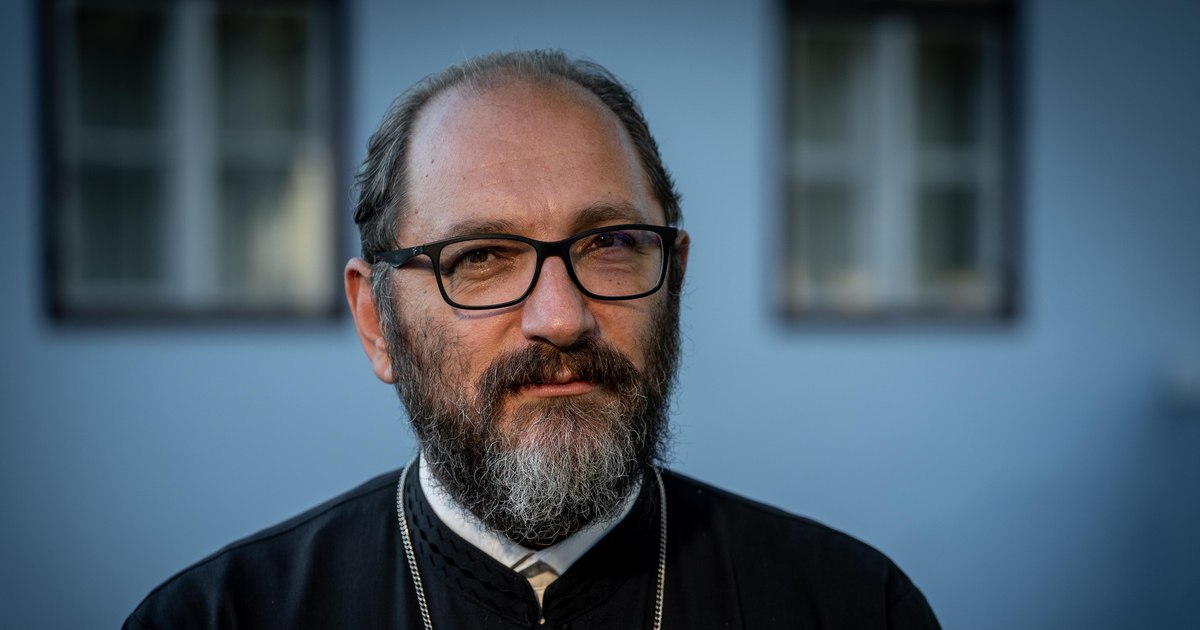
The celebration of Easter brings us again to essential dilemmas about faith, tradition and the true meaning of life. In an open dialogue for “The Truth”, Father Constantin Necula analyzes how Romanians relate to the celebration in the year 2026. He offers a sincere perspective on the relationship of young people to the Church, on the deep need for healing of a nation that is searching for its balance, but also on the Easter night seen as a window to eternity.
The truth: The resurrection is the central event of Christianity, but many Romanians live it more as a cultural than a spiritual celebration. What is lost, concretely, when Easter becomes just tradition without faith?
Rev. Constantin Necula: That can’t really happen. People, even if they breathe culturally, know that the Resurrection of Christ is at the heart of the celebration. I think that even the most fervent atheists know Who it is, that they seem to turn against Him too much. But one thing is certain. There is not only culture related to Easter without the Resurrection. But when it becomes mere tradition – and we mean here vague ritualism and cheap idolatry – the truth that Christ is Risen is entirely lost. A truth that cannot be received and lived in segments, in fragments, in fragments of goodwill. The opposite of the Resurrection of the Savior is the spiritual demagoguery of the times that limits the theology of eternity. It’s a game of cheap and provocative syncretism for mediocrity looking for its spiritual root. This is the falsification of the spiritual life proposed by the Resurrection.
The commercialization of Easter, supermarket lamb, plastic eggs, Holy Week holidays… How do you see Romanians’ relationship with the holiday in 2026?
It is one of normalizing the inter-human relationship. I hope for more peace. I assure you that the anxiety we have been struggling with for some time does not come from shopping off the shelf but from chasing the illusions of an ideologized talciok that has nothing to do with the spiritual life to which the Resurrection calls us. I never forget that the first question, immediately after the Resurrection, that the Angel addresses to the brave little myrrhs is simple: “Why are you looking for the Living One among the dead?”. It seems that I have not yet understood that this is not the direction of the search, that Christ is Risen! Nothing in the profile of the commercial assumption of Easter is about Christ, but about man’s need to escape from the camp of concerns that he considers suffocating. A part of Romania, however, is looking to return home, to their parents or to the safe space of the Home House. Look for the monasteries or the island of modesty of the village. I think both have their own gain from their celebration. I would be happy for some to not be just one of the “shelf”, and for the others to remind the soul of the power to fulfill its immortality.
“We have a large percentage of young and very young priests”
Young people return to the Easter Church, even those who do not step on its threshold the rest of the year. Is it a sign of hope or an illusion?
Young people are always concerned with joy and if they learn to look for the real one they discover it where it is. The spiritual life has its “seduction” and it is not only at Easter that they feel it. Or maybe it’s Easter in every meeting with the Church and that keeps them close to it. No, I’m not scared at all that we don’t have the youth on our side. They are the ones who propose more realism in pastoral care, a dynamic and fruitful obedience in projects. Let’s not forget, first of all, that we have a large percentage of young and very young priests. They have constant addressability to their peers and often see how they perform pastorally. Then I can’t help but see the dramatic entanglement between virtual and virtue, as it presents itself in the online space or in the environment of media discussions. Much ado about nothing, often noise that cancels out the patient murmur of prayer. I believe, fundamentally, I believe in their power to regenerate the great questions of life and propose to the Church the register of pastoral emergencies. I often see them upset that we don’t do more, and I, personally, get upset when I don’t see them more engaged in the service of their neighbor, in curing the wretched indifference in which we have been bathing for years.
“The Night of Resurrection is the threshold between me and me”
You have said many times that Romania needs healing. Is Easter her time?
Any time is good. We have to start somewhere to heal the evil of a nation always stimulated by its values, but always crucified in its values. I don’t think that Easter is a moment of healing as much as one of resurrection of consciences, of cleansing souls. The sum of souls cleansed of sin gives great strength to any community. Even more Countries. Whoever steals the Christian ideal from a nation and turns it into an ideology sins not only against the Gospel, but also against the culture of its fulfilled future. I believe that the healing of Romania starts from the Romanians’ effort to heal not only their weaknesses, but also their absurdities. We witness the Resurrection only when we experience it as such, as a unique, historically and humanly imperishable reality.
What does Resurrection night mean for you personally?
Sthe seconds of the perpetuation of a Truth! The fact that we are immortal, but not only because of our effort, but, above all, as a gift from the Savior. Resurrection Night is the threshold between me and myself. From my attempt to grasp my human ideal and God’s gift to the man in me: eternity! The night when men mingle with angels and heaven with earth and the departed with the living and even with those we wait to settle alive in our lives. I fundamentally believe that Resurrection Night is the radiance of God’s Joy in the breathless darkness of the times.
