
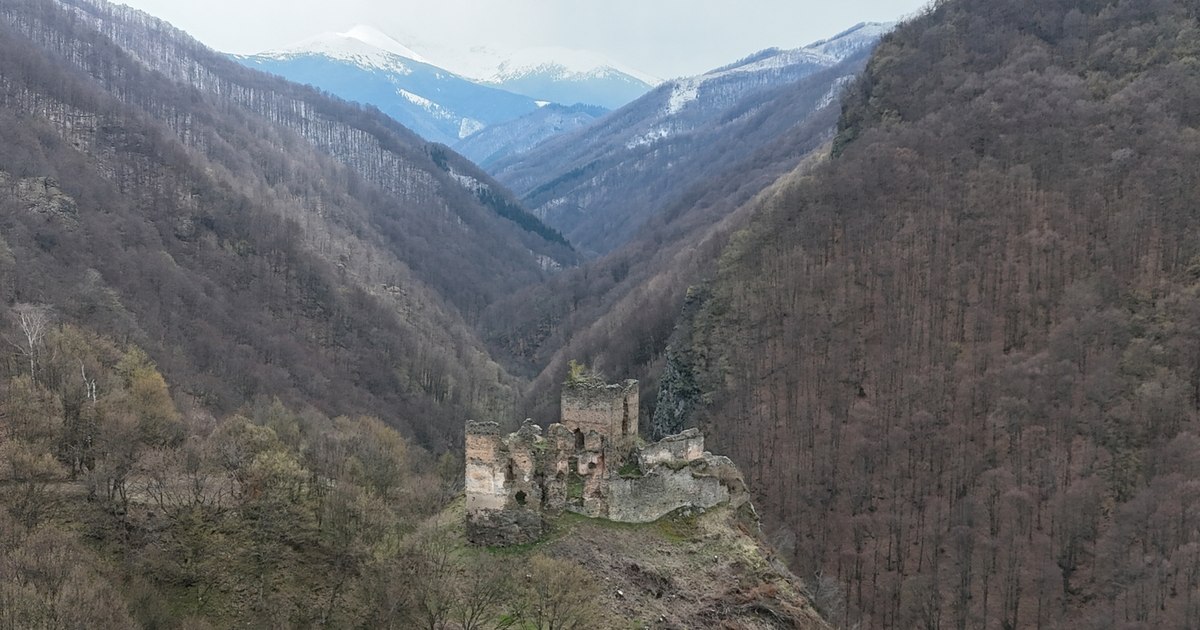
An original route reveals the “Carpathian Castle”, a medieval fortress abandoned for centuries on the cliffs that rise at the entrance to the wild land of Retezat. Colț Citadel remained for a long time an unwelcoming place, “haunted” by dark legends.
More than six centuries old, but ruined for a long time, the medieval fortress of Colț has remained a landmark of the land at the foot of the Retezat.
Citadel of the Knezis
It would have been built in the 14th century by the Candești family, which would be Hungarianized under the name Kendeffy. The place chosen by the cnejis for the construction of the fortress were the rocks that rise over a hundred meters above the Râușorului valley, at the entrance to the Retezat gorge from the Râu de Mori.
In the valley, on the opposite slope, the Cândêști family built the Colț Monastery, famous in the past because of the legends about the treasures hidden around it, but also for the medieval paintings, vandalized in the following centuries. Some historians pointed to the Turks who invaded Hateg County in the past centuries as the authors of the destruction of the icons in the old churches, others to the Calvinists. The locals had other theories.
“Descending from the Colț Citadel and passing over the Râuşor, we see the Monastery of the Monks. An old Byzantine-style church, with the tower covered with stone and the ruined front. You can still see the paintings of the saints according to the Greek rite. For one thing, I lamented those saints, that is because they are all blind, not by nature, but with their eyes removed. To satisfy my curiosity, immediately after returning I asked a grandmother who could take out the eyes of the saints. “Well, young lady,” he answers me later, “the eyes of the saints are very good at bewitching. Then, I don’t want the eyes of the saints to be good at the spells that are cast on their unbelieving wives, so that they do not see what their wives do.” informed the newspaper Tribuna, in 1886.
The castle in the Carpathians
The medieval fortress that dominates the valley of Râușor has kept even more mysteries. Local legends fancifully describe stories of princesses imprisoned in its dungeon, and in modern times some authors have tried to associate the fortress with the “Castle of the Carpathians”, described in the 19th century by the famous French writer Jules Verne.
“It is indistinguishable from the background of the mountains. What you would be tempted to take as a dungeon is nothing more than a dark pile of stones. Anyone who looks at it has the impression that they see the battlements of a wall, where there is perhaps only a rocky ridge. The whole ensemble is vague, moving, uncertain. So, if we were to believe the various travelers, the Carpathian Castle exists only in the imagination of the people of the county”. note the author of the short story “The Carpathian Castle”.
Jules Verne told about the fears of the locals regarding the ruins of the abandoned castle on the rocks, left in the care of nature and haunted, in the imaginations of the villagers of Werst, by the ghosts of its former owners.
“Although the Castle in the Carpathians was better preserved than it gave the impression, an infectious fear, increased by the power of local superstitions, defended it no less than the pives, howitzers, bombards, bolimezes and other pieces of artillery from past centuries could do.”Jules Verne also wrote.
Unique route to the Colț Fortress
Almost a century and a half since the French writer published the famous book about the “Carpathian Castle”, the place that preserves his memory has remained in ruins. However, if in the past years the path to Cetatea Colț was difficult to follow, due to the numerous paths through the forest with which it intersected and the lack of tourist markers and signs, a thematic route recently laid out has brought it back into the tourist circuit.
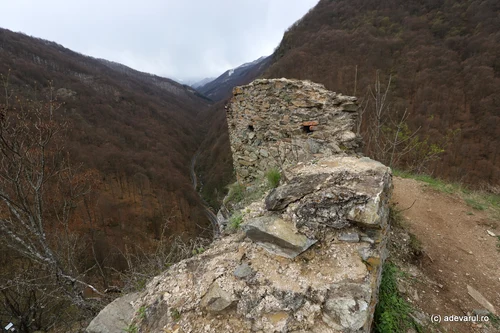
“The story trail from Cetatea Colț is the first thematic trail in Romania interpreted through comics and was inspired by the novel “Carpathian Castle” by Jules Verne. The new trail, with a length of just over one kilometer, offers visitors a unique experience that combines art, education and nature. Along the route, panels illustrated by Șerban Andreescu, renowned author and illustrator of comics, show in a captivating graphic form Jules Verne’s novel. These are complemented by thematic panels dedicated to the biodiversity, geodiversity and cultural heritage of the Cetății Colț area”. informed the UNESCO International Geopark Țara Hațegului – University of Bucharest.
The dark secrets of the oldest churches. Why are they decorated with saints with their eyes out VIDEO
According to the representatives of the Geopark, in the pavilion at the entrance to the route, tourists can take souvenir photos, and at the end of it they are invited to discover, by scanning QR codes, two local legends in audio format and an educational activity sheet, designed to turn the hike into an interactive learning experience. Most of the information presented on the trail is available bilingually, in Romanian and English, to facilitate the understanding of the content by Romanian and foreign tourists. Also in the gazebo located next to the citadel, they can leave feedback about their experience, contributing to the further development of the project.
For several years, the situation of the medieval fortress in țara Hațegului has improved, and tourists have started to seek it again. Those who reach the fortress must remain cautious. Its steep cliffs rise above dizzying precipices, and among the menacing “stone fangs” on which the citadel was built, vipers found shelter.
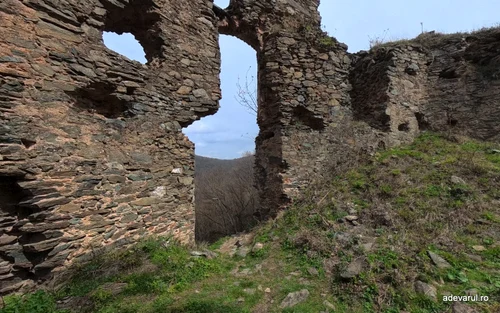
The citadel, which has never been restored in the modern era, has nevertheless retained its authenticity, and greening works in recent years have led to its “unveiling” of the abundant vegetation that had grown freely over some of its terraces.
Rău de Mori, the place where the Retezat roads start
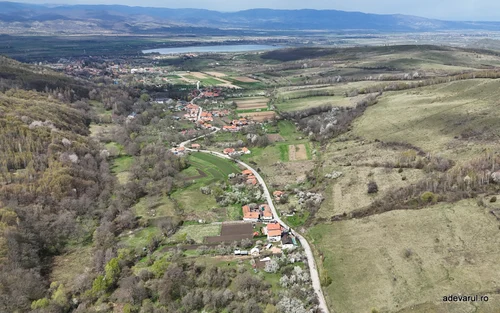
In the village of Râu de Mori, located less than 20 kilometers from Hațeg, several hostels and campsites for young people have been opened in recent years, and the fortress is presented in their offer as one of the tourist landmarks in the area. On foot, it is accessible on the newly constructed path, which can be traversed through the forest in 20–30 minutes.
From Râu de Mori, two tourist routes that go up to the alpine area of Retezat “compete” in attractiveness. The Râușor Valley rises from the area of the Cândêști Citadel and the medieval church at its foot towards the Râușor mountain resort in Retezat, located at over 1,400 meters above sea level.
The road winds through the steep and wooded slopes, which occasionally leave a few clearings that can be used as rest stops. The Râușor resort is sought after in winter for its ski slopes, and for most of the year it is the place from where travelers begin their ascent to Vârful Retezat (2,482 meters), located at the end of a route of about three hours. The climb from the resort to the emblematic ridge of Retezat can be risky on its last section, between Şaua Lolaia (2,217 meters) and Vârful Retezat, so tourists need adequate equipment for its completion.
Also from Râu de Mori, travelers can take the road from the Râului Mare Valley to the Gura Apelor dam in Retezat, located about 20 kilometers from the village of Șara Hațegului and at over 1,000 meters altitude.
Strange phenomenon on Kogaionon, the sacred mountain of the Dacians. “Gugu Peak hid from me. It rises as if from the earth” VIDEO
Lake Gura Apelor occupies over 400 hectares in the wild land of Retezat, and its dam made of rock, almost 170 meters high, is one of the highest in Europe. From Gura Apelor, the tourist routes go up the forest roads from Valea Lăpușnicului Mare to Poiana Pelegii, the starting point for hikers to dozens of glacial lakes and ridges of over 2,000 meters in the Retezat Mountains.
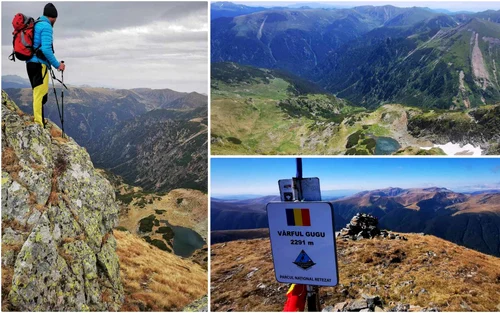
Another forest road bypasses the reservoir and, crossing the Lăpușnicului Mic Valley, opens the way for tourists to Gugu Peak (2,291 meters) in the Retezat-Godeanu Massif. Mount Gugu is the highest peak in the Godeanu Mountains, but also one of the most isolated peaks in the Carpathians. It is surrounded by the Retezat, Țarcu and Cernei Mountains and can be explored on the mountain trails that start from the Gura Apelor Lake area in Retezat or from Retezatul Mic – the Câmpusel area.
Some scholars have called it the “holy mountain of the Dacians,” the legendary Kogaionon, the mountain the Dacians considered holy and where they worshiped Zamolxis, according to the ancient historian Strabo. The Godeanu Mountains, where Gugu Peak is located, are famous for the erosion platforms, almost smooth surfaces formed by the erosion of the mountains over time, located at over 2,000 meters, often used by shepherds.
