
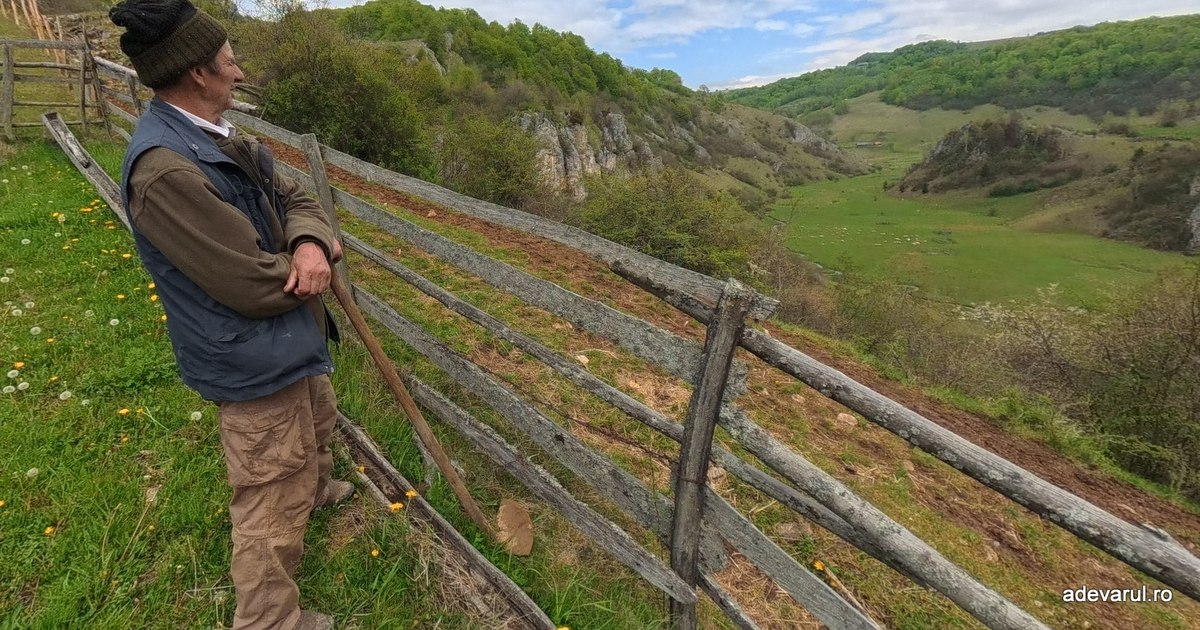
The end of Ponorului, Ponorici and Poiana Omului, the places of the old houses and stables in the Șureanu Mountains, were reanimated with the arrival of spring, by shepherds and tourists. Via Transilvanica gradually changed the lives of the locals in the isolated settlements.
From 2022, Via Transilvanica crosses the counties of Alba and Hunedoara, in the famous land of Dacian fortresses, called Terra Dacica by the creators of the tourist route.
The largest part of the “Dacian” route, stretching for almost 170 kilometers, passes through the Șureanu Mountains (Gradistea Muncelului Cioclovina Natural Park) reaching places unknown to many tourists. It is a place of ancient fortresses, but also of villages, hamlets, sheepfolds and archaic settlements in the mountains, established by shepherds or used in close connection with shepherding.
Fundura Ponorului, the spectacular place in the mountains
In recent years, some places in the Șureanu Mountains have become increasingly sought-after destinations by tourists, and with them, the lives of the locals have started to change.
“Until a few years ago, before the Via Transilvanica, Fundătura Ponorului was an almost unknown place. Tourists came from Hunedoara, took photos and then returned home. The road is very bad, being a former forest road, also used for the bauxite quarry from Ohaba Ponor, so people didn’t really get here, to Fundătura. We used to go up with sheep, cattle, horses, but only from spring to autumn”. says Constantin, an animal breeder from Federi (Hunedoara county), located in the valley of Streiului, at the foot of the mountains that shelter Fundătura Ponorului.
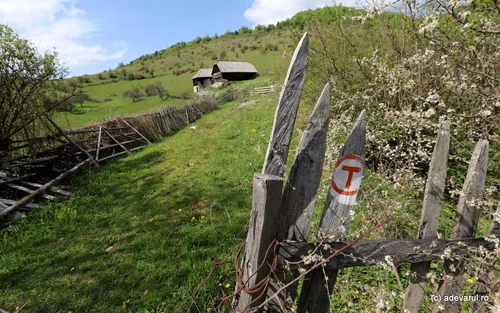
The local has noticed in recent years the growing interest of tourists in this place and has gradually become a host for them. Like other villagers from Federi who have homes in Fundătura Ponorului, Constantin welcomes travelers to his family’s seasonal homes here. He shows them kindness, guides them when needed and serves them with local products from the barn. Among the visitors are also many foreigners who discovered the place on the hiking trail maps.
“With the coming of spring, more and more people come to Funatura Ponorului. Some called it God’s Palm, but for us it was always a place where we kept animals in the summer. For me it was even more. I was employed at Ocol and in 1983 I planted this spruce forest, instead of the beech forest that covered these mountains. I grew up in these places.” says Constantine proudly.
Funatura Ponorului and Ponorici, close
Two kilometers and almost an hour’s walk from Fundătura Ponorului, another dead end emerges from Via Transilvanica. Ponorici was also a place sought after by the shepherds who roamed the Șureanu Mountains in transhumance, either to climb the Retezat in the summer, or in longer transhumance, on routes outlined from ancient times, when flocks of sheep came down from the Carpathians to the Danube plains.
“Thousands of sheep used to pass here in the spring and autumn, on their way from the Sebeș area to Retezat. I have also walked with them, since childhood, through all these mountains. Now, the flocks are fewer and fewer, because young people are no longer attracted to such a job. But more and more tourists are coming, on foot or by bicycle.” says David, a local from Federi, settled during the summer in a village in Ponorici.
The local, who takes care of several cattle, has also noticed the popularity of the places, but for him they have a deeper meaning.
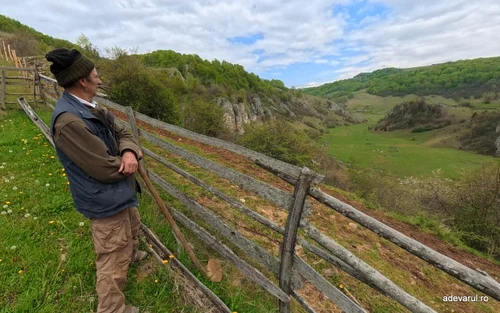
“There were Dacian fortresses and settlements here. The Dacians and the Romans fought, and in some places, which not many people know about, arrowheads, pieces of helmets and shields and all sorts of other things from the time of the Dacians have been discovered”he recalls.
The Trojan from Ponorici
Such a place is right above the Ponoriciului meadow and the Cioclovina precipice, two to three kilometers from the Dacian fortress Piatra Roșie, and people called it “the Trojan”.
Spectacular phenomenon caught in the Apuseni Mountains. The splendor of a temporary lake formed in Poiana Glade PHOTO
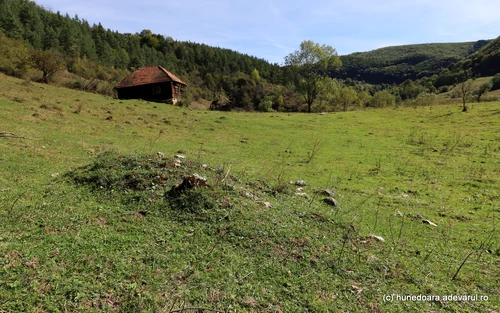
Here, in the 1950s, the historian Constantin Daicoviciu discovered the traces of a strong defensive system, stretching for about two kilometers, which he called the wave from Cioclovina – Ponorici. It showed that the Trojan had a thickness at the base of about 10 meters and heights of up to three meters. Its more than 30 secondary waves, made of piles of stones, were about six meters thick and up to 36 meters long, being raised at distances of 18-35 meters between them.
“You see, we are dealing with a dry wall consisting of pieces of limestone rock and very little soil, held together on both sides by a wooden palisade, possibly a woven fence. By burning the palisade, the stones were calcined, the soil between them reddened, and the top of the Trojan collapsed. Obviously the original thickness of the palisade wave could not have been greater than 2-2.50 meters. What is seen now is only the result of the collapse of the Trojan”. noted the scientist.
At the beginning of the 20th century, a forest railway went down from the village of Ponorici to the village of Pui, from the Streiului valley.
At Ponorici, the narrow-gauge railway intersected with “Troianul”, the great ancient defensive wall, which archaeologists assumed was used as an outpost against a Roman invasion initiated from the south of the country, through the Streiului valley. The end of the railway was near the Cioclovina precipice.
Here, the trains stopped and returned slowly descending along the “Trojan” and then through the hills, sinkholes and valleys. Above the Ponorici, a funicular line established at the beginning of the last century was used to transport the “guano-phosphate” extracted from the Cioclovina Cave to the railway station of the Pui commune. Only the embankment was preserved from the old railway, and only traces of the places where the poles were erected remained from the former funicular installations.
The Glade of Man and the legend of Decebalus
Above Fundătura Ponorului and Ponorici, the hiking trail brings travelers to another legendary place. Located at over 1,000 meters above sea level and surrounded by vast forests of beech, oak and fir, Poiana Omului was a crossroad of meadow roads used by transhumance shepherds. Its name would come, the locals say, from the legend of the death of the Dacian king Decebalus.
“I have known, like many who have lived here, about this legend of Man’s Glade, as the place of Decebalus’ death, ever since I could remember. From the age of 13 I roamed these mountains with the flocks, and I have always liked the life of a shepherd. Here at Man’s Glade it was a very big thing. The flocks of sheep came down, there were thousands of sheep that came to this place, which were put in the barns and they were chosen here, and the shepherds were also bargained here”recalled Duțu, one of the shepherds from Poiana Omului.
The strangest abandoned hamlet in the Șureanu Mountains. People were afraid to stay here at night
About Poiana Omului, the people of the area say that it would have been the place where Decebal met his end, while he was being pursued by the Romans. The Dacian leader would have left Sarmizegetusa, riding on the mountain tops through Poiana Omului, where in Antiquity there would have been a communication node between the Dacian fortresses in the Orăștiei Mountains, and his death would have taken place in the shade of the oaks that grew in this clearing. Like Fundătura Ponorului and Poiana Omului it has become a point of attraction on Via Transilvanica, and travelers can find shelter here.
Traces of supposed Dacian stables, Roman stables and the better known Dacian settlements of Piatra Roșie and Blidaru were discovered nearby. From Poiana Omului, Via Transilvanica heads towards Târsa, then descends into the valley of Grădisti, on the road to Sarmizegetusa Regia.
Another old plain road, with numerous ups and downs, continues from Poiana Omului towards the peaks of Rudele (1,300 meters), Meleia (1,419 meters) and Tâmpu (1,495 meters), dotted with the remains of some seasonal Dacian settlements. From Vârful Tâmpu, the hiking trail goes up to Vârful Steaua Mare, located at about 1,700 meters, and from here tourists have five kilometers to cross, on the old plai roads, to Vârful Godeanu (1,659 meters), located near Sarmizegetusa Regia and considered by some historians “the holy mountain of the Dacians”.
