
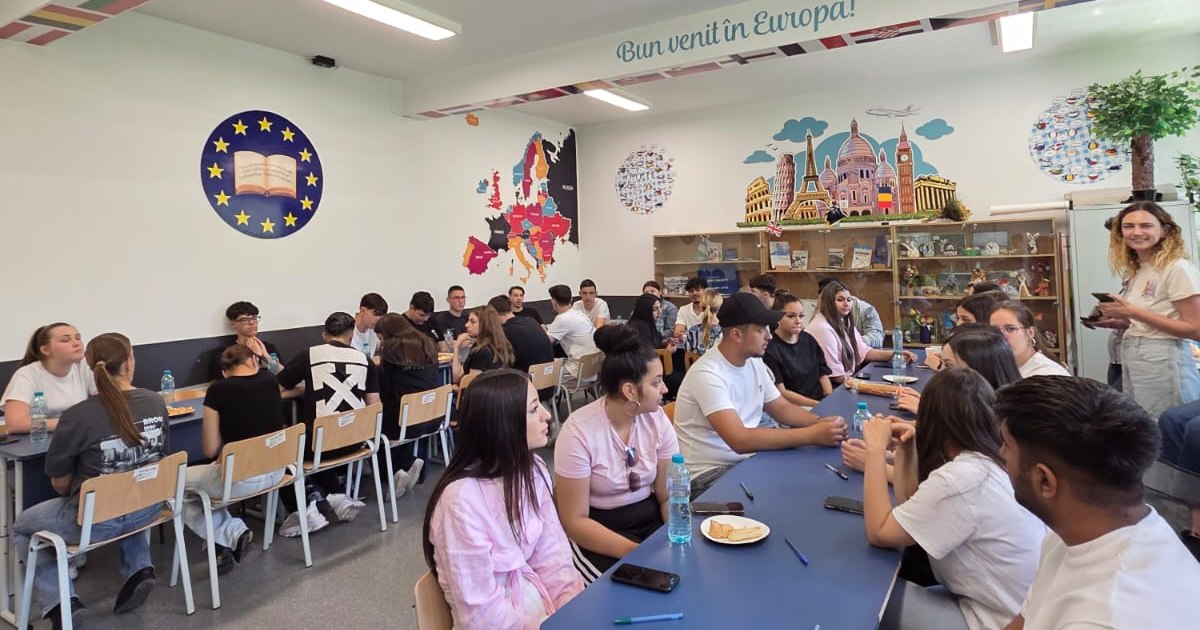
Continuous improvement in school outcomes is not achieved through inertia, nor is it measured in one school year. World Vision Romania data show that, over time, the results of children who are supported to go to school every day improve considerably.
Children from the support programs of the World Vision Romania organization have a passing rate at the BAC of over 85%, well above the national average (which is, in technological high schools, 50-52%). There is a need for constant support, the members of the organization found over the years by working in disadvantaged environments, in rural schools and in urban technological high schools that select their students from the village. For a high success rate, interventions should start at an early age.
“A child who stays at school, passes the exams and becomes the first student in the family”
In the year 2025, according to the annual report made public by World Vision Romania, over 127,000 children were supported through education programs, prevention of school dropout and professional integration, and this in the conditions where almost half of the secondary school students in rural areas do not want to continue their studies at high school.
The data from the “Rural child well-being” study, carried out by World Vision Romania, shows that 41% of secondary school students from rural areas do not want to continue their studies at high school, and 24% of children eat only two meals a day.
“We see in every community how fragile a child’s educational path can become when poverty, lack of educational support and family difficulties overlap. At the same time, we also see how much a constant intervention can change: a child who stays at school, passes the exams and becomes the first student in the family. Investing in education is not only a social investment, but a strategic one for Romania’s future”, said Mihaela Nabăr, executive director of World Vision Romania.
The organization’s programs also included 53,251 adults – parents, teachers, refugees, people with disabilities, people from other categories.
Kindergartens supported in all counties of the country
Most children benefiting from support programs are in kindergartens, over 64,000. “Start in education”, a program run by World Vision Romania with the support of OMV Petrom, has reached over 1,000 communities, in all the counties of the country, with 1,500 kindergartens being equipped with educational materials.
Parents of children from disadvantaged communities were co-opted into parenting sessions, and more than 3,200 teachers were trained to work with parents and children from vulnerable communities.
Digital resources dedicated to early childhood education have also been developed, which are available online and have reached millions of users.
The program that perhaps showed its fruits the fastest, however, is “Bread and Tomorrow”, through which 123,633 portions of hot meals could be provided. It was quickly found that a “simple” meal offered to children at lunch, followed by participation in remedial programs, significantly improved the school results of 1,200 children. The schools where this program took place – which has since been taken over by the Ministry of Education, although it is still financed from public funds far below what is needed – reported a 99% attendance of co-opted children, with teachers saying that school attendance increased by more than 90%. The outstretched hand actually made the difference between continuing education versus dropping out. 78.5% of the children in the program, participants in the remedial and personal development activities, improved their results in Romanian, and 76% in mathematics.
High school admission 2026. Growing interest in high schools that prepare future teachers. “The strongest point is the pedagogical practice”
“Ready for high school” and “I want in 9th grade” in numbers
Two other programs run by World Vision Romania are addressed to secondary school students who are going to be admitted to high school and, respectively, to students admitted to high school but who face the risk of dropping out. Many come from single-parent backgrounds, from large families or have parents gone to work abroad, and the lack of support at home pushes them to absenteeism, demotivation and early pressure to drop out of school to enter the labor market, often working “in the dark”.
In the “Prepared for high school” program, dedicated to students at risk of dropping out of school, in which 340 students from rural areas were included, the result was that 91% obtained averages above 5 in the National Assessment. The meditations on the exam subjects, the mentoring and educational counseling activities, carried out in more than 3,600 school preparation sessions, have changed the course of some children who otherwise, many of them, would have dropped out of school at 14-15 years old.
Student support also continues at the high school, where children from vulnerable backgrounds are also selected. According to the 2025 annual report, in the “I want to be in 9th grade” program, World Vision Romania supported 864 high school students from rural areas to continue their studies.
The figures indicated a success rate well above the national results, with 84% of high school students supported in the program, from technological high schools, passing the Baccalaureate exam, while the pass rate for high school courses was 100%. More than 3,350 meditation sessions and 80 individual mentoring sessions took place with them. Through the program they were offered support to cover the cost of commuting, the cost of supplies or clothing, etc. The students also participate in various training courses, meetings with entrepreneurs or camps.
Among those with very good results, but for whom the situation in which the family is still in could be an obstacle, the support continues in the “I want to go to college” program. According to the report, 68 students from vulnerable backgrounds received financial support, mentoring and counseling to continue their university studies.
World Vision Romania is part of the World Vision International partnership, present in almost 100 countries around the world. It is an organization concerned with the well-being of children, which carries out education, emergency humanitarian intervention, development and advocacy programs. Interventions are focused on working with children, families and communities, with the ultimate goal of overcoming poverty and injustice.
