
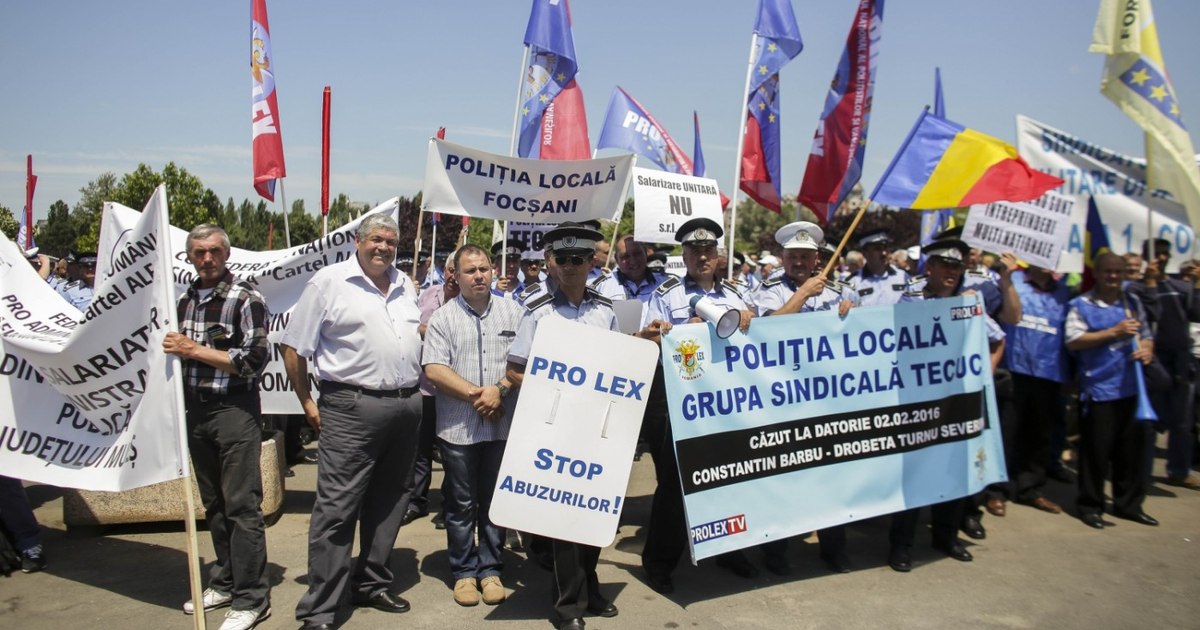
The Single Pay Act and the removal of public sector increments continue to cause discontent and uncertainty among employees in education, health and administration. The unions have announced a series of protests, on Wednesday, July 3, the clerks will stop their work. The unitary salary law stipulates that 87 out of more than 150 increments granted by the state, to employees from the budget, should be eliminated. These days, the interim Minister of Labour, Dragoş Pâslaru, is in Brussels to renegotiate the terms that Romania assumed in the PNRR milestone.
“Adevărul” spoke with economics professor Christian Năsulea about the salary reform and the pressures assumed by the PNRR and why this reform is necessary. He says the wage bill could even be called the “elimination of allowances bill,” because that’s where the real problem lies. In some cases, bonuses and overtime were as much as 75% of the salary.
“The elimination of increments is a matter that is necessary, considering how bad the way the salary works in the public sector looks. Because, the situation, at the moment, is that we have all kinds of patches that are effectively put over a section on the basis of which some problems are solved, only that they are solved differently. That is, the situation is not the same in every field, in every locality, in every area.
So there are big differences that should, in my view, be the main thing that bothers people who want to take to the streets now, because they don’t agree with the way things should be done. So it’s absolutely normal that people are unhappy because, from what I’ve seen, there are a lot of computing problems in a lot of areas. So some professional categories are certainly right to be dissatisfied with the form in which the law would be adopted at this time. It should put them in a position where the level of pay, after things settle down, is one they can rely on,” says the expert.
Inequity in the system is the main argument of the law under debate
At the same time, the specialist believes that people’s reaction is natural, because there are numerous calculation problems and many professional categories have real reasons to be dissatisfied with the form in which the law would be adopted.
“That’s one of the main reasons why we need a wage law that’s very well done and very clear, so that we don’t have these situations where different people, for the same job, in different places in the system, earn very, very different amounts, depending on how their bosses have gone about getting them raises, or approving them of raises, or exempting them from certain things that apply to other employees who do the same job”says the teacher.
The most dissatisfied categories
Regarding the categories that could gain or lose, Christian Năsulea points out that there is still not enough clear information for a serious evaluation. It is not known exactly which increments will be integrated into the salary, which increments will disappear, nor what the final form of the reform will look like. For the time being, a percentage of 57% reduction in increments has been circulated in the public space.
“Because we do not currently have a final form of the law, so that we know exactly which increases are integrated into the salary, which increases disappear or what is the exact plan that the Romanian state wants to implement through this reform as it will look at the end.
It is impossible to say who will gain more and who will be more disadvantaged as this reform is implemented. You see, this is precisely the problem, that it is not very clear to anyone at the moment what things will look like when all these reforms are implemented. So I haven’t seen some plans put up for public consultation, but we are far from having a very clear, very concrete picture in such a way that even these people who are preparing to take to the streets can know for sure what their salary structure will look like after the new salary law is given.
Here’s actually the problem, no one knows for sure yet, everyone assumes things are going to look bad. Some unions and people in certain fields have done some calculations based on the information that is available and in general have come to the conclusion that it does not look good, that they have more to lose than the stability they gain as a result of the implementation of this reform. I mean we understand people who want to take to the streets because they’re unhappy, and at the same time we understand that the law needs to be polished and we need to start fixing things when it comes to public sector pay.”, says the specialist.

Five years of analysis for a law that doesn’t work
Romania could have avoided assuming this deadline if it had not assumed this reform through the PNRR. But even the strictly political assumption, after five years have already passed since this reform was assumed, would have represented a generous term. Năsulea says that politicians and bureaucrats ignored this problem for years, although it was known as a major priority for the Romanian state.
“Ok, sure, this milestone might not be included, but what are we talking about? It’s already been 5 years since it was thought of as a milestone until now. Until then, let’s sit down and think a little more and let the system get even worse than it is now, and more riddled with patches and boosts and other dressings put over a system that needed to be maintained anyway.
So it has so many inequities, so many problems related to unequal pay for equal work that if we had not ended up, as usual, having to somehow be forced by this desire to take a few hundred million euros, we would probably have been quiet in the future, with a salary in the public system that is dusted, that does not even work, that does not meet the needs that society has from public sector employees because it does not motivate them in the first place them to do their job and this matter would never have been resolved.”

The law should not be changed for 5 years, but changes will occur
While there is talk that the law would need to remain unchanged for five years for the milestone to be considered properly met, he says he is confident that changes will occur quickly after passage.
“From the discussions held on this topic, it follows that we should have a law that cannot be modified for 5 years, for the form to be considered correctly fulfilled, we should succeed in making a form of this law that can remain stable for 5 years.
I, for one, am convinced that this will not be taken into account, and I am convinced that we will realize that changes are needed. And we will make changes in one form or another no later than a month after this law that we are discussing now passes.
Because it’s made on the knee. Because the politicians sat too much, I don’t know, looking at the stars, looking at the walls, thinking intensely about what this law should look like, that’s how we ended up in the situation where we don’t have time to do things the right way.
And here, of course, the responsibility for this rush is borne by the politicians who are now trying to pass the law and save their milestone, the politicians who took their salaries as dignitaries and did not do their job. Unfortunately, again we can’t expect one thing to be well done. There is simply no time for very good or perfect. So we are in a situation where we have to wait and see if we can make it work. Let’s do something that’s an improvement over what we had before.
In such a way that it is not about ticking off another PNRR milestone that Brussels will accept because we have done something, but that it will still be an improvement that will be useful for the public sector employee.”
In conclusion, says the professor, at this moment one can only hope for a slight improvement in the way the state finances and the public sector payroll system work, especially for the categories of employees who do not even have the security of income from one month to the next.
