
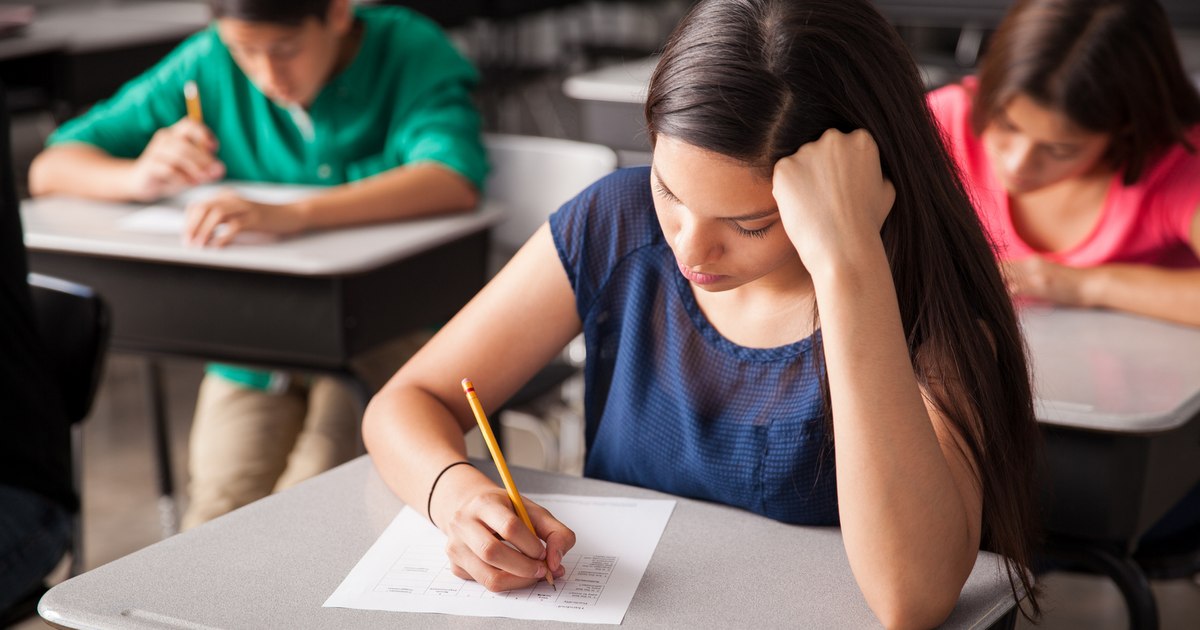
The education unions warn that they are ready to boycott the national exams, and the reason is the draft of the unitary salary law, currently under public debate, which eliminates two essential rights for teaching staff: merit grading and management allowance.
The trade unionists accuse that despite the fact that they postponed the law by three years after the last strike, the current Government no longer even recognizes the negotiations that took place then. And while teachers have their allowances cut, senior dignitaries such as ministers, parliamentarians and the president get substantial pay rises, according to the same legislative proposal.
Marius Nistor, the president of the Federation of Education Unions “Spiru Haret”, warned, in a discussion with “Adevărul” journalists, that the teachers will start the protests, if the Ministry of Labor does not come up with changes to the current draft of the law, during this week.
“The Ministry of Labor has until the end of the week to respond to the demands we have submitted. Otherwise, the representative trade union federations will categorically initiate protest actions. I think we have enough reasons for dissatisfaction to boycott the correction of national exams as well“, Marius Nistor, the president of the Federation of Trade Unions in Education “Spiru Haret”, transmitted to “Adevărul”.
Alexandru Mihai Mihalcea, trade unionist teacher, detailed, for “Adevărul”, the reasons for the students’ dissatisfaction:
“From many points of view, a rather gloomy question has also arisen, in my opinion. Namely, if the negotiations with the Executive are not valid even after the prime minister leaves, then should we strike every time when a new government is installed? As a union leader it is very difficult to formulate an answer to this question to my colleagues.
We observe at the moment that the current Cabinet, in power in the form of an interim, behaves as if it was not the Government of Romania that negotiated with us in 2023, but probably the Government of Botswana. Politicians also fail to realize that if they attack the education act, students will suffer the most, even though teachers will take the direct hit“.
What students say about the possibility of a boycott
In this context, several students expressed their opinions, for “Adevărul”, regarding the possibility of teachers boycotting the correction of baccalaureate papers. Some of them learned about this possibility from school, others did not.
Elena Adriana Sima, student in Moreni, Dambovița county, confesses that she found out “in passing, when the history teacher brought up this topic, saying that there is a possibility to boycott the exam, but he did not prolong the discussion very much”.
Andrei Copșa, a student in Bucharest, says that he heard about this possibility “îin the first phase during the simulations, which eventually took place, but since then I haven’t heard anything concrete”.
Larisa Popescu, also a student at a high school in the capital, reports:
“I kept hearing throughout this school year that unheeded teacher complaints could significantly influence the conduct of the baccalaureate exams.”
On the other hand, Bianca Irina Rotaru, a student from Moreni, says that discussions do not take place during classes, and the information is “either suspicions on the part of my classmates, or uncertainties on the part of other teachers who mention that “nothing is known, nothing is heard at the moment”, but remembering a teacher who wore an armband as a sign of protest.
Mihai Buleandra, a colleague in Moreni with Bianca, says that at the moment he has not heard anything very explicit and that “unfortunately, in my high school the teachers are not so united when it comes to defending their rights, including salary ones”.
Luca Istrate, a student in Bucharest, claims he was not directly informed of the possibility of a teachers’ boycott, but there were discussions about a possible protest, but not for what the unions claim: “it was talked about the problem of simulations and the way in which they were corrected. Due to the reduced number of teachers, there were bigger discrepancies between the scores”.
Although they fear the possibility of a boycott, the students show solidarity
Regarding the fear they feel in front of a possible boycott, opinions are divided among the students.
Mihai Buleandra says this scenario does not scare him, since “I saw how difficult their conditions became, even though the teachers were exhausted, and how unsafe everything became. That’s why I could assume that the publication of the results will be delayed a little, for a better and fair common future at the end of the day”.
Final results of the 2026 Baccalaureate simulation. Higher grades than last year in all tests
Elena Adriana Sima declares that she does not necessarily feel fear, but rather a disturbance, but she understands the teachers’ difficulties:
“I don’t necessarily look at it with fear, considering that I understand where the teachers’ frustrations come from, but more with concern, considering that it would be total chaos, including that registrations at faculties would also have to be postponed, but also the preparations of students regarding the start of a new stage.”
“Indeed, for both me and a few colleagues, the possibility of a boycott creates a state of anxiety, being flattened by the belief of some that, being a national exam, defining for many, the probability of such an event decreases. At the same time, personally, I can understand the current necessity of such a movement, being, perhaps, the only way by which teachers can make themselves heard”, says Luca Istrate.
Also, Andrei Copșa claims that, although this thought “causes him panic and insecurity”, he would convey to the teachers “that although I do not want the postponement of the exam, which comes with the delay of admissions and entrance to the faculty, I understand the perspective from which he acts. I believe that only through actions you can bring about a change at the national level, even if it means boycotting an important exam.”
Larisa Popescu admits that the possibility of a boycott presents an uncertainty that inspires her fear, as it could mean that she could no longer enroll in the desired faculty. On the other hand, it considers that “the dilemma is also an impediment for teachers, a war that cannot be won by anyone, since teachers are wronged from various points of view, their protests are ignored most of the time, they are left with few other means to draw attention to this critical situation”.
On the other hand, Bianca Irina Rotaru states that she is not at all afraid of this possibility, being sure that, in the worst case, “grades could be released late, given that teachers’ displeasure does not capture their empathy for us, our work, and our future.”
What messages do students send to politicians?
Luca Istrate says that he can only convey to the Executive that “teachers do not reach such measures out of the blue”, and to the teachers, although he can understand the source of their dissatisfaction, he conveys to them that he wants to make them aware of the difficulty in which the students of the twelfth grades find themselves: “To the teachers, although I can understand the source of their dissatisfaction, I still want them to be aware of the difficulty in which the 12th grade students will find themselves in such a context”.
“Major error!” The Faculty of History of the University of Bucharest requires the retention of the compulsory exam in History at the Baccalaureate
On the other hand, Elena Adriana Sima showed complete solidarity with the teachers’ grievances: “Personally, although it would delay my life somewhat, I support the teachers in this movement, as they have been ignored for years. With the help of these people, we form our character and path in life, and they should be rewarded. Therefore, I believe that if the Government does not take appropriate measures regarding the teachers’ grievances, they should resort to boycotting the baccalaureate exam”.
Also, Bianca Irina Rotaru vehemently supports any attitude of change in education: “Only in this way can a state evolve and have a thriving economy with an educated people. Teachers’ grievances are not unjustified, they have been fermenting for years in the teaching community, affecting even students and parents. Their reactions are valid, the problems are solved from the root, and I vehemently support any attitude of change in education, especially if the cause of these dissatisfaction concerns those who helped me build my future”.
Mihai Buleandra expresses his desire for teachers to be adequately compensated: “I would like politicians to think seriously, not just in the eyes of the media, that an educated future cannot be ensured without funds in this area. The most important thing, in my opinion, is that teachers are not just puppets that we throw forward when we see bad results in PISA tests or so on. They must be compensated for their continuous effort and they must also be motivated with fair salaries, not be the first to be cut when we we realize that too much was stolen”.
