
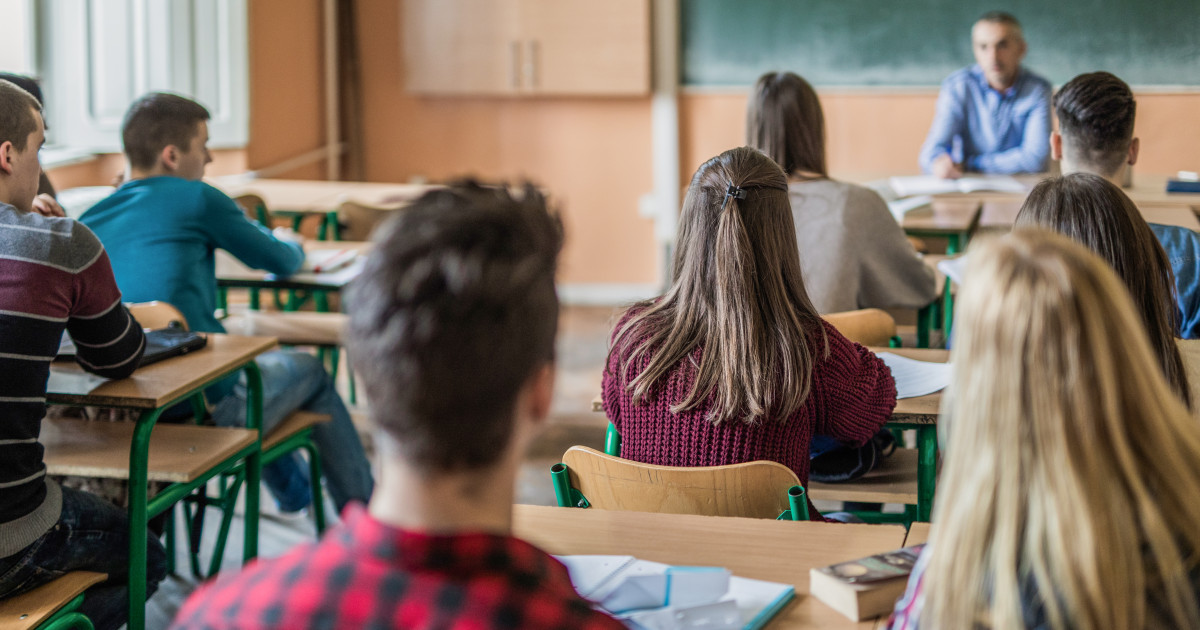
High school students will be able to study, starting from the 2027-2028 school year, the optional subject “Artificial Intelligence (AI) and digital citizenship”, the curriculum of which has been approved by the Ministry of Education and Research. The course will address the operation of AI systems and their responsible use, with a focus on personal data protection, information verification and copyright compliance.
The proposed activities start from concrete situations: a chatbot that gives wrong information, a recording modified to mislead the public, or a school paper made with the help of AI. Students will analyze such examples to understand the limits of the applications and the consequences of their use.
Who can study the new discipline and how many hours are provided
The curriculum is addressed to students from all streams, profiles and high school specializations and can be completed in any of the 9th, 10th, 11th or 12th grades. The course is designed for one hour per week for the duration of one school year.
The discipline is included in the national offer of the curriculum at the decision of the student from the school offer, abbreviated CDEOȘ. It is optional, and its study is done under the conditions of the framework plans and the methodology applicable to the level of education.
The curriculum was approved by the Order of the Minister of Education and Research no. 85.80 of October 14, 2026, published in the Official Gazette no. 894 of October 26, 2026. The annexes were published in number 894 bis of the same day.
The teacher will adapt the explanations, the difficulty of the case studies, and the requirements of the projects to the class level and the previous experience of the students. For upper grades, the document recommends more rigorous argumentation of conclusions and discussion of the limits of the information on which they are based.
How high school students will learn to use artificial intelligence
The syllabus includes explaining the basics and the relationship between data, algorithms and the results obtained. Through examples from everyday life, high school students will learn to distinguish artificial intelligence systems from other technologies that automatically perform certain operations.
Part of the activities will look at the role of people in decision-making. Medical or recruiting situations are proposed to explain under what circumstances human supervision is necessary and why an app’s recommendations should be evaluated before they are used.
In this context, the risk of discrimination will also be discussed. AI systems can produce biased results, influenced by the data used, how it was built, or the context in which it is used. Students will analyze the consequences for the affected people and the principles that must be respected, such as fairness, transparency and protecting privacy.
What data should not be entered into applications
Before the hands-on content generation exercises, the teacher will discuss information privacy with the students. They will learn to consult the terms of use of the platforms, identify the data collected and check the rules applicable to minors.
The document states that how information is stored and used differs between services, account types and settings. Proposed exercises include comparing privacy policies and identifying a safe alternative when a user is tempted to provide personal data to a chatbot to get a personalized response.
Students will be instructed not to include their full name, address, contact details or pictures of themselves in requests. The teaching staff will check in advance the conditions of the platforms used in the classroom, including the minimum age of use and possible parental consent requirements. Where possible, the program recommends using institutional or test accounts.
How they will check for misinformation and deepfake content
Another component concerns the identification of erroneous or fabricated responses by the generative tools, called “hallucinations” in the program. Students will be able to analyze information on familiar topics to spot mistakes, then check answers on unfamiliar topics by consulting reliable sources.
Activities will include examination of AI-generated or modified text, images, audio recordings and video materials. In the case of deepfake (falsified/modified) content, exercises are proposed to identify some clues and argue the criteria used to evaluate authenticity.
The program aims to distinguish artificial intelligence content from misleading and verified information. Automatically generated material is not disinformation, but the claims it contains must be evaluated before it is used or distributed.
What rules apply to work done with AI
The use of these tools in assignments and projects will be approached from the perspective of originality, copyright and citation. One of the proposed activities is to create a short paper that combines the student’s contribution with the support of an application, clearly stating how it was used.
High school students will be able to develop, as a team, a code of conduct for the ethical use of AI in school work. They will also analyze existing or simulated rules to identify unclear aspects and situations that require further explanation.
What they will study about social media and environmental impact
The course will also cover the mechanisms by which digital platforms recommend content. Students will analyze the interests that may influence these recommendations and the effects on users, differentiating between public information, observable characteristics, and their own assumptions.
Debates will include the responsibilities of companies and authorities in regulating artificial intelligence. Through role-playing, participants will be able to support different perspectives and formulate reasoned proposals regarding public policies in the field.
Another topic concerns energy consumption and environmental impact. Estimates discussed in class will be analyzed along with the data and assumptions on which they are based so that students understand their limits and the reasons why results may vary.
How classes and assessment will be conducted
The syllabus recommends case studies, debates and projects carried out individually or in teams. Students can keep a journal/learning notebook, on paper or electronically, to record what they have understood and how their perspective on technology has changed over the course of the year.
Activities can also be adapted to schools with limited resources. Analyzes and debates can be conducted on the basis of printed materials, and exercises involving the use of generative applications can be presented through demonstrations on a single device.
The recommended evaluation is continuous, through projects, portfolios and oral presentations, based on criteria communicated in advance. As a final test, the syllabus recommends developing and presenting a lesson or activity on AI for a well-defined audience, preferably in the school community. Online publication of the project is not mandatory.