
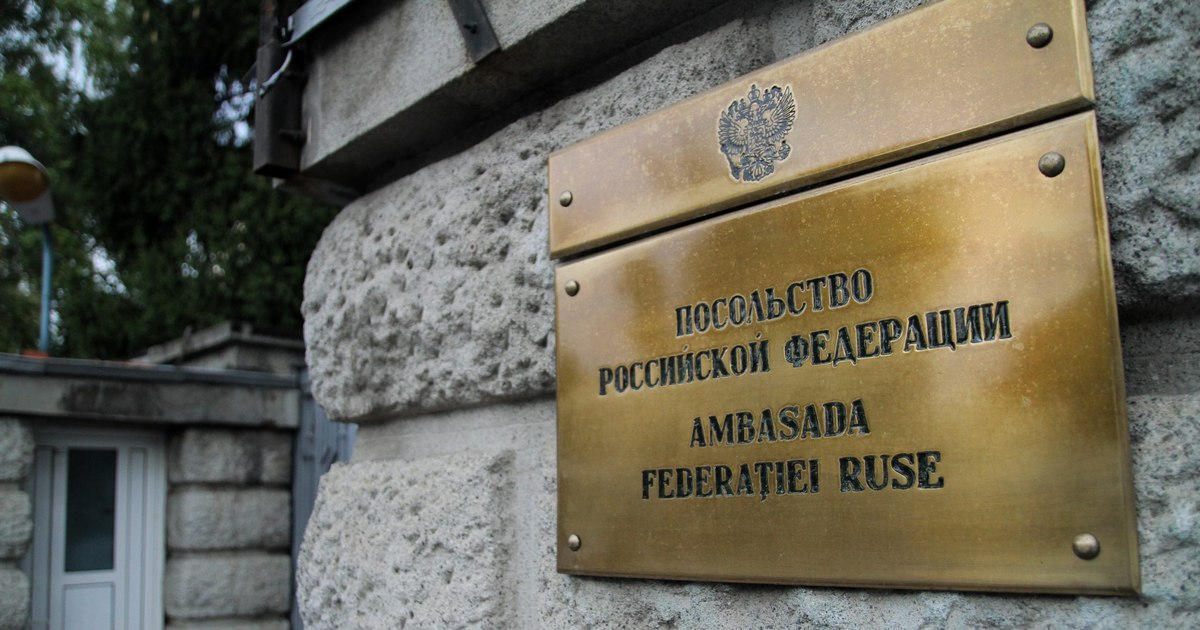
Romania sent Moscow the harshest diplomatic signal in the recent history of bilateral relations, expelling the consul general from Constanța — the highest-ranking Russian diplomat present on the country’s territory. But the gesture immediately raises a question: what happens if Russian drones continue to fall on Romanian territory? Analyst Cristian Barna draws a map of the diplomatic escalation for “Adevărul” and explains how far Romania can go without definitively breaking relations with Russia.
“Adevărul” discussed with the foreign policy analyst Cristian Barna the diplomatic significance of the decision taken by Romania. The Consul General of Russia in Constanta, Andrey Kosilin, left Romania after the Ministry of Foreign Affairs (MAE) declared him persona non grata and the consulate was closed following this decision.
“The expulsion of the consul general from Constanța was not properly publicized. Everyone said that there was an espionage office there, that it should have been closed a long time ago and so on. Perfectly true, it is. But what? The Russian ambassador in Bucharest is not an espionage office? It is even an espionage office at an even higher level, so to speak. From a diplomatic point of view, what happened after the attack in Galați was the most offensive gesture that Romania could make from a diplomatic point of view”, signals the analyst.
According to him, the choice of a consul general as the target of the diplomatic measure is not accidental, as this is the highest diplomatic rank.
“None of the people who are in the Russian Embassy in Bucharest has such a high rank as a consul general. Maybe less the military attaché, but as far as I know, he was already declared persona non grata a long time ago. And then, basically, Romania’s gesture, which even the president did not explain properly, is a protest gesture. The protest gesture is: we are tightening our diplomatic relations with Russia. At this level, the second most important person in Romania in terms of position diplomatic mission of the Russian Federation, we declare him persona non grata and close that consulate as well.”
What could be the next step in the diplomatic escalation?
Asked if Romania could end up expelling the Russian ambassador, the specialist says that there are several intermediate options.
“There is no higher step than declaring the Russian ambassador persona non grata. There are several alternatives. You can only declare the ambassador persona non grata and there remains a political adviser to keep in touch with Romania and Russia, you can also close the embassy. Let’s declare the ambassador persona non grata and then we have some relations at the level of, I don’t know, political secretary of the embassy, consul general in Bucharest.
The declaration is at the next level, if it happens again, we want to declare the diplomatic protest at a higher level. “
What would happen to the Romanians in Russia if the embassy in Moscow were closed?
In case of closing the embassy, what would be the situation of Romanian citizens in Russia. Approximately 5,300 Romanian citizens live in Russia, and their number has decreased three times since the beginning of the war in Ukraine. The specialist explains that international law provides solutions for such situations.
“If the embassy in Moscow is closed, usually the consular obligations are taken over by another embassy, which the Romanians agree with the Russian Federation. There are international precedents for strained relations without closing embassies.”
To explain why states sometimes avoid a total diplomatic break, the specialist offers the example of the relationship between Saudi Arabia and Iran.
“Saudi Arabia and Iran are very angry about what Iran has done to Saudi Arabia. But although after many years they resumed diplomatic relations, during this conflict they did not close their embassies. I mean, the ambassador of Iran exists, he is still in Saudi Arabia and they are talking to him.”
In his opinion, diplomatic reactions must also be analyzed through the prism of a balanced reaction and the escalation of the conflict must be avoided.
“We have to look at the dimension of proportionality. Did Latvia, Lithuania, Estonia, Poland close their embassies in Moscow? Although a drone fell over a wall in Latvia as well. It’s almost the same situation as us. We have the worst situation because two people were injured, but the situation could be just as serious in the Baltic countries or in Poland”
How could the Russian Federation respond to Romania’s gesture?
The specialist emphasizes, however, that diplomatic gestures have primarily a symbolic and political role, explaining that “this is a protest tool of the Romanian state, exercise it, that you consider it hostile by decision”, and in his opinion, Moscow will most likely react symmetrically.
“The Russian Federation can respond and will most likely respond at about the same level. It is established by way of reciprocity, it is seen what is the highest level of the diplomat who was expelled. The counterpart of the consul is the first collaborator of the Romanian ambassador in Moscow or one of the two plenipotentiary ministers or the consul. They will probably do this if they do not consider that they are ignoring us, they can do this too.”
However, Romania currently does not have a comparable consulate in Russia, which complicates an eventual identical measure.
A possible diplomatic escalation between Romania and the Russian Federation would rather have a symbolic and reciprocal character, while the real strategic stake remains the control of Ukrainian export routes in the Danube area and the military pressure on Odessa.
