
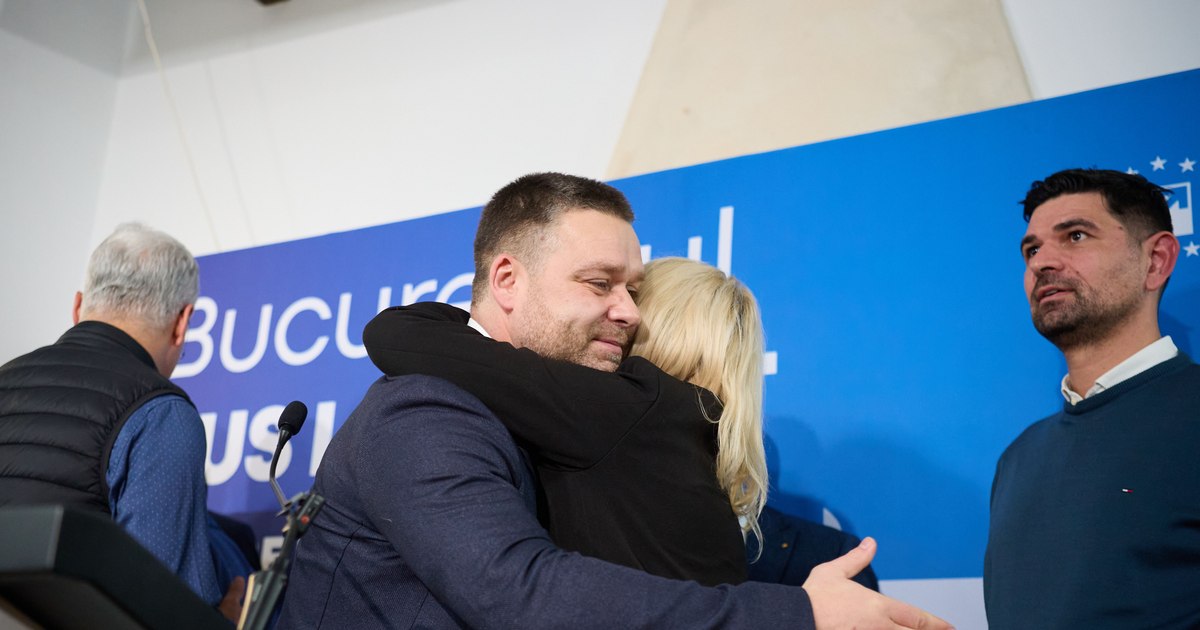
The victory of Ciprian Ciucu in the elections for the position of general mayor of the Capital, with the vote of only 11.7% of the voters registered on the electoral lists, brought back to the discussion the issue of representativeness, but also that of voting in a single round.
The low turnout at the polls is not a statistical surprise, but the confirmation of a downward trend, Gelu Duminića believes. The sociologist presented the historical data of attendance at the polls for Bucharest, and the figures show a chronicling of absenteeism. In 2025, attendance was 32.71%. Comparatively, the years 2012 and 2024 were the happy exceptions, not the rule, and the drop in interest is evident compared to 2004, when he won from the first round with a turnout of over 41%.
A situation similar to that of these elections took place in Bucharest in a partial election. In 2005, after the election of Traian Băsescu as head of state, the elections for the Capital City Hall registered a record of absenteeism. Voter turnout was only 24.8%. Then, Adriean Videanu won in the first round, with 53% of the votes, which represented 13% of the total number of voters in Bucharest.
Several states require compulsory voting
While Romania relies on civic volunteering – a natural thing after the years of communism – other states combat electoral apathy through legal coercion. Countries such as Belgium, Luxembourg, Greece (albeit with a more relaxed application of sanctions) or Cyprus have included compulsory voting in their democratic mechanisms.
A relevant example is Australia, where voting is a legal duty and absenteeism is punishable by a fine. There, turnout at the polls consistently exceeds 90%, which eliminates discussions about representativeness from the start.
Cristian Preda: The distinction between legality and representativeness
Returning to the domestic context, the fundamental problem relates to the existing electoral mechanism. Professor Cristian Preda explains the fine nuance between being a legitimate mayor and being a representative one. From a legal point of view, Ciprian Ciucu’s mandate is unassailable, even in the absence of a coercive system like the Belgian or Australian one.
“Legitimacy exists because there is no threshold to validate the elections. In the 90s it was like that and it was repeated in ‘92 picks in the first round, picks that in the first round had not brought half plus one. But since then the condition no longer exists. And then surely there is legitimacy. The representativeness is what the public interest gives. One candidate or another is not to blame, because fellow citizens are not interested in the topic of who will make their decisions”, explained Cristian Preda for “Adevărul”.
The disappearance of the second round affects the representativeness of the elected mayor
However, Professor Preda identifies the source of the representativeness crisis in the abandonment of the two-round election, a political decision taken in 2008 that deeply affected the quality of public debate.
“Yes, in itself, the second round forces more dialogue and a compromise that the citizens do not want, a reasonable one if it is made in the general interest. Unfortunately, this huge mistake has been made since 2008. The abandonment of the second round. You see that also during this period the important tool in an electoral campaign of confronting projects, of points of view, was abandoned, for fear that, in the end, the comparison would disadvantage one or on another. This is a very harmful effect of entering into a majority logic in a tour.”
Preda pointed out.
In fact, even Ciprian Ciucu, after exiting the polls, promised that he would fight for the local elections to take place in two voting rounds.
“As general mayor I will campaign for two rounds, including within the Coalition and within the PNL. I will bring all possible arguments. Why? It is very important to have mayors with legitimacy, to have mayors with authority. Authority comes from legitimacy, in the sense that there are projects that must be implemented”argued Ciucu.
The paradox of fragmentation and the frustration of the “silent majority”
Moreover, the effects of this electoral system have proven contrary to political theory. Instead of clarifying the political scene, single-round voting has created confusion and division.
“In theory, such a way of voting favors the emergence of a radical bipolarization in the form of two parties, a two-party system. This is not the case with us. In fact, since 2008, we have not reached a system in which there are two camps and there are more. It is the opposite effect. There is greater fragmentation since all these changes were made.” emphasizes the professor of political science.
The direct result of this fragmentation is a general state of dissatisfaction. Although the democratic procedure was respected, the fact that the overwhelming majority of Bucharest residents did not vote for the winner generates tensions, believes Cristian Preda.
“And then there is great frustration in society, because if you don’t have a majority and no one has won a majority in the General City Hall since 2008. Of course, a majority of the public is frustrated because there are more who did not vote convincingly”, added the teacher.
In conclusion, Ciprian Ciucu begins his mandate under the specter of this electoral reality. His victory is valid, but the system that produced it leaves behind a population that does not feel represented.
“That’s it. So yesterday’s result is meritorious for Mr. Ciucu and I congratulate him. But he doesn’t have a majority, he has the most votes and, I repeat, from a democratic legal perspective it’s fine, but the enormous frustration for those who didn’t vote with him. Even if there are various camps, it’s not his fault.” concluded Cristian Preda, professor of Political Science at the University of Bucharest.
