
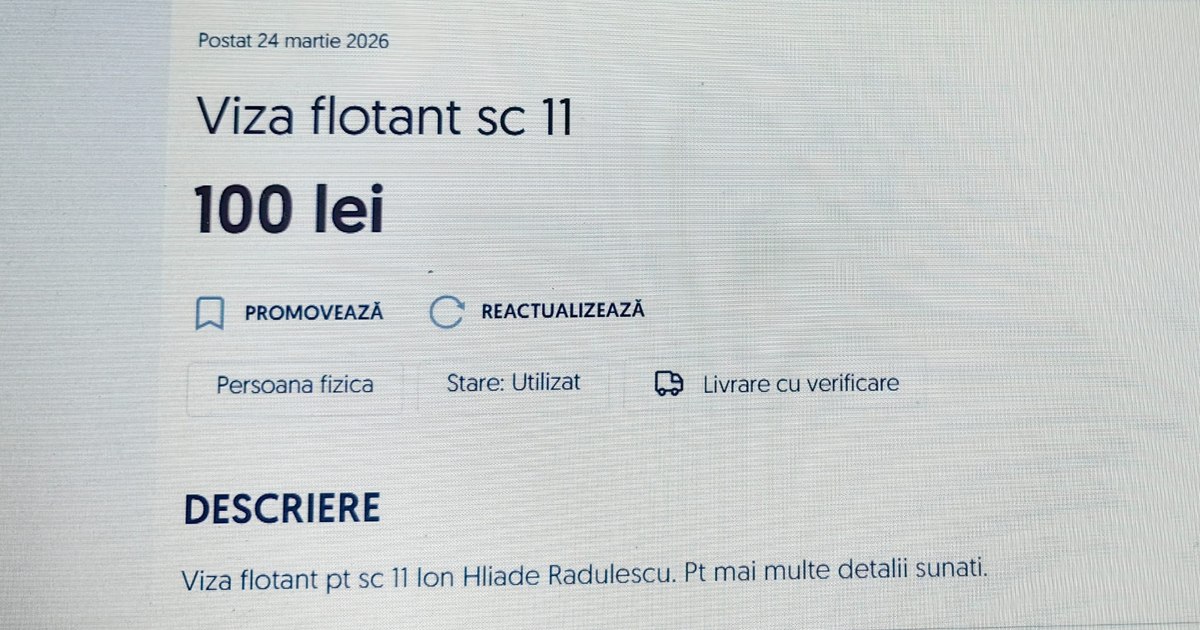
In the middle of the process of enrolling children in primary education, the phenomenon of floating visas has not disappeared this year either. The administrative procedure is used for students’ access to schools perceived as “better rated” and reflects both the fierce competition between parents and the deep distrust in the education system. In a society where the reputation of the school matters more than the actual course of the child, parents end up making choices that also affect the routine and development of the little ones, draw the attention of the specialists.
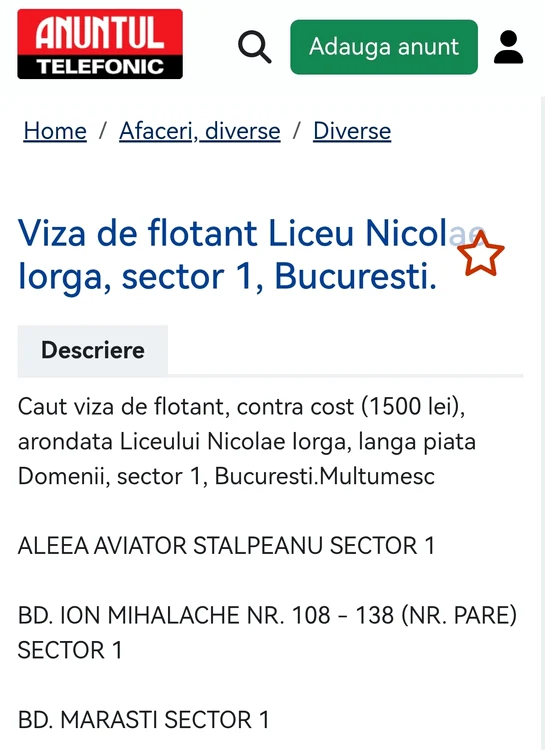
Bucharest is, categorically, also the capital of floating visas. On the classifieds sites, the phenomenon is already visible and explicit: either the owners offer floating visas for a fee, or the parents are looking for them, and the amounts they are willing to pay are not at all modest. For example, someone announces that they are offering 1,500 lei in exchange for a floating visa in the Nicolae Iorga High School area, an educational unit where students can be enrolled from the preparatory class.
“Don’t buy a floating visa, but a promise”
An informal market is thus taking shape, in which even the place at the school has a price, although students can be automatically enrolled in the district school. The practice results in more time spent by children in traffic, but also disproportionalities in the occupation of places in educational institutions. Why does this phenomenon persist? Gabi Bartic, education expert, says:
“Because they are trying, in their own way, to reduce the risk. They are not buying a floating visa, but a promise: that if they get to a ‘good school’, their child will have a safer path. The problem is that this promise is falsely simplistic. Behind it are, in fact, mistrust of the quality of the system as a whole, social pressure (“everyone goes there”) and a lack of clear benchmarks about what really produces learning. So the shortcut appears: you no longer choose the school for the child, you choose the address for access to the illusion that that school will definitely mean a good result for the child”.
Daniela Voinea, director of Sfinții Voievozi Secondary School in Bucharest, located near Garia de Nord, mentions a reason that many parents probably do not say out loud, but which is encountered in practice: that of avoiding social diversity.
“I don’t know why we run away. From the reality that surrounds us, from the children who are from different backgrounds? This is the society we live in. (…)We don’t have to keep the children under a glass globe. After the globe breaks, what do we do?”
Debunking a myth
One of the most persistent beliefs is that reputable schools automatically produce high-achieving students. Gabi Bartic believes that it is just a myth, which – although it is uncomfortable – can be easily dismantled:
“Most ‘reputable’ schools do not produce performance, they select it. It brings together children from families already involved, with additional resources and support, who are (here) willing to make small “optimizations” for their own child, and the results reflect this context, not necessarily the value added by the school. In the primary cycle, what really matters is not the brand of the institution, but the quality of the interaction between the teacher and the child, the adapted pace, the real feedback and the classroom climate. In the long run, it’s not “where you did grades 1-4″ that makes the difference, but whether you’ve learned to think, whether you’ve remained curious and whether you have confidence in yourself as a student.”
The pressure of “good schools” and the reality on the ground
Daniela Voinea, director of Sfinții Voievozi Secondary School in Bucharest, says that the perceived differences between educational institutions are often exaggerated.
“It matters a lot the teacher in primary education, who is usually just as well trained in a school where floating visas are made – and if the Ministry of the Interior checked, we would find ten families in one apartment – and in a school like mine.”
The director also talks about a reality that derives directly from this phenomenon: the overcrowding of schools.
“There is a lot of pressure on the desired schools. On the other hand, for parents and children, the program will not be very convenient. Because there are hours – from what I heard from my colleagues – from 08:00 to 11:00, from 11:00 to 13:30, from 13:30 to 15:00. And then the parent realizes that he cannot take it or that it is very tiring for the child. I understood that there were schools that had two preparatory class shifts
>. But why don’t you go to the school two blocks away?”
Students returning to neighborhood school
Daniela Voinea says that there are also situations in which, after realizing the reality of complicated routines for children – fragmented hours, daily commuting, lack of time for rest and recreation – there are also parents who choose to transfer them to the proximity school, where they could enroll them automatically from the beginning.
Why teachers with inappropriate behavior escape sanctions. ISMB does not keep any record of complaints
“Parents change their mentality only after they realize that it is very difficult. They come to ask for a transfer to us after two or three modules, because they notice that either the child has not adapted, or is too tired, or is better here. We have had such situations, where the parents could have opted for Sfinții Voievozi School from the beginning and preferred to go to another school. Then they return.”
What does the phenomenon of floating visas show?
The phenomenon of floating visas indicates a deep lack of confidence in the average quality of schools and structural problems of the system, believes Gabi Bartic.
“When parents feel they have to cheat the system to protect their child, we already have a structural problem. At the same time, the phenomenon also speaks of a society that has internalized the idea that rules are negotiable and that individual solutions are more effective than collective ones. We are not, in fact, running TOWARDS “good” schools, but FROM schools we don’t trust. And that says more about the system than it does about the parents.”
The real role of primary education
Gabi Bartic emphasizes that primary education should not be a race to “be ahead”, but the stage where the foundation is built: competent readers, basic thinking, confidence in one’s own abilities and the child’s relationship with learning.
“It’s the age when individual attention, the right pace and emotional security matter enormously. Paradoxically, these very things become harder to secure in highly sought-after schools, where classes crowd around reputation.”
Its message to parents is clear:
“Don’t buy yourself a better address for school, buy your child the years lost on the road, daily, in traffic, while telling yourself it was worth it. There are no schools so good that it’s worth raising your child in traffic”
For her part, Daniela Voinea says:
“We ask the parents to do in the way that is most convenient for the children. I insist that everything be done in favor of the child: for his peace, for his rest (which is absolutely necessary at this age).”
How to register for the preparatory class
Enrollment of children in the preparatory class for the 2026–2027 school year began on March 26. Parents have until May 6 to complete the application – online or directly at the school where they are applying for enrollment – and submit it to the secretariat of the educational unit.
The results of the 2026 Baccalaureate simulation, postponed until April 9
For parents whose children turn 6 by August 31, 2026, enrollment is mandatory. Instead, children who turn 6 years old between September 1 and December 31, 2026 can be enrolled in the preparatory class based on a recommendation (issued by preschool education units) or based on the evaluation of the County Center for Educational Resources and Assistance/Bucharest City Center for Educational Resources and Assistance (CJRAE/CMBRAE).
The rules of the Ministry of Education provide that the parent can opt:
1. for enrollment at the constituency school: in this situation, the child is automatically enrolled, based on the validation of the enrollment request;
2. for an educational unit, other than the district school: in this situation, the child is enrolled within the limit of free places and, if necessary, based on the general criteria and, subsequently, on the specific tie-breaking criteria.
On May 21, in educational units and on the websites of the school inspectorates, the lists of enrolled students and the remaining vacant places will be displayed.
The final lists will be displayed by each school on June 16.
