
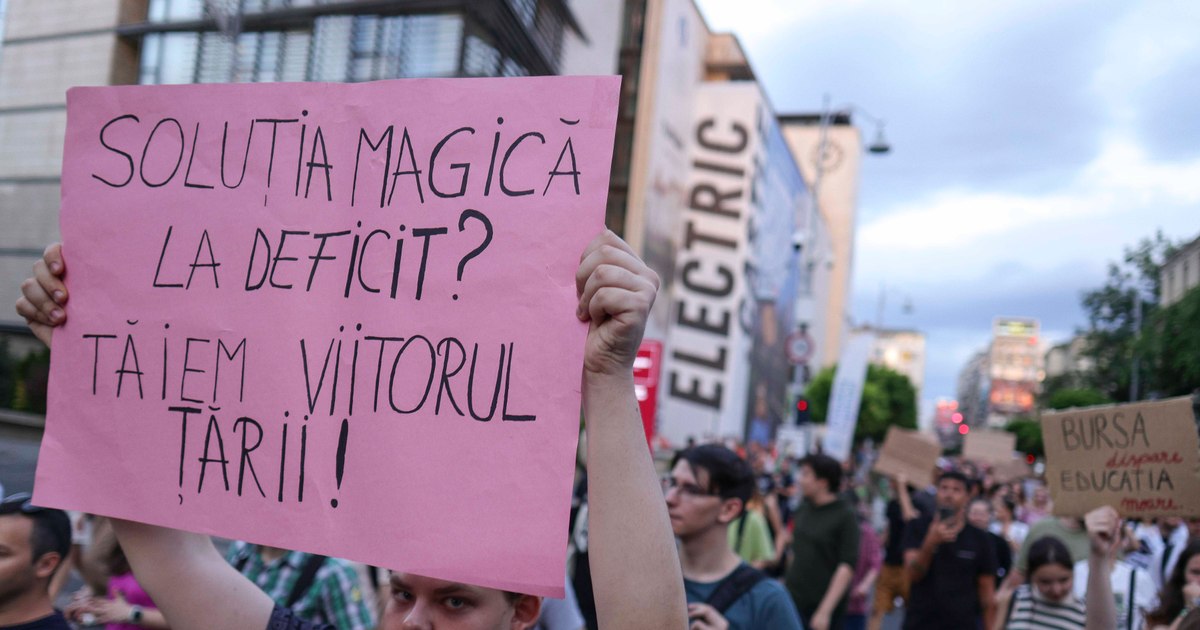
The year 2025 marked the beginning of austerity in education, the year the scholarship fund was cut by approximately 52%, leaving more than 40,000 beneficiaries without support, the year the 90% reduction of students on rail transport from all routes to the university center – home route was limited, the year in which fee-paying students became ineligible for scholarships and in which the state only grants subsidies for 9 months of the 12, it is shown in an analysis of the National Alliance of Student Organizations from Romania (ANOSR).
ANOSR launched on Monday, January 12, in the public space, the analysis “The student’s minimum basket, in full austerity”.
“How much does it cost to be a student? – more than 2,000 lei per month. The analysis clarifies the situation of the minimum costs that a student has every month in order to keep studying, the situation of the support offered by the state to them, also explaining the importance of increasing the percentage of the population with higher education and the support given to them during the entire educational process, but also the advantages of these measures at the state level”. it is shown on the Facebook page of National Alliance of Student Organizations from Romania.
During 2025, “in a context where Romanian education and students have been the target of several massive cuts to fundamental rights and expenses necessary for proper functioning”the entire education community reacted vehemently, constantly, trying to justify through pertinent analyzes and argued points of view the fact that the measures to reduce funds proposed and subsequently adopted by the Romanian Government “destabilizes the functioning of the education system, discourages the continuation of studies and hinders the educational path of young people in Romania“:
“In the light of dozens of protests held during 2025, among the messages sent to the governors, we recall: “Are you afraid of an educated people?”, “If you want to destroy a people, you don’t need bombs, but destroy their higher education.”.
The year 2025 marked the beginning of austerity in education, the year the scholarship fund was cut by approximately 52%, leaving more than 40,000 beneficiaries without support, the year the 90% reduction of students on rail transport from all routes to the university center – home route was limited, the year in which fee-paying students became ineligible for scholarships and in which the state only grants subsidies for 9 months of the 12″
ANOSR specifies that, despite the multiple positions it has adopted, as the legitimate representative of all students in Romania, “positions in which the numerous reasons why cuts in education must be stopped were listed, the Government of Romania continues in the same manner, there are discussions in the public space related to the decrease in the number of higher education enrollments and the reduction of university funding”.
A student’s expenses: “At least 2,027.99 lei every month”
The National Alliance of Student Organizations from Romania brings to public attention an analysis that substantiates the expenses of a student as being at least 2,027.99 lei every month, with the following categories of expenses and minimum amounts granted in this regard:
Table – 1,071.00 lei
Accommodation – 454.00 lei
Study materials – 68 lei
Local transport – 11.99 lei
Clothing and footwear – 234.00 lei
Household and personal hygiene products – 189.00 lei.
“Considering the fact that the value of the minimum amount of the social grant is 925 lei, we consider the austerity measures in education absolutely unjustified, against which we have vehemently stood since the first discussions held around the measures”, states ANOSR.
The main conclusions of the ANOSR analysis
The minimum amount of the social grant is today 925 lei, far below the minimum amount that a student needs every month to keep studying, in the amount of 2,027.99 lei, according to the conclusions of ANOSR.
Romania provides only a percentage of 10% of the students’ monthly income, placing itself below the European average in this regard, a good part of the income being provided by the parents, according to the same conclusions.
“Scholarships represent a real support for young people and contribute to maintaining them in the educational process, but approximately 44,000 students were left without scholarships following the measures adopted by Law No. 141/2025”, draws the attention of the National Alliance of Student Organizations from Romania:
“Romania ranks first in Europe, with a percentage of 17.2% of people who face severe material problems and cannot afford to pay for basic factors such as food and housing, cannot secure medical services and cannot participate in other types of social activities. Studies show that for those with qualification levels between 5-8, which correspond to undergraduate, master’s and doctorate university studies, the risk of poverty is reduced. Thus, we can realize how important education and the completion of higher education is for combating poverty and social exclusion”.
According to ANORS, Romania is below the European average when it comes to the funding that the state allocates as support for students from their monthly expenses, with a percentage of only 10% of the students’ monthly income, with a major difference compared to the first ranked state, which covers a percentage of 49% of the students’ income.
“Students’ income in Romania is made up of 57% of their parents’ contribution, so Romanian students depend a lot on their families’ incomes, which means that their ability to pursue higher education depends directly on the support that the family can provide, and in Romania the rate of poverty and social exclusion is 27.9% of the population, thus leading to a considerable number of students who cannot be supported by their parents to complete their higher education”, explains ANOSR.
What students ask for
ANOSR requests are:
The return to the allocation of the scholarship fund throughout the calendar year (12 months);
Increasing the percentage of the net minimum salary from which the value of the standard cost is calculated for the constitution of the scholarship fund from 10% to 17.5%, to return to a value of the allocated scholarship fund similar to that of 2024, when the value of the standard cost represented 10% of the gross minimum salary;
Reintroduction of the possibility for students enrolled on fee-paying places to benefit from scholarships from the state budget;
Increasing the contribution from the higher education institutions’ own funds to the scholarship fund, in order to supplement the number of scholarships granted, especially in order to cover the requests of students eligible for social scholarships;
The return of the 90% discount for students on domestic rail transport on all routes.
The entire analysis, HERE.
