
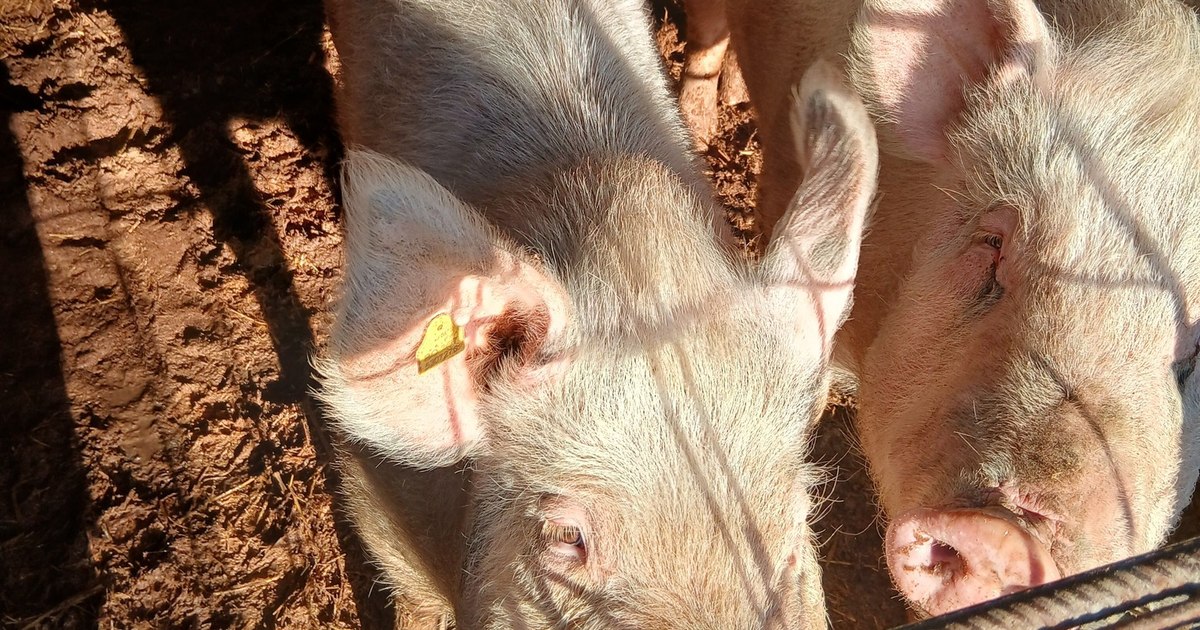
Store offers continue for pork, a sign that sales were below the forecast. Farmers who, in addition to the slaughtered animal for the family, also raised pigs for an extra penny complain that they are at a loss.
Consumers who wanted to eat farm-raised pork but couldn’t afford the price still have a chance, with many farmers still looking for customers even after Christmas.
Breeders’ offers started from 18 and even 20 lei/kg “live” before Christmas, reasoning that they increased their costs a lot. Nostalgic for the taste of pork from their childhood, many Romanians who could afford it paid the asking price. Others waited for it to continue to decline, sensing that farmers would be forced to sell below the production price because otherwise the unsold and unslaughtered animals would continue to consume, and the chances of marketing would decrease even more.
When it reached the point where the farmers would have sold their labor almost for nothing, the price dropping below 10 lei/kg and even approaching 6 lei/kg, they said “Stop playing!”. This is why the Internet is still full of offers, but also of counters between sellers and potential buyers.
Retailers haven’t fared too well this year with pork either, and that can be clearly seen in the offers still in place at the big chain stores. It ended up that the price of boneless pork neck decreased by more than 5 lei/kg, and could be bought for 16 lei/kg, the cutlet cost about the same, and the processed meat, preferred by many buyers to be chopped at home, dropped to 12 lei/kg.
Minced meat is sold these days with “limited offers” and at 8 lei/kg (from more than 25 lei/kg), a sign that the sales estimated by traders were nowhere near reached.
Offers, even if not as tempting as those in the supermarket, this year, for Christmas, even the small factories, recognized for the quality meat sold at slightly higher prices, had this year, which is a first. Even so, the customers did not rush, a sign that either frugality is making its way into the “menu” of Romanians, or the purchasing power has decreased considerably.
“We still have one more for damage, because there is still time until the stevia and nettles”
Farmers who chose not to sell at extremely low prices (it dropped to less than 10 lei/kg) are also now looking for buyers, placing offers for slaughter pigs together with those for fattening pigs. I also do it on the Internet, where I also receive malicious replies. “The price is already increasing, towards 8 lei per kg”netizens are amused. “They were asking like drowning 20 lei/kg live, now they eat BIO meat!”comments another netizen.
“I stayed with the pigs at home and with a full belly, and those of you who commented on the price stayed with empty bellies, it didn’t really go well. Leave them in the coop, because even in the summer we eat meat”, animal breeders console themselves. “Perhaps negotiate with the supermarket to bring you some country pork to give you a taste,” adds a farmer, accompanying the reply with some photos from the pig butchering.
Another breeder also admits that he stayed with the animal in the coop, but lets it be understood that he is not so upset: “We still have one for damage, because there is still time for the stevia and nettles.”
The price was the lowest it had been for several years, farmers say, as their costs continued to rise. Worse is that, left with the animals in the enclosure, the costs will continue to increase, and as the animal gets bigger, the chances of being capitalized will also decrease.
These being the facts of the matter, all that was missing to enrage the breeders even more was the question “What year do you still raise pigs?”, phostage to a group of animal sales.
“Go get it from the supermarket if you don’t want to grow! Of course we’re still growing!”, there were also angry responses that cannot be reproduced in full.
“Of course! Just for the family. I also bought two boys for next year, as I always do,” was another answer.
“Leave the pork because it is very bitter. Better eat cheese for 45 lei per kg. Pork at 18 lei is expensive”, other answers were given.
Hard decision: find solutions for survival or liquidate the farm?
And if for the farmers who raise the few pigs in addition to what they do for the family this year’s failure has a high price, for a farm in Dolj organized according to all the rules the price at which the pigs raised in a semi-open system were sold and are being sold can mean bankruptcy. The farm is located in Valea Stanciului, and the owner announced, in November this year, that he is in a position to sell the animals below the production price. He also announces that this is the last year in which he raises pigs and that he sells them for 15 lei/kg, although the meat would be worth 20 lei/kg “live”.
The young entrepreneur who owns the mentioned farm presented, in a video of a few minutes, the business he developed on five hectares: a farm of pigs raised in a semi-open regime, on rotating pastures. Specifically, the 5 ha area was divided into lots of 1,500-2,000 m2, and the 400-500 animals were in turn divided into groups of 50-70 to graze for several days on each lot. The grazed lot is then left for 45-60 days to recover.
Although the method of raising the pig on pasture gives a special taste to the meat, the advantage did not prove enough. The costs were ultimately higher than the price of the animals, because the extra corn, wheat and oats offered for feed, combined with the fact that pigs are brought to slaughter weight in almost 12 months, compared to four months on industrial farms, increased them considerably.
“We produced them at over 16.8 lei/kg almost and we sold them at 15. Because we also exaggerated”, explained the entrepreneur Bogdan Ionuț Mișcoci, for “Adevărul”.
A lot of vegetables and fruits were bought for the animals, plus the feed mentioned above. It is the third year of the business and the year the entrepreneur became convinced that he had to do something. He would like to abolish the farm, but even that cannot be done quickly, so at the same time he is looking for efficiency solutions.
“The idea is that if we clapped our hands to get rid of them, I would probably give up, but the problem is much more complicated than that.”said the entrepreneur.
Animals cannot be redeemed overnight. Approximately 700-800 euros were spent on each breeding specimen, but now they are in a position to sell the pigs for 5 lei/kg “live”. Even at this price, things are not simple, the young man continues, because the slaughterhouses purchase animals weighing up to 130 kg, or the sows on the farm weigh 300 kilograms. “The ones that can slaughter pigs over 300 kilos, like my genetic sows, that’s what they give us per kilo, 5.3 or 5.6, something like that two weeks ago.” stated the owner.
Some of the sows are pregnant, so they could not be slaughtered now. The sale of the farm to another owner interested in continuing the business is also problematic, says Mișcoci.
“We either sell breeding sows to other commercial holdings, or to slaughterhouses. At the moment, none of the options suit me. I mean, other farms can’t afford it because they probably have their genetics and slaughter means it’s against nature. And there is also the option where, yes, if I decide from tomorrow to do nothing, I put the lock on the farm and let the animals die of hunger, because at some point they have to be supported. And that’s not an option either, because I can’t let them starve. So we’re still struggling to try to fight back somehow,” explained the contractor.
He even tried to slaughter pigs and produce various meat preparations, but this would be the optimal option if he had his own slaughter line. He hoped he could do that, but he missed out on a grant that would have given him a chance at his own slaughterhouse. In order to be able to produce meat products, the animals must be transported to another county for slaughter, because there is no pig slaughter line in Dolj. Costs thus increase enormously and profitability disappears.
“For us to produce and sell from fork to fork, due to the fact that we didn’t manage to get, in fact we missed, a grant by which we had to have our own slaughterhouse and our own processing, we have to take each individual animal from there, they must weigh up to 130 kg, put them in an authorized car, take them to the slaughterhouse, (…) then take the carcass from there, bring it to a local processor, be able to do craft products, which increases our production prices tremendously and again we are not competitive. (…) Those products, if you look on the website, are close to the industry price, instead we will have to continue doing this process which greatly reduces our production margin on traditional products”, the entrepreneur also said.
With what they managed to sell before Christmas, things will be able to be maintained on the farm until March, but the long-term solution is still being sought, the entrepreneur said.
