
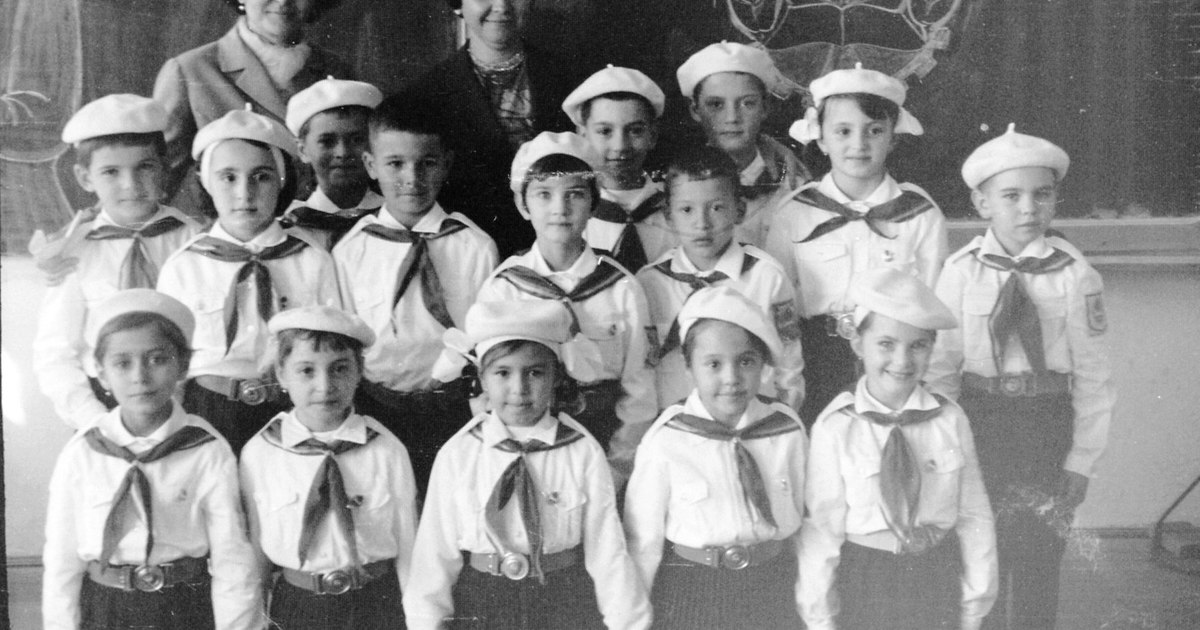
“Weekend Adevărul” discussed with Professor Matei Gheboianu, a specialist in the history of communism in Romania, about the role of school uniforms and clothing before 1989, the hidden purposes of education rules, as well as the negative effects of clothing diversity in Romanian schools today. At the same time, he also explained some measures that the Romanian state could implement in order to reduce the risk of segregation due to financial possibilities among students.
The little pioneers, in the first weeks of school. Photo: Facebook
“Weekend Adevărul”: In the communist period, wearing the uniform, the same throughout the country, and of the matriculation number were mandatory. Creditand that they were taking to one extent or another it improvesÞlack of discipline and a organization ANDcollege?
Matei Gheboianu: I don’t think so. After 1989, the reluctance to wear a matriculant was even immediate. Since ’90, with the return of students to schools, most of them gave up this rule because they saw it precisely as a form of control. I don’t think the school was getting any better if he controlled them more or not. The regime also had another interest, that of monitoring them, not letting them move from one area to another, preventing them from forming groups with people from other areas, which was happening at the level of the whole society, not only of the students. Now, at the start of the school year, we see the whole discussion of parents moving their children from one school to another and getting a floating visa to another district to enroll them in better schools. This did not happen during the communist period, especially at the level of primary schools. The idea of the communists was to give you everything you need in the area where you live and to keep you as much as possible in an area where they could watch over you. The purpose of the regime was not to walk from one neighborhood to another, not to create groups in which there are people from other areas because such groups, over time, can create protest movements. So everything was organized so that all or most of your activity took place around the house: both school and leisure.
“The Model Child”
Beyond clothingto you, what should a student wear?
There were, including in kindergarten, all kinds of didactic materials in which it was explained that a model child had to have a short haircut, so long hair was not accepted. Girls who had longer hair wore it in ponytails with bows, wore headbands. Also, all the children had to wear a handkerchief, which had to be clean, have their nails trimmed, and the teachers made checks and punished those who did not respect these things. In high school, young people were not allowed to wear jewelry, let alone eye-catching jewelry, make-up, nail polish or dyed hair. Those who broke the rules were punished, sometimes very harshly: from being sent home to being expelled.
Exceptions to the rule: the children of nomenclaturists
there and exceptions?
Yes, they were the children of nomenclaturists, people with positions in various organizations or systems, who also allowed themselves to grow their hair long, to go to school sometimes without or with an incomplete uniform. But most people followed the rules.
But there were certain subliminal forms of a-ANDcustomize them somehow Þuseless?
Yes, but they were often particular cases, not necessarily a constant among young people. Communism succeeded in instilling in people the spirit of self-protection by conforming to the rules precisely to avoid problems. Let’s not forget that, many times, in the Romanian school, there were corporal punishments in one form or another: pulling the tail or tails, hitting the palm with a ruler, putting in the corner and so on. These forms of “discipline” were used in the Romanian education system. So the students were trying to comply to protect themselves.
You think it was somehow better that the uniforms were identical at the na levelÞional or a more flexible system, adapted to each, would somehow have been more beneficial ANDcoli, aANDas we see today, where ANDschools are free toANDi choose the model of the uniform?
If we look at the countries of western or central Europe during the communist period, it turns out that wearing the school uniform customized by each educational institution gives a sense of group belonging to those children. At the same time, the regime promoted uniformity and equality, but we know that people are not equal, everyone has their own abilities. Often there is no difference between a school and its students in Bucharest and one in Cluj or a locality in Moldova. This uniformity is not normal, because individuals are not the same and you have to give them the opportunity for personal development.
The need for financial incentives
With this in mind ANDand looking at the situationÞthe present day in which this obligation debate still existsÞthe uniform, he thinksÞand that it should somehow be reintroduced or that everythingANDand clothing diversity from ANDcoli may better reflect democratic values?
It’s a whole discussion. Nowadays, compared to the communist period, the gaps between people have actually increased. Back then, most of the population was at a fairly close income level, but now the polarizations are much greater. These polarizations attract different costs for dressers, which can often bring frustrations to some children. In turn, they convey to their parents the pressure to buy them a certain type of clothes, schoolbags or other more expensive or brand-name things. Of course, the diversity of clothing also makes them different, but it also causes problems, especially among people who cannot afford to show off their clothes and other things from a certain company. Perhaps, up to a certain level, a uniformity at the school level, not at the national level, at least of the clothing would by itself attract an easier integration of children into such a school community and would not create a segregation of students from because of financial possibilities.
So a standardization at the level dress school…
Yes. Schools can make these decisions at the level of governing boards that include teachers as well as students and parents. I don’t think the ministry wants to regulate at this level now. Maybe if they regulated better, they could also come up with some financial incentives for families where purchasing uniforms is a big financial effort. So the implementation of clothing or uniforms in all schools would be beneficial, but the state needs to help those categories of vulnerable people who cannot afford to buy it. At the level of Romanian pre-university education, from primary to high school, we are talking about a very high school dropout rate and one of illiteracy. The state needs to integrate all these children and it should be a priority. They should allocate amounts, make programs and follow the progress of the students to the end, including what the parents do with the funds, i.e. if they buy the child what he needs or spend the money on something else. In particular, the Ministry of Education should deal with such things, but local communities should also get involved and take care of their students.
