

Regardless of the county you choose, you know that everywhere in Moldova you will find art, stories, food, traditions, faith, all under the big hat of history.
Sunset over the monastery PHOTO Shutterstock
The palace from Ruginoasa and its story
Wherever your steps take you in the lands of Moldova, you will find a story. If you choose to stay in Iasi, stop by the Ruginoasa Palace, which is strikingly similar to the one in Miclăușeni, being built by another branch of the Sturdza family, the treasurer Săndulache Sturdza. The palace became the property of ruler Alexandru Ioan Cuza in 1862, having been bought at auction from Alexandru Sturdza, who had mortgaged it to the Bank of Moldova. Although he would have wanted to have his summer residence here, he would not be the master of the palace, but Mrs. Elena, who settled in Ruginoasa with her two adopted sons, Dimitrie and Alexandru, children that the ruler conceived with his mistress, Maria Obrenovici, a controversial character of the era.
Even after death, Alexandru Ioan Cuza would not stay here, although this was his wish. Went into exile in 1866 after being forced to abdicate, the former ruler died in Heidelberg (Germany), and his mortal remains were brought to Ruginoasa, where they stayed until 1944. As the front approached, the remains of the ruler and those two sons and the precious scents of the church were taken to the Curtea de Argeș Monastery and kept here. As the church was partially destroyed during the Second World War, Cuza’s remains were moved in 1946 to the Church of the Three Hierarchs in Iasi.

The palace from Ruginoasa PHOTO Shutterstock
The two sons of the ruler died within a short time of each other. Mezinul Dimitrie committed suicide in Paris in 1888 out of love for a French woman of easy morals. His lifeless body was brought to Ruginoasa by Elena Cuza and buried to the right of his father. The older son, Alexandru, married Maria Moruzzi in 1889. While on their wedding trip to Madrid, although she had severe myocarditis, she also contracted phthisis. He managed to write the will in favor of his wife, after which he died. It had only been six months since they had sworn eternal fealty. Destroyed during the Second World War, the Palace regained its splendor after 1978, when it was restored. In 1982, the “Alexandru Ioan Cuza” Memorial Museum was opened here.

Palace of Culture Iasi PHOTO Shutterstock
In the “sweet fair of Ieși”
At a distance of only 60 kilometers is the “sweet fair of Ieși”, the old capital of Moldova, a cosmopolitan and romantic city at the same time, where every street has a history. If you want to continue with the story of the Cuza family, you can visit the Union Museum, which was the residence of ruler Alexandru Ioan Cuza and King Ferdinand, who established his headquarters here during the First World War, when Bucharest was occupied by German troops.
Also here, in Iași, in a charming square, with bohemian bars and beer halls, one of the most beautiful pages in the history of Romania was written: it is the place where Hora Unirii was played for the first time, in 1857. The bohemian life no longer exists long ago, but the memory of that Romanian hour lives in the soul of every Romanian, and not only on January 24. If you arrive in Iași, don’t miss the Palace of Culture, the building that dominates the city’s esplanade, where four great museums are gathered together: the Ethnographic Museum, the History Museum, the Art Museum and the “Ștefan Procopiu” Museum of Science and Technology.

Iasi Botanical Garden PHOTO Shutterstock
Copou Park, with Eminescu’s Teiul, located near the “Alexandru Ioan Cuza” University, the Botanical Garden, which has species of flowers and shrubs that delight you in any season, are just as many dream destinations in Iasi.
If you want to know even better the ancient history of the Romanian people, enter the world of the scholar Dosoftei, the first hierarch who translated religious books into Romanian – the house turned museum is located near the Palace of Culture.
At Creangă’s Humulesti
Ion Creangă’s stories are everywhere in Moldova, wherever you go. In Iași is Bojdeuca, where the great storyteller lived, and in Humulesti, in Târgu Neamț, is the parental house, whitewashed and with exposed beams, with “the small hearth hummed”, with “the chimney pillar where my mother used to tie a string to the end of a mop, so that the cats would crack playing with them”. You are happy like a child when you discover in your parents’ house from Humulesti, now a museum, everything that was related to the universe of your childhood, everything that you learned in the first years of school. You are a child again and you run with your memories into the wonderful world of Creangă’s stories.
On the porch of the house is now another Nica, with flowing hair, who stopped running for a moment just to think about what to do next. In the village, for so many centuries, Ozana flows “the beautifully flowing and clear as crystal, in which the Neamţ Citadel is mirrored with sorrow for so many centuries”.
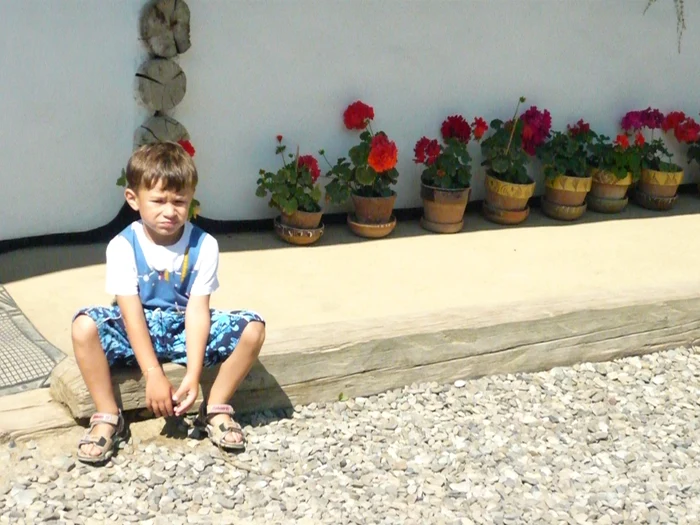
Another Nîca in Humulesti PHOTO MI
The world of Nica’s stories goes on. In the fairytale land of Moldova, discover, one by one, the villages described by Ion Creangă in his memories. Dai de Broşteni, where Nica got scabies from Irinuca’s goats, or Pipirig, the place where Creangă’s grandparents, David and Smaranda, were born from Agapia.the one hidden from the worlde”, by “Văraticul where the rich and merciful Brâncoveanca spent her life” or by “the famous Citadel of Neamţului, fenced with desert, covered with lightning, inhabited in the summer by cattle driven by the strechy and guarded by the Ceucles and the sellers who found it good for making nests in it”.

Monastery PHOTO Shutterstock
Fortresses and monasteries, intertwined with history
If you arrive in the area of Moldavia, it is impossible that the road does not pass by a fortress. Stop for a moment from your wanderings and step on the holy places where Stephen the Great defeated the Turks centuries ago. Neamț Citadel, Suceava Seat Citadel or Cetățile Romanului are just a few of the fortresses that have been left to us as a legacy from the Moldavian lords. A few others, such as Hotin, Cetatea Albă and Chilia, are in Ukraine, and Soroca, Orheiul Vechi and Tighina are on the territory of the Republic of Moldova.

Neamtului Citadel PHOTO Costin Lincă
By far, the most famous visiting cards of the north-eastern area of Romania are the monasteries. Agapia, Voroneț, Văratec, Putna, Humor, Moldovița are just a few holy places where, in addition to filling your soul with faith, you can also admire some of the most spectacular churches, many in the UNESCO heritage. After you fill your eyes with the brilliance of the blue of Voroneț and look for the hidden meanings in the painting “The Last Judgment”, go to Sucevița to see the “Stairway to Heaven” and the “air customs”, climb to the former Upper Country of Moldova, to Putna, for to worship at the tomb of Stephen the Great.
At Ancuței Inn

Hanu Ancutei PHOTO Shutterstock
If you want to be a part of Mihail Sadoveanu’s stories, go to “Hanul Ancuței”, a well-known stopping place at the intersection of some roads, where merchants stopped on their way to Roman, Suceava or Iași. “The gates were open as in Domnie. And through them, on autumn days, you could see the valley of Moldavia as far as the eye could see and the peaks of the mountains on fir forests as far as Ceahlău and Halauca. And after the sun sank towards the other realm and everything in the distance was erased and slipped into mysterious blackness – the fires lit up the stone walls, the black mouths of the cracked doors and windows. It contained for a while the fiddler’s song, and the stories began…”the great writer so beautifully described this story place.
Now, the inn is still at a crossroads, in Tupilati commune, Neamt county. And now, Ancuța also serves you at the table, dressed in folk costume, and from a corner, a fiddler brings spiritual delight.
Offers of accommodation and money
In Iasi county, you can find accommodation at prices between 229 lei and 488 lei for two people, in guesthouses or hotels. Accommodations in Neamt are priced between 142 lei and 400 lei per night. In fairytale Bucovina, you can also find cheap accommodation, at 117 lei per room, and even more expensive ones, which go up to 473 lei per room. No matter where you sit, the Moldovans put their best on your table: soups, as they call them, the famous pork alms, Moldovan tochitura, alivencs, sarmales, and at the end, even though you can’t anymore, you still eat a few laps in belt, from which the syrup from the sweet, aromatic cheese and from the powdered sugar with which the specific dishes are snowed drips.
