
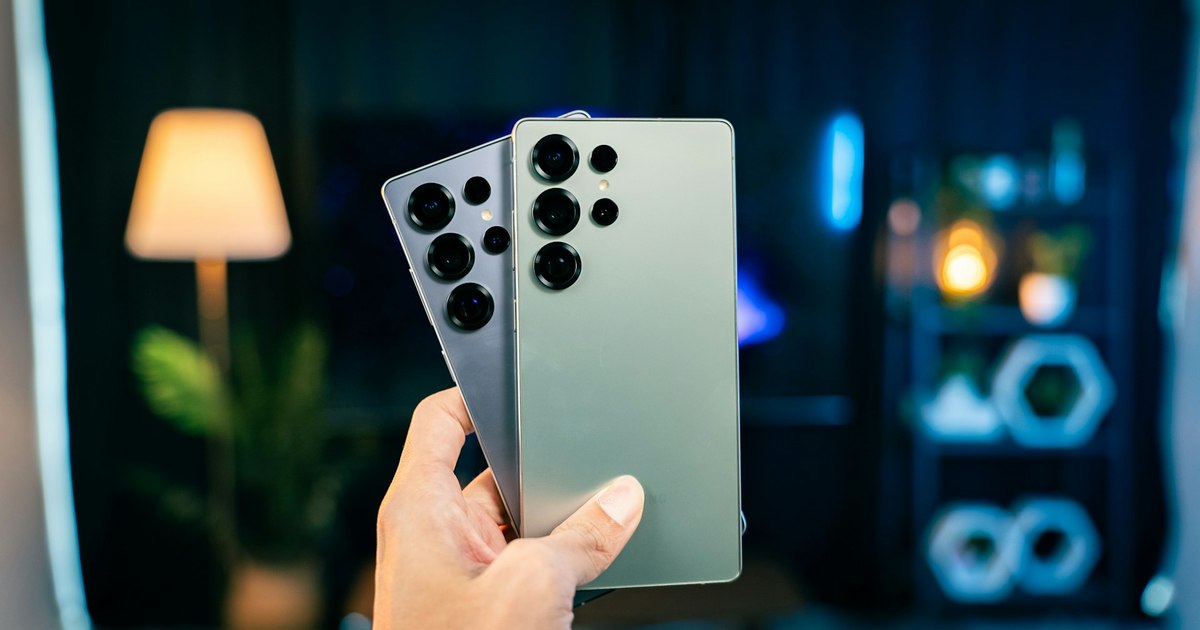
At the beginning of every year, Samsung releases a new generation of Galaxy S series phones, and 2025 is no exception.
The Galaxy S25 and S25 Ultra entered the market with the promise of redefining the mobile experience, but in a saturated technology landscape, the natural question is: what does this series really bring?
For casual users, the differences from previous models may seem subtle, and for spec enthusiasts, the details matter more than ever.
Samsung seems to have adopted the “winning team doesn’t change” philosophy, keeping the familiar design and refining the already existing features.
The Samsung S25 Ultra comes with rounded corners, straight edges and a spectacular display, while the S25 maintains compact dimensions and a balance between performance and portability. But beyond looks, the real competition comes down to processor, camera and AI features.
In an era where phones are becoming more and more similar, the real differences are found in details that are hard to see at first glance.
The S25 Ultra offers up to 10x optical zoom, an integrated stylus and impressive photo capabilities, while the Samsung S25 is aimed at those who want an affordable flagship without major compromises. The choice between the two models no longer depends only on the budget, but also on the style of use.
This article does not aim to sell a phone, but to analyze lucidly what it means to choose between two variants of the same concept. We will explore the real differences, strengths and limitations of each model, in a context where innovation seems to have become more of a marketing strategy than a technological revolution.
The Samsung S25 is essentially a compact phone with a 6.2-inch Dynamic AMOLED 2X screen, FHD+ resolution and 120 Hz refresh rate. It is ideal for users who prefer a device that is easy to operate with one hand without sacrificing visual quality.
With a 4000 mAh battery and Snapdragon 8 Elite for Galaxy processor, the S25 offers solid performance in multitasking and gaming, but without excesses.
The Samsung S25 Ultra, on the other hand, is a massive phone with a 6.9-inch Quad HD+ screen, integrated stylus and a 5000 mAh battery.
It is designed for users who use the phone as a tool for work, creation or intensive multimedia consumption. Up to 10x optical zoom and 200MP main sensor make it a serious contender for compact cameras.
On the AI level, both models benefit from features like Circle to Search, Now Bar and cross-app actions, all powered by local processing on the device.
Samsung promises a personalized experience, but in practice, these features are still being refined and do not revolutionize everyday use. They are useful, but not essential.
The storage differences are noticeable: the S25 starts at 128GB, while the Ultra starts at 256GB and goes up to 1TB.
For users who shoot a lot or use complex applications, the extra space is a clear advantage. Still, for most, 256GB is more than enough.
The front-facing camera is identical on both models – 12MP – which shows that Samsung hasn’t put an emphasis on selfies this generation.
In contrast, the main cameras are completely different: the S25 has a triple system with up to 30x digital zoom, while the Ultra offers 5x and 3x optical zoom, plus up to 100x digital zoom. It’s a difference that’s felt in photography, but less so in everyday use.
The design is refined, but not revolutionary. The S25 Ultra has rounded corners and straight edges, which improves ergonomics. The S25 keeps the classic line, with a glass back and an aluminum frame.
The differences are subtle and hard to notice without direct comparison. For an average user, appearance will not be a decisive criterion.
Autonomy is decent on both models, but not spectacular. The S25 Ultra promises up to 31 hours of video playback, the S25 up to 29. In reality, heavy use will reduce these figures. Fast charging is present, but does not exceed current standards.
The competition already offers larger batteries and more advanced technologies.
Price is obviously an important factor. The Samsung S25 is more affordable and offers a good performance-to-cost ratio. The S25 Ultra is a premium phone with a price to match.
The choice between the two is made not only on the basis of budget, but also on the basis of real needs. If you don’t use the stylus or advanced zoom, the price difference can be hard to justify.
For users coming from S24 or even S23, upgrading to S25 is not mandatory. The differences are minor and the overall experience remains similar. Samsung has refined, not reinvented.
It’s a good choice for those who want the latest model, but not a must for those happy with their current phone.
In the end, the S25 series is a demonstration of stability, not innovation. Samsung chose to play it safe, offering a mature, balanced and performing product. But in a market where real differences are becoming harder to justify, the question remains: how much does it matter to have the “newest” if it’s not also the “most different”?
The Samsung Galaxy S25 and S25 Ultra are two phones that reflect the maturity of a brand that has reached its peak.
It is no longer about technological revolutions, but about refinements, optimizations and the consolidation of an already well-defined experience. For some, this is enough. For others, it may seem like stagnation.
Choosing between the two models is more about style of use than raw specs. If you’re a user who appreciates compactness, balance and simplicity, the S25 is an excellent choice.
If you want everything a phone can offer in 2025 – from stylus to optical zoom and huge screen – the S25 Ultra is the ultimate flagship. But none are perfect, and none are truly revolutionary.
What are you looking for in a new phone? Performance, camera, autonomy or maybe a design that inspires you?
Let us know in the comments what matters most to you and if the S25 series manages to meet those expectations.
