
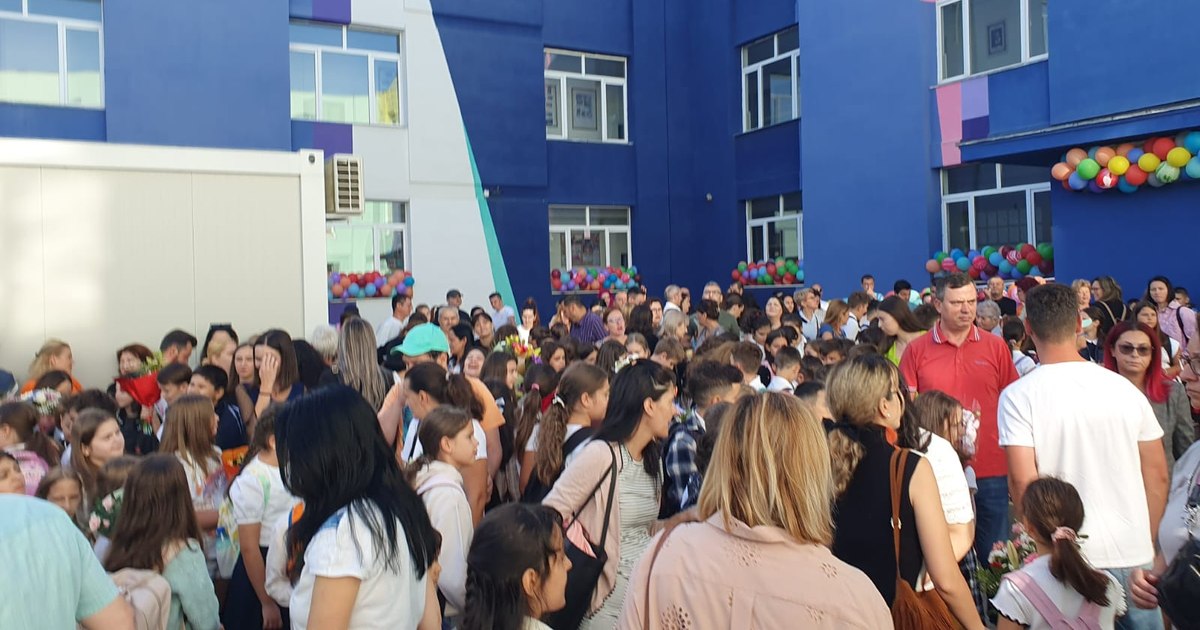
More than three million students returned to the banks on Monday, and with them school started and parents, many of them even more emotional than the children. But even more dissatisfied, is the conclusion of an IRES survey, which also comes with other worrying conclusions.
School started with emotions for children and worries for parents. Photo source: The Truth
According to the latest IRES survey on the Romanian education system, parents of students are, at the beginning of the school year, worried especially from a financial point of view. While some will be forced to pay for textbooks that should be given free to children, others think with horror of the hundreds of lei they will spend on extras. We no longer count those who will have to contribute money this year for the renovation of the classroom or its equipment. The most “unlucky” are the parents of the students who will need meditation. And the complaints don’t stop there.
Parents, dissatisfied with the lack of medical services in schools: “They abolished them!”
One of the biggest complaints that parents bring to the system concerns the lack of medical offices in schools and related medical staff. Only 10% of parents say that there are dental offices and related medical staff in their children’s schools. 28% of parents stated that there is a school doctor in their children’s schools, 65% said that there is a medical assistant in the school and 61% that there is a doctor’s office. “Such public services have not existed for years. They abolished them. Before 1989 all schools had medical offices. Now they are extremely few. The reason? First of all, the lack of staff. We don’t have doctors, we don’t have nurses. Because money for equipping the cabinets would be, if we think about the amounts that could be taken through PNRR. Another reason is the fact that many schools do not have space for these offices, either medical or dental. Maybe just open them in some container in the schoolyard”, Dan Tita, the president of the Federation of Parents in Sector 1 of the Capital, told Adevărul.
Meal, no milk, no horn
The IRES survey also says that approximately half of the students benefited from the “Romanian School Program” last year. It stipulates that students in grades 0-4 receive fruits and vegetables, dairy and bakery products, in different proportions, during a week. But, when asked about their children’s diet, more than half of the parents said that they received fruit twice a week, 51% stated that they received milk at least two days a week, 48% said that they received corn or other bakery product every day and 24% stated that students received other dairy products at least three days a week. Regarding the National “Healthy Meal” Program, only 15% of students benefited, in the last school year, from a free hot catered meal, 12% received a food package composed of products other than corn, milk or fruit, and 9% had a hot meal in school.
“School, free only in the Constitution”
More than 8 out of 10 parents have to pay, every year, different amounts for textbooks or aids used in class by their children, the IRES study also says. More than two-thirds (69%) of them buy only the auxiliaries, and they receive the textbooks for free from the school, 10% receive a part of the textbooks and a part of the auxiliaries for free, and they pay for the rest from their own money, and 6% do not receive free of charge, neither aids nor manuals. The costs of those who pay for textbooks or children’s aids even reach over 700 lei in the case of 11% of the parents participating in the survey. 12% pay no more than 100 lei, a third (35%) pay between 101 and 300 lei, 17% between 301 and 500 lei, and 5% pay, annually, between 501 and 700 lei. “School was never free. Than in the Constitution. And that’s because every year the parents have to take money out of their pockets. We, at the Federation, have requested that even the auxiliaries be offered free of charge to the children. But some of them don’t even get textbooks! Why? Because in the middle there are all kinds of interests..”, considers Dan Tita. For example, regarding textbooks, the parent told us that there are teachers who order for the whole class at a discounted price but pocket the difference. “The price of an auxiliary from 30 lei, as written on the cover, ends up costing about 12 lei. The difference from 12 to 30, the teacher puts in his pocket”. Why do we pay for textbooks? Because many are still not in stock or ordered by school unit directors. “And the parents have to buy them themselves from the bookstore, from the Internet…from all kinds of online stores.”
The law of meditation, a vicious circle
At the beginning of the school year, a third of the parents participating in the study said that their children had done private meditation so far, especially those from the urban environment, who live in the south of the country and who are now in high school. The reason? 39% of those surveyed answered that students needed to deepen the information received at school. A fifth of parents say that they have chosen private meditation for their children because they do not understand the information received at school, and 12% need to prepare their children for taking national exams. Almost one in 10 parents say meditation was necessary for their children to get better grades. “We ask that meditations exist only for excellence. Not to pass the class. Do you want to participate in national or international olympics? You meditate, although even here the teachers should offer these meditations for free at school. This phenomenon is a scourge that we will not get rid of anytime soon because it is not wanted by either side. Neither parents nor teachers can break this vicious circle. Unfortunately, most do not want to do it. Others have nowhere to go. I’ll give you an example. A math teacher in an elementary school only taught two or three students in the class, very good children. The other 27 did not understand anything. What did the parents do? They sent them to meditation to pass the class!”
Parents agree to detention room and cell phone ban
The school year brings a series of new rules for students, this after the Ministry of Education modified the Student Statute and the School Organization Regulation. According to the IRES survey, the most well-known provision is the prohibition of mobile phones during classes, except for their use for educational purposes, with the consent of the teaching staff. Three quarters of parents have heard of this new rule, and 96% agree with it. Although, there are voices that claim that this measure could give rise to another phenomenon. Dan Tita stated for Adevărul that many teachers will avoid confiscating children’s mobile phones, once they have caught them with them in class. “It’s complicated to do that because a receipt-handover protocol should be drawn up. Because it’s one thing to take the phone and keep it on the chair until the end of the class, when you return it, and another to take it to the secretariat, and let the device stay there all day”.
According to the IRES survey, 45% of parents of students who have a smartphone say that they constantly talk to their children about the content they watch on the Internet. 29% do this quite often, 16% speak only sometimes, and 7% only in exceptional situations. 2% do not discuss this aspect with their children at all. More than half (59%) of parents of students who own a smartphone believe that the use of this device has a rather negative impact on their children, while one in three parents believe that the impact is rather positive. Specialists, however, raise a big alarm signal. “Prolonged exposure to screens leads to the emergence of psycho-emotional diseases, affective and behavioral disorders among children up to 10 years old. Then, let’s not forget that in the last five years the number of cases of children with special educational needs has exploded”, explains psychologist Radu Leca. “Like conditions caused by prolonged exposure to screens, we have light autism in the first place. In second place we have anxiety and depression. In third place we have obsessive-compulsive disorder. Then we have anxiety about sleeping at night or eating, which can put the child’s life at risk. Children addicted to computer games, especially network games with a high degree of violence, can also become angry and aggressive. And the parents end up in a situation where they simply can’t communicate with the teenager at all anymore”says the specialist.
About the “detention room”, 52% of parents have heard, and 72% agree with this measure. However, there are also opposing voices. “Many parents believe that we are returning to education with the whip, instead of preventing we are punishing. Others fear that teachers will abuse this new “power” they have. Because, after all, what does it mean to be cheeky? What exactly does it mean to disturb the hour? Everything is up to the teacher who will decide who to punish and for what”Dan Tita also explained.
