
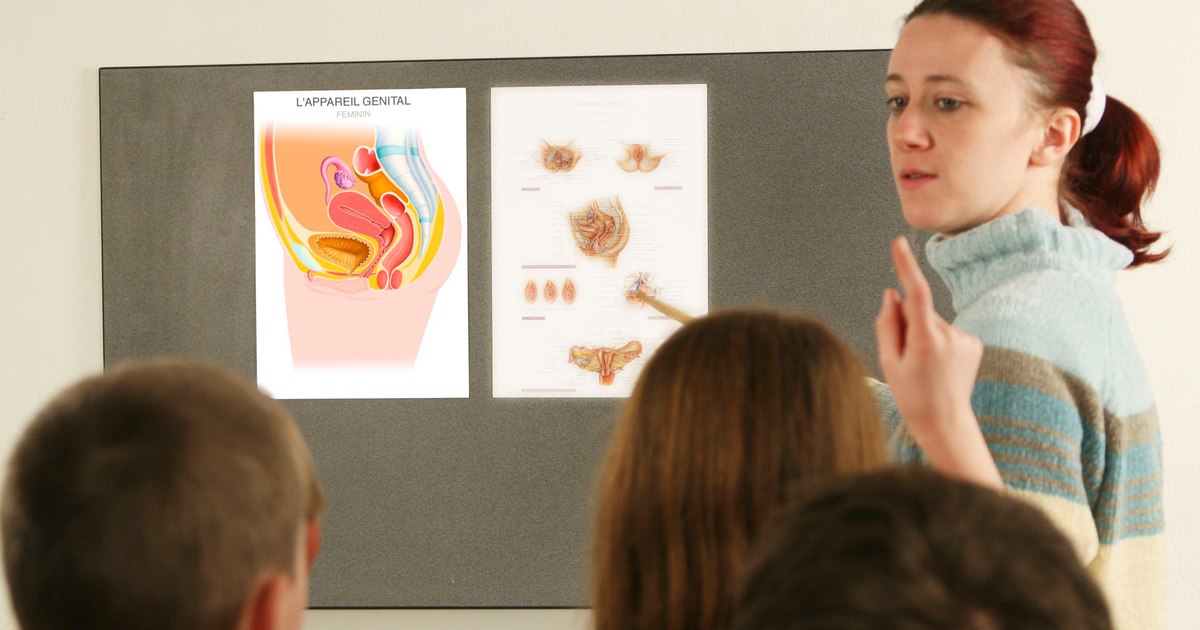
The subject “Sexual education” should become mandatory in all schools in Romania, demands the National Council of Students, which launches the call “Educate today, to prevent tomorrow”. Student representatives draw attention to the latest scandals in schools and universities, but also to some more than alarming statistics: 45% of mothers under 15 in the European Union come from Romania.
Sex education is an optional subject. Photo source: archive
The National Council of Students conveys in a statement that sex education prepares young people for life by preventing unwanted pregnancies and sexually transmitted diseases, by promoting healthy relationships based on mutual respect, by combating sexual violence and supporting the emotional and psychological development of the students.
Student representatives draw attention to the fact that, “while the presidential candidates debate about abortion, a painful reality remains ignored: Romania has the tragic record of underage mothers in the EU. 45% of all mothers under 15 in the European Union are from our country. Behind these numbers are life stories marked by challenges and early giving up.”
The students point out that this problem generates severe consequences such as poverty, social exclusion, difficulties in public and mental health, as well as high economic costs. At the same time, it negatively affects the image of our country internationally.
According to the organization, changing the curriculum and framework plans is an ideal opportunity to discuss these topics and introduce sex education as a compulsory subject.
“Although the discipline “Education for health” exists and includes aspects related to sex education, it is optional, which means that the information does not reach all students. (…) We demand that sex education be a national priority, regardless of political orientation. The future president should support sex education, put pressure on the education system and open a national dialogue on this topic. We want a better informed and healthier future, a shared responsibility, not just of students or teachers”, the students also sent.
Teacher: “Contraception is already included in the Baccalaureate curriculum”
A much-debated, controversial idea to say the least, sex education in schools, as students are calling for, is hard to implement, teachers say. “If we are talking about a compulsory subject, this discipline should be contained in a common trunk and enter the didactic norm of a teacher. And this teacher could only be the biology teacher”, Ionela Cociorva, a Biology teacher at the ILCaragiale National College in Bucharest, stated for “Adevărul”. “Or, who knows, a medical staff, a teaching assistant. But regardless of who would teach this subject, one thing is certain: from my point of view, the subject should include a much wider scope of information. It would be best if it were called ‘Health Education’ and designed according to the age of the students and their ability to understand and assimilate this information.” the teacher also specified.
Ionela Cociorva believes that specialists such as doctors, psychologists, sociologists could be invited during these classes to explain certain basic notions to the students and to strengthen their general culture in the first place: “Although, I tell you honestly, the classic, established subjects also touch on this topic. For example, in the 6th, 7th, 10th and 11th grades, students learn about diseases in Anatomy, but in a different way. For example, we learn about the digestive system, we talk about gastritis. We learn about the reproductive system, we also talk about pregnancy, conception, contraception, sexually transmitted diseases, etc. Contraception is even included in the Baccalaureate curriculum”.
A difficult idea to implement. “The whole school curriculum should be changed”
The teacher believes that one hour a week would be enough to talk to the children about health and sex education: “You don’t have as much information as you spread it evenly over an entire school year. How much to talk to children? At some point you have nothing left to say to them. So sex education should be inserted into a subject that includes broader health information and notions.”
If it is desired that the subject becomes compulsory, then the school curriculum will be changed:“Which, at the gymnasium, is already designed and implemented. So I don’t see how they could introduce one more subject. Everything would be turned upside down. The curriculum should be redone. Which is impossible. At the high school, on the other hand, there would be chances, because the new program is still being worked on”.
But, continues the teacher, students should think very carefully about what they are asking for, because a compulsory subject comes with corresponding responsibilities: “They will have to learn, they will be listened to what they have learned, they will be assessed, they will be graded. And then they might stop wanting it, stop being so excited. Honestly, I don’t think that high school students want compulsory sex education”.
Father: “Such an idea does not stand, for now”
It is more than obvious that in Romania we need sex education to be taught in school, believes Iuliana Constantinescu, the representative of parents from the “Lucian Blaga” Theoretical High School in the Capital: “But everything must be very well thought out and very well organized. And at the moment such a proposal does not stand. As a compulsory discipline, it will be very difficult to implement, given that we already have some outlined in the gymnasium framework plans which has been in place for several years. So no other mandatory disciplines can be introduced in the common core”.
The father told “Adevărul” that the subject – mandatory or optional – should be called “Health Education” and include a much wider palette of concepts, notions and information: “Starting with sex education, health education, first aid lessons, disaster response etc. Many children who do not know basic concepts look for their information on the Internet. Here, however, I find them distorted, erroneous or even distributed with bad intent. And then yes, the school should teach them from what changes occur in their body to what sexual abuse means, how we recognize sexual abuse, how to protect ourselves, how to prevent it, who we can ask for help. The child must know from a young age where the limit of decency goes, where the joke ends and where the abuse begins”.
Teachers, the silent witnesses of aggressions in schools
But teachers should also be “educated” in this regard, the parent believes: “Teachers need training on many levels because, unfortunately, the school only teaches them to strictly teach some scientific notions in a certain discipline. And that’s it. And they don’t know basic notions of how to behave around a child, how to communicate with a child. It takes tact, skill, the ability to adjust your speech according to the age of that child and his ability to understand”.
Iuliana Constantinescu stated that many teachers are aggressors themselves, and others are silent and indifferent witnesses to acts of violence that they should normally report. “But they choose not to get involved. I would very much like teachers to have the power of reaction. Because, very often, they notice inappropriate behavior around them, but they choose to look away”, said the representative of the parents.
Optional, Timetable Cinderella
Currently, the subject “Health Education”, which also includes information on sex education, is an optional subject. But only in certain schools and high schools. The reason? Many of the high school students turn to other electives, which help them prepare for the Baccalaureate. “Subjects such as Health Education, Financial Education, Legal Education hardly find their place in the students’ timetable. The reason? Most opt for subjects that really help them prepare for national exams. For example, if the students take the English exam at the Baccalaureate, it is natural for them to choose an English optional”explained the teachers we talked to. Then, in general, optional subjects do not have a place in the students’ timetable, loaded with established subjects: Romanian Language, Mathematics, Physics, Biology, Chemistry, etc.
