
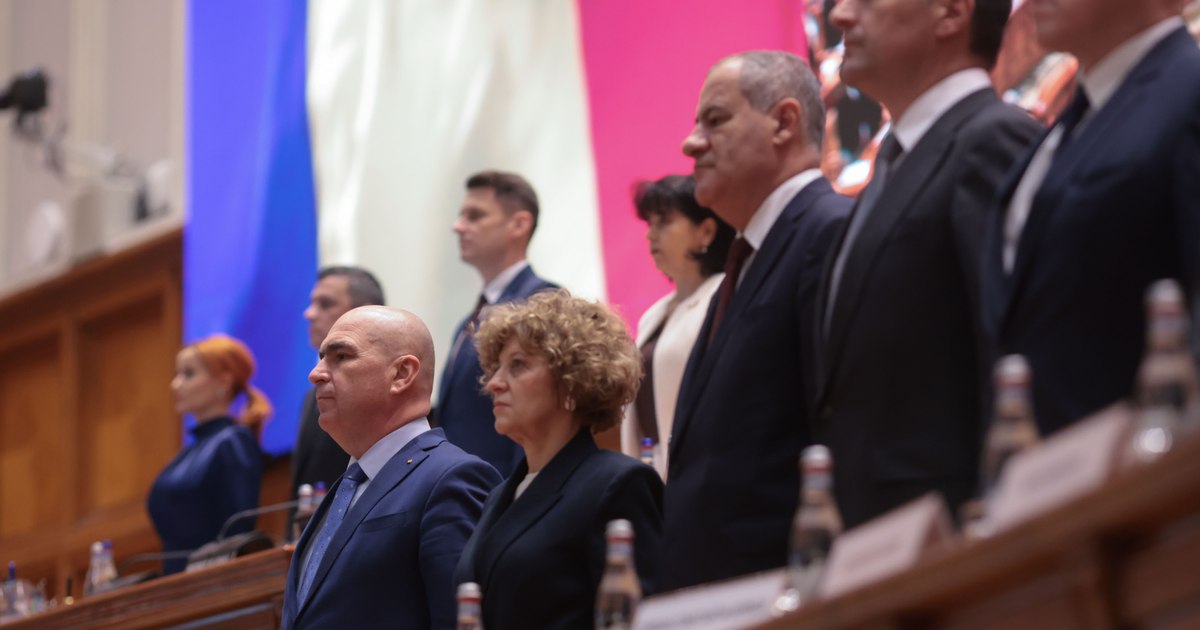
The year 2025 brought a new coalition government, this being perhaps the most complicated government construction in recent years, which had 6 months to restore Romania’s economic situation.
Political scientist George Jiglău emphasizes that the Executive formed this year was forced to act in a context that it did not create, against the background of some problems, especially of an economic nature, generated previously.
Moreover, the situation forced, once again, the formation of a complicated coalition, this time from four different parties, with support from the minority group in the Parliament: “We, such a difficult coalition as this, I don’t really think we had. I don’t know, maybe at the CDR in the 90s. But in the recent past, we, such a complicated coalition as this one, did not have”.
Two different speeches
The most recent data indicate a deficit for the first 11 months of the year of 6.4%, compared to 7.15% in the same period last year, indicating an economy of 4 billion lei. For the current year, Romania initially had a deficit target of 8%, renegotiated to 8.4%. For this result, the year 2024 was, in fact, marked by two different approaches: it was marked by a radical change of economic discourse:
“It is the Ciolacu approach, let’s remember, in the first part of the year and in recent years, which said that there was no problem, everything was going well, we made investments, but there was a bit of a deficit. We are negotiating and the European Commission forgives us that we had to spend and invest, even if we do it somewhat on debt. And it is the Bolojan approach, which said that the problem is very serious, we are incapacitated, we no longer receive any money from outside, no one takes us seriously anymore and everything goes to waste, if we do not act extremely decisively and quickly”.
The current government, marked by political compromise
The difficult context also forces the governing parties to negotiate, the political scientist also points out: “It’s a compromise government. But not a compromise in the negative sense, but a compromise in a positive sense, specific to politics and hard times, say, when the economy and society are going through complicated moments, when it’s not easy to govern and when you can’t do anything but with compromises. Because none of the parties, nor the prime minister, is in a position to impose their point of view and they are constantly obliged to negotiate.”
This is also one of the reasons that generated tensions in the coalition. The main problem, however, lies in the PSD-USR opposition: “The conflict in the coalition is between USR and PSD, which have always been in conflict, they have never been in government with each other.”
Talks about breaking up the coalition have started since the beginning of the coalition. The political scientist notes, however, that all parties “I’m still here though.”
The role of the president Nicușor Dan
The current president Nicușor Dan also contributed to the stability of the current coalition: “He is one of those who, let’s say he was one of the craftsmen of this governing coalition, facilitated its formation”.
But this position does not come without political costs: “This somewhat positive contribution, in relation to stability, comes with some image costs for him. (…) Rather, he has a minority of people who deeply sympathized with him to put their stamp on him directly at a time when they still had other alternatives (NR – Round I). So those people and those who voted for him in the second round, many of them may have a problem with the fact that Nicușor Dan has shown himself to be quite friendly with PSD, with whom including as mayor generally had a problem”.
The approach to PSD surprised many supporters: “Suddenly, his relationship seemed quite natural, he said so, and with Sorin Grindeanu personally, and with PSD. Of course, we justify it by the difficult context in which everyone has to work together”.
A “reasonably good” government
However, the political scientist’s conclusions also indicate an important stake for the future: “All in all, I think we had a reasonably good governance I would say, so with a passing grade. On the other hand, I don’t know if this kind of governing will in any way convince the non-democratic illiberal front in Romanian politics. (…)
There are some extremely, extremely deep issues here. This seems to me to be the biggest stake, beyond the deficit and other things. I wouldn’t blame the performance of these parties or this government, no matter how much room for better there is, I don’t think that any government can convince those people to stop sympathizing with Georgescu, Simion and others”.
