
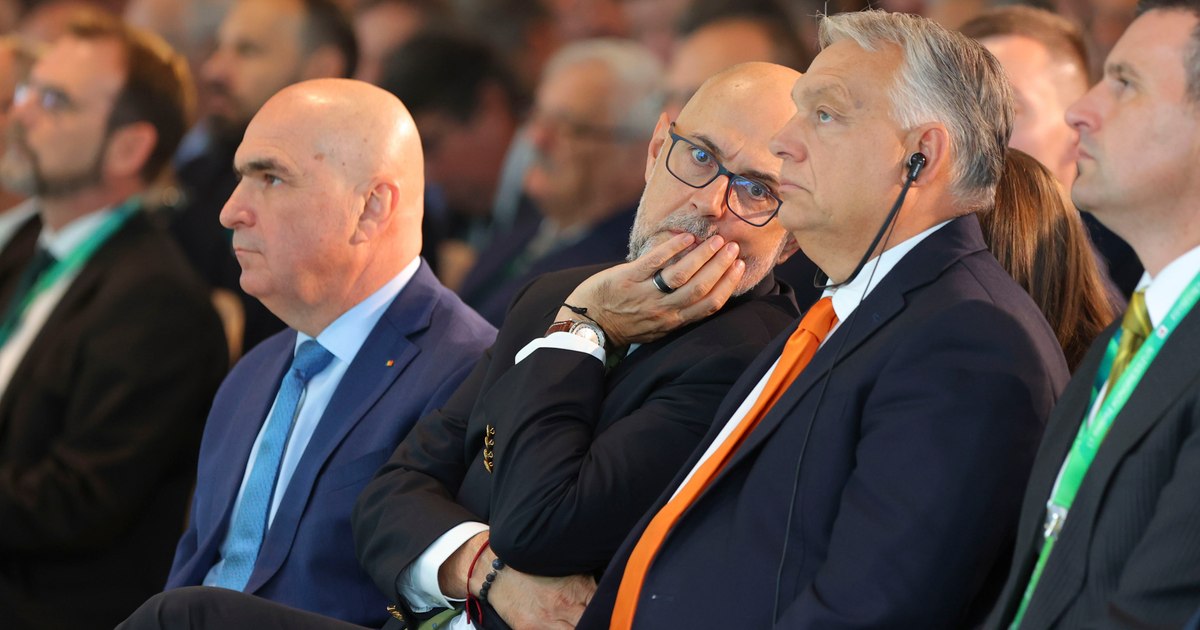
Next month’s parliamentary elections in Hungary could mark, for the first time, the end of the Viktor Orban era. Although polls indicate a possible failure for the current prime minister, political scientist Cristian Pârvulescu warns that the opposition camp, led by Péter Magyar, underestimates the diaspora vote. In this context, while Bucharest seems to be counting on continuity from Budapest, experts suggest that a change of regime would, in fact, be to Romania’s advantage.
“It does not matter, for a democratic Romania, whether Viktor Orbán will be prime minister or Peter Magyar. I say this while I am aware that, although opinion polls are unfavorable to FIDESZ and Orbán, Viktor Orbán has the first chance”. emphasizes the political scientist Cristian Pârvulescu for “Adevărul”.
The political scientist notes that “the Romanian authorities seem to bet on the victory of Viktor Orbán. In any case, the Prime Minister seems to believe in this victory and help in this victory.” he says, recalling the December 5 visit of Prime Minister Ilie Bolojan to Budapest. “It happened 5 months before the elections. So it was a political signal”concludes the political scientist.
An opportune moment for Romania
A victory for Peter Magyar would bring a more complicated situation for the UDMR, present in the coalition of the Romanian Executive, the political scientist believes. “But for us, for Romania, it would be a positive signal in the sense of other electoral events that took place in the last weeks since the vote in Slovenia, on Sunday, in the referendum for Justice in Italy, which shows a weakening of the position of the Trumpists. (…)
For us, it would be opportune to orient ourselves even more clearly towards the values of European democracy. In the meantime, a Viktor Orbán victory would push us further into a zone of democratic uncertainty that Russia can only take advantage of. Because we cannot forget for a moment that Viktor Orbán is Vladimir Putin’s best ally. Viktor Orbán is, in fact, following Vladimir Putin and Donald Trump, a destructuring of the current international political order in favor of increasing Hungary’s influence. An increase in the influence of Hungary, which would become the heir to the Austro-Hungarian Empire. It is not about rebuilding Greater Hungary, but about increasing influence. Indeed, Hungary is already an active presence, far beyond its economic and political power, in the Balkans. So, it’s not the same.”
The role of UDMR
The role of the UDMR in the Hungarian elections remains a discreet topic in Romania, although it has major regional implications. With a Kelemen Hunor openly supporting FIDESZ, the Hungarian community here becomes an essential pawn in Budapest’s electoral strategy.
“More than 300,000 Hungarian voters are registered in Transylvania, who can vote in Hungary, and I estimate that the total number of Hungarian voters outside the borders can reach 600,000, given that the normal average presence in Hungary is somewhere around 5.5 million voters. It can be a contribution between 8 and 12% of the total votes. So it can change the result”, also shows the political scientist Cristian Pîrvulescu.
These calculations, regarding the vote of the diaspora, are underestimated by the opposing camp from Hungary, draws the attention of Cristian Pîrvulescu. “Magyar should recalibrate Hungarian politics in a much more European sense. I don’t know if he can, and I’m still quite reserved about the real possibility of victory, because opinion polls don’t measure what’s going on outside very well. And, I pray, they are under the illusion, many of them, that the contribution of the vote from the Hungarian diaspora will be somewhere around 1-2%, it can reach up to 12%, which is completely different”. emphasizes the political scientist.
“The majority of Hungarians in Transylvania, thanks to social networks, are under the direct influence of the propaganda from Budapest” – Cristian Pîrvulescu, political scientist
If for Romania, a failure of Viktor Orban is far from a loss, for the UDMR, things are completely different, the political scientist emphasizes:
“UDMR was forced by Viktor Orban to change its political direction and leadership, because at the beginning of Viktor Orban’s uninterrupted reign, which is already 16 years old. Viktor Orban was prime minister for 20 years, because he was also between 1998 and 2002 and he also came from 2010 until today. At the beginning of his reign, the president of the UDMR was Marco Bella, who had a much more clearly democratic position. The change took place because Viktor Orban categorically refused to collaborate with the UDMR, he even tried to support dissidences in Romania, anti-UDMR dissidences and finally understood that he could rely on the current leadership of the UDMR.
In fact, the UDMR problem is simple. UDMR is very likely, at the leadership level, much more pro-European than FIDESZ was or will be. But the majority of Hungarians in Transylvania, thanks to social networks, are under the direct influence of the propaganda from Budapest. So UDMR is obliged to adapt to this situation. We must say that Mugyar made an attempt to get closer to the Hungarians from Transylvania, but he did not succeed”.
