
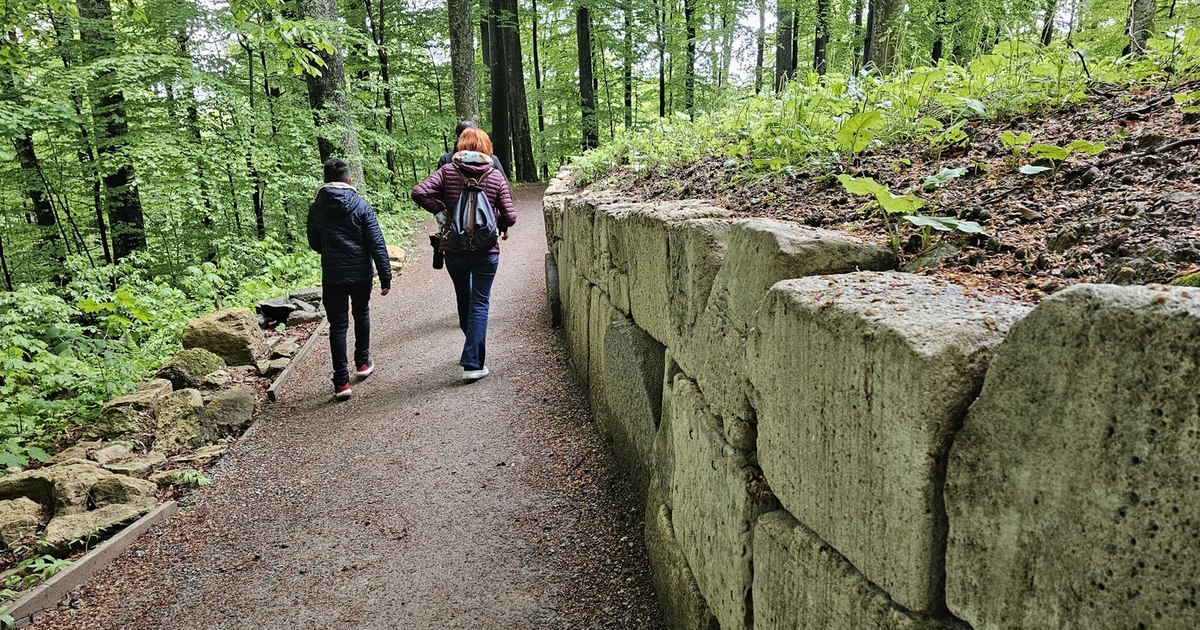
Over one hundred Dacian cities were identified on the territory of Romania, but few of them have become tourist landmarks. The most famous of them remains Sarmizegetusa Regia, the historical ensemble being one of the few cities in which investments take place.
The ancient walls of Sarmizegetusa Regia, restored. Photo: Daniel Guță. TRUTH
Nearly 70,000 tourists visited Sarmizegetusa Regia in 2024, the most popular Dacian fortress in Romania. The modernized road and the agglomeration of ancient settlements on the Grădiștii Valley made the ancient capital the favorite destination of tourists attracted by the story of the Dacians.
Sarmizegetusa Regia – the most popular Dacian fortress
Sarmizegetusa Regia is one of the few Dacian cities in Romania sought daily by groups of tourists.
Located about 40 kilometers from the municipality of Orăștie and the A1 Sibiu – Nădlac highway, accessible from Hunedoara on a 35 -kilometer road in Călan, the capital of Dacia from the time of King Decebal was visited in 2024 by over 67,000 tourists.
Some of them traveled thousands of kilometers to reach the Dacian fortress and were impressed by the atmosphere of the ruins in the middle of the forest.
“Sarmizegetusa Regia is a hidden jewel in the middle of the forest, this place is absolutely wonderful! I went there with the car (attention on the road, in some places it has pits) and parked in the parking lot that is a kilometer (0.6 miles) away from the ruins. From there I took a paved path, at all, at all. The ruins even took us back in time. notes a tourist.
Other foreigners offer more balanced descriptions to the Dacian fortress.
“The landscape is pleasant, in the middle of nature … but it is impossible to walk there. The place itself is not exceptional for an ordinary visitor, but it can be different for someone curious about the Dacian culture. The road through the forest is good, but the last 20 kilometers are really very long”, SDust a traveler from Turkey here.
The Romanian travelers from Sarmizegetusa Regia often mention, in reviews, the historical figures related to the past of the settlement.

Image 1/23:
Sarmizegetusa Directed by Photo Daniel Guță Adevărul (110) JPG
“Sarmizegetusa was not only a city, but a sanctuary of the Dacian spirit, a place where heaven and earth met in a sacred harmony. Here, Zalmoxe’s priests read the signs of destiny, and the Dacian warriors found their power before the fight. Circular were clocks of eternity, aligned with the walking of the stars ”notes a Romanian tourist, in a Google review.
Restorations that could play his charm
Although the number of those who saw it is much lower than the visitors of the Corvin Castle of Hunedoara (about 400,000 tourists), Sarmizegetusa Regia remained a popular tourist landmark and a valuable monument, in the UNESCO World Cultural Heritage. In the coming years, the authorities expect the Dacian settlement to become more busy, with the restorations carried out here.
Three investments meant to restore their brilliance takes place at Sarmizegetusa Regia. One of them, at the end, aimed at restoring his fortification, which includes ancient stone walls with a length of almost one kilometer and three monumental gates. The investment worth over 2.2 million euros was financed by SEE 2014-2021 grants, the so-called “Norwegian Funds” and the Hunedoara County Council.
The second project, at the beginning, will lead to the restoration of the remains of the Andesit temple on the XA terrace in Sarmizegetusa Regia. The investment, financed with European funds, through the National Plan of Redress and Resilitis aims to preserve the ruins of the Temple and play an image close to the original, in accordance with recent research. At his end, tourists will see at Sarmizegetusa Regia, for the first time for Romania, a Dacian column restored in the way he looked in antiquity.
Also this year, the works to restore the ancient paved road from Sarmizegetusa Regia could begin, estimated at 7.3 million lei, for which the Hunedoara County Council, the institution that manages the historical ensemble, has accessed funds through the program “Stamp of historical monuments”, coordinated by the National Heritage Institute.
The Dacians gave an impetus tourism in Hunedoara
The restoration work in Sarmizegetusa Regia will make Sarmizegetusa Regia a more appropriate historical settlement for tourists, even if the ancient ensemble is in the heart of the Orăștia Mountains.
Orăștie – Costești Road is in the site, but its modernization works are approaching the end. Starting from Costești, the last 20 kilometers of the road to the Dacian capital crosses with few human settlements, slipping among the steep and wooded slopes, on the Grădiștii Valley.
In recent years, due to tourists, many and locals from the villages on the Grădiștii Valley have prospered. The village of Costești, in the middle of the distance between Orăștie and Sarmizegetusa Regia, has become a small resort, with many houses transformed into pensions, with other pensions raised from scratch and places where people welcome tourists with traditional products such as the pies and the sweets and souvenirs.
“Most tourists go to Sarmizegetusa Regia, but also from here, from Costești, others go up to the Costești and Blidaru cities. Or pass the hill at Târsa and then descend to Boșorod to visit the Dacian city of Red. Dacian cities in one day ”, He tells a local, who sells his products in the leisure area on the outskirts of Costești.
Not only did tourism boost the economy of the villages on the Grădiștii Valley, but also the numerous plantations of blueberries and fruit shrubs. In the communes of Beriu and Orăștioara de Sus, the blueberries remain the most sought after season.
“Several years ago a German came here, bought land and opened a blueberry plantation. Over time, more and more evil example followed, and today many people grow blueberries and take advantage of their sale.” says a local from Beriu commune.
Most Dacian cities Ocloite by tourists
The vestiges of at least one hundred Dacian cities have been identified on the territory of Romania, most of them are easily overlooked as tourists. The Dacian fortress Bănița, although in the UNESCO heritage, along with five other Dacian sites (Costești, Blidaru, Sarmizegetusa Regia, Piatra Red, Căpâlna) is almost inaccessible to tourists, due to the steep route.
In a similar situation is the Fortress of Ardeu, from the Geoagiului Valley. Other such settlements have remained difficult to recognize, practically having no visible surface monuments. Other former Dacian fortresses, instead, remained with the name, not being investigated and identified exactly, or being bypassed by the tourist routes.
