

Society is increasingly dissatisfied with the economic situation and the way the authorities manage the fuel crisis shows a new survey carried out by the Center for Urban and Regional Sociology – CURS at the end of March 2026.
The research, conducted on a representative sample of 1,517 adults between March 23 and 27, with a margin of error of ±2.5%, highlights the growing tension felt by Romanians, but also significant changes in political preferences.
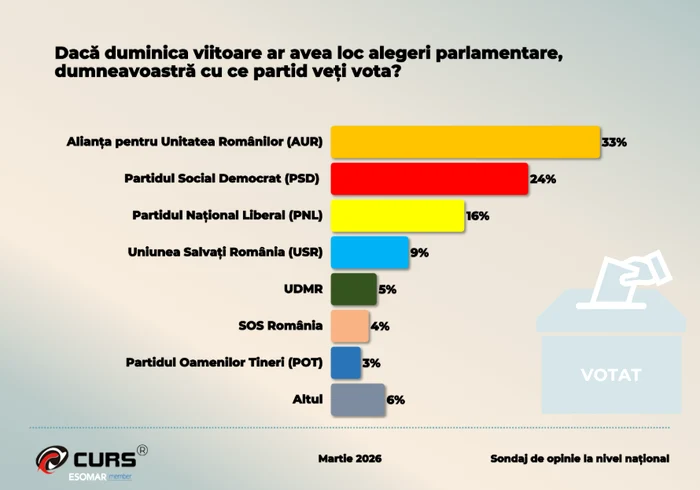
If parliamentary elections were to be held next Sunday, AUR would remain the party with the most support, obtaining 33% of voting intentions, a considerable decrease compared to the INSCOP poll released at the beginning of March. PSD is in second place, with 24%, while PNL registers 16% of voting intentions. USR would get 9% of the votes, UDMR 5%, and SOS Romania 4%. The Young People’s Party (POT) would collect 3%, while other formations together accumulate 6% of the electorate’s options.
The results show a transfer of trust from traditional parties to new formations or critical of the government, reflecting the growing discontent of the population.
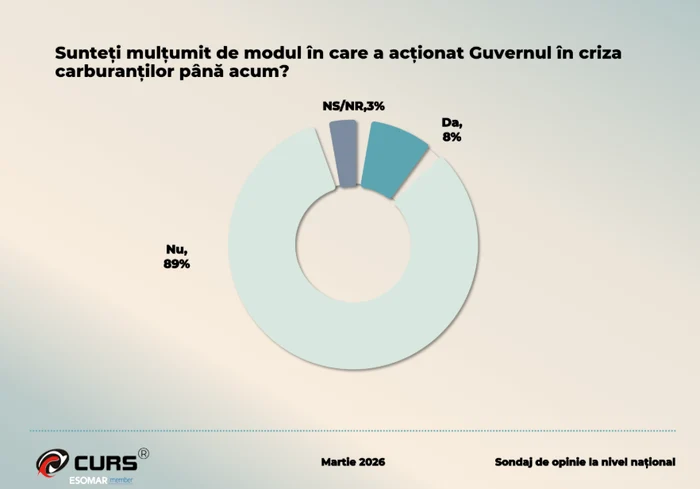
Dissatisfaction with the way the Government has handled the fuel crisis is overwhelming. According to the survey, 89% of respondents say they are not satisfied with the reaction of the authorities, while only 8% say they are satisfied, and 3% do not have an opinion.
The increase in fuel prices was felt directly by the majority of the population: 37% say that the impact was very high, 44% consider it high, and only 11% perceive it as low and 5% as very low. More than 80% of Romanians have seriously felt the effects of price increases, which explains the high level of dissatisfaction with the Government and amplifies social tension.
Romanians also clearly express their preferences for solutions that mitigate the effects of price increases. 36% believe that the authorities should have simultaneously reduced VAT and excise duties on fuels, while 25% believe that the reduction of VAT would have been enough, and 22% support the reduction of excise duties. Only 13% are in favor of leaving the market free, and 4% have no opinion.
A clear preference for direct state intervention in price setting is thus emerging, in contrast to the liberal view of the free market.
Against the background of these economic tensions, the perception of the direction in which Romania is heading continues to be negative.
Eight out of ten Romanians believe that things are going in the wrong direction, and only 17% believe that the direction of the country is a good one. This perception is directly reflected in electoral preferences and general dissatisfaction with the authorities.
The March 2026 CURS survey thus illustrates an increasingly tense and dissatisfied society, in which the economic pressure felt by citizens, especially through the increase in fuel prices, has a direct impact on the political and electoral climate. The results indicate a clear relationship between economic dissatisfaction and voting choices, with possible effects on future parliamentary elections.
