
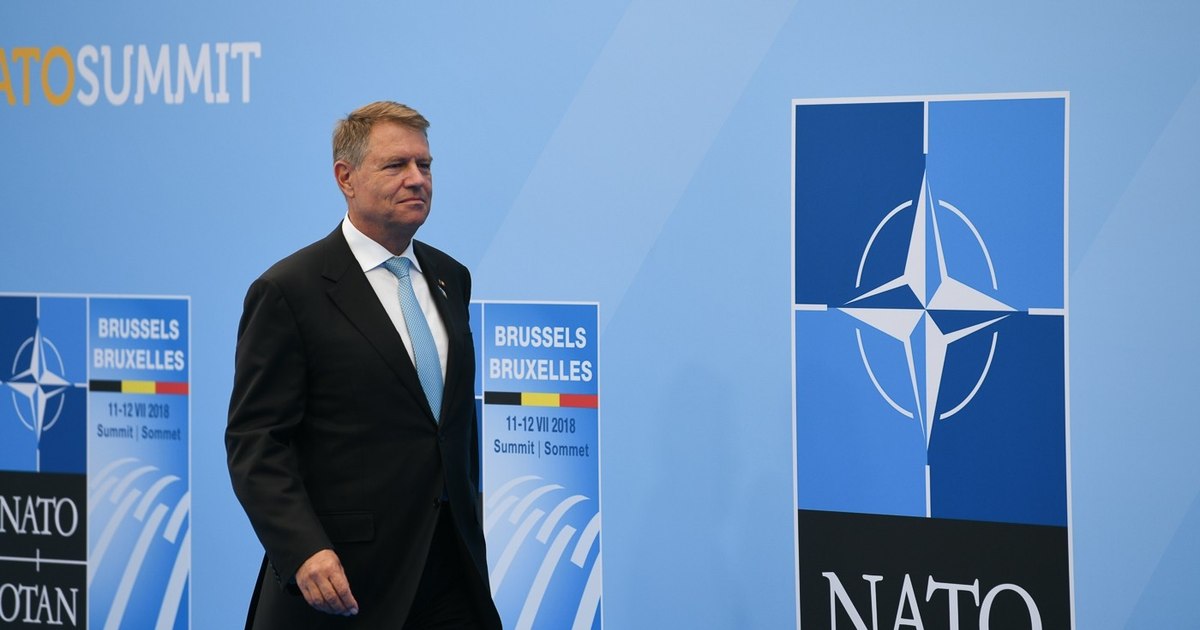
President Klaus Iohannis seems to have run out of support in the race for the position of Secretary General of the North Atlantic Alliance, after Hungary and Slovakia announced their support for Mark Rutte. Political analysts Cristian Pîrvulescu, Radu Delicote and Radu Magdin explained for “Adevărul” if this candidacy was good or not for Romania and what could be the dimension of this “failure” for the head of state.
Analysts talked about the possible “failure” of Klaus Iohannis in the NATO race PHOTO presidency.ro
President Klaus Iohannis announced on March 12 that he will run for the head of the North Atlantic Alliance. The president's announcement came on the 25th anniversary of NATO's first expansion to Eastern European countries, with the president's main argument being the need for a representative of the Eastern countries.
At the time Iohannis made the announcement, at least 20 of the 32 NATO members, including the most important Western members – the US, Great Britain, France and Germany -, had announced their support for the resigned Prime Minister of the Netherlands, Mark Rutte.
And since then he had managed to get the support of Hungary, and countries like Bulgaria, Slovakia and it was believed that Turkey also did not seem to agree with the Dutch Rutte at the head of NATO.
On Tuesday, however, Hungarian Prime Minister Viktor Orban stated in a post on X that he is ready to support the candidacy of his Dutch counterpart Mark Rutte for the head of NATO. “We reached an important agreement with NATO Secretary General Jens Stoltenberg. We agreed that no Hungarian personnel would participate in NATO activities in Ukraine and that no Hungarian funds would be used to support them.(…) After the meeting yesterday (Monday no) in Brussels, Prime Minister Mark Rutte confirmed that he fully supports this agreement and that he will continue to do so, if he becomes the next Secretary General of NATO. Considering its commitment, Hungary is ready to support Prime Minister Rutte's candidacy for the post of NATO Secretary General“, wrote, on Tuesday, the Prime Minister of Hungary, Viktor Orban, in a post on X, next to a letter signed by Mark Rutte, in which he assumes the understanding.
On June 3, the Hungarian leader, present at an electoral event organized to support the UDMR candidates in the European Parliament elections, organized in Salonta, Bihor county, mentioned that Budapest supports the candidacy of Klaus Iohannis for the headship of NATO.
In fact, Slovakia also claimed at the beginning of April regarding the candidacy of Klaus Iohannis to NATO that “it is a legitimate candidacy”, and that until then there had not been a “reasonable” candidate to protect the security interests of the Central-Eastern countries -European, (and those of his state which was left without anti-aircraft protection after the NATO allies – the Dutch and the Italians – withdrew their temporarily supplied systems), but without expressing his support for his country, he announced, on Tuesday, the support to Rutte.
“Following consultations with both candidates and following consultations with Prime Minister Robert Fico and the Slovak government, I can announce that the Slovak Republic supports the election of Dutch Prime Minister Mark Rutte as head of the Alliance“, said Peter Pellegrini, adding that Rutte would have shown his willingness to address the topic of ensuring the protection of Slovak airspace, according to Slovak TASR agency.
President Klaus Iohannis declared, on Wednesday, that he will present his position regarding the candidacy for the head of NATO on Thursday, within the CSAT, and then he will publicly announce the decision taken on this subject.
“About NATO, more tomorrow. I will present these matters first in the CSAT, and then to public opinion. I can assure you that tomorrow afternoon you will be cleared “, declared Klaus Iohannis, in a press conference.
The new head of the Alliance is decided by consensus, so all 32 states must agree, preferably by the July NATO Summit in Washington.
Romania is the only country in the Alliance that has not announced its support for the Dutch prime minister, who would need the support of all NATO members.
The mandate of the current Secretary General of NATO, Jens Stoltenberg, already extended twice, ends in October.
What the Dutch press is saying
ANP, the national news agency of the Netherlands, wrote on Tuesday that “Hungary supports Dutch Prime Minister Mark Rutte for the leadership position at NATO“. “Dutch Prime Minister Mark Rutte is virtually assured of the NATO leadership job now that Hungarian Prime Minister Viktor Orban has agreed to back him. Hungary and Romania were the only two countries standing in the way of Rutte taking over from Jens Stoltenberg after Slovakia gave its blessing to the appointment on Monday night“, the ANP also shows.
And the Dutch news publication NOS, writes that “Rutte becomes the new Secretary General of NATO, the Romanian opponent will withdraw“. “”Mark Rutte will become the new Secretary General of NATO. Now that Hungary also fully supports Rutte's candidacy, all that remains is to wait for the withdrawal of the only opposing candidate, President of Romania Iohannis”, says the publication that quotes internal sources, who confirm for NOS that Iohannis will retire soon.
And the daily Volkskrant states that Rutte will almost certainly be the next head of NATO and that only the “hopeless” Romanian candidate must withdraw. The publication reports that incumbent Prime Minister Mark Rutte is close to being the next NATO secretary general after Hungary and Slovakia dropped their objections, and that Romania will soon follow, insiders expect, so that Rutte obtain the necessary consensus of all member countries.
What the specialists say
Political analyst Cristian Pîrvulescu declared for “Adevărul” that it is “surprising the change of line of Viktor Orban“. “This candidacy of President Iohannis was a candidacy to help member states overcome the crisis that Orban's opposition implied. When this opposition no longer exists, the premises for such a candidacy no longer exist either”, a explained the analyst.
Cristian Pârvulescu believes that “it is not a failure” this possible withdrawal of Klaus Iohannis, stating that he is not among the analysts who believe that such attempts should be interpreted as a failure, “especially because it has to be seen in context“. “And the context was related to a position by Orban and others who were with him on Rutte's candidacy, a position that was largely changed for reasons that are not yet apparent. The Republican Party and Donald Trump did not want this appointment of Rutte to be carried out, they wanted it to be postponed if possible, until after the election of the new president they hoped for – Donald Trump. So Orban was practically not alone (…) and in this context the candidacy of President Iohannis, who came as a crisis candidacy, must be interpreted. And that's why I say it can't be considered a failure. In the end Viktor Orban seems, because we still don't know if he has given in, he seems to have given in. There is no clear and definitive statement regarding this. So this candidacy of President Iohannis no longer makes any sense.” the analyst added.
Cristian Pîrvulescu supports on the other hand cUm “the majority of the press and commentators are jubilant in Romania”, and that “there is a sense of frustration with President Iohannis, huge.” “Political forces in Romania have done everything possible for this candidacy to be viewed with hostility or indifference from an international point of view”, adds the analyst.
As for Romania, Cristian Pîrvulescu emphasizes that obviously, our country “he would have gained from the nomination, so he has neither to gain nor to lose“. From his point of view this candidacy “she couldn't be bad“. “From the point of view of most commentators it was a failure. It depends from which perspective we look. I considered it a crisis candidacy to solve the Viktor Orban problem, because Viktor Orban had nothing against such a candidacy. In the end, Viktor Orban changed his mind on the last hundred meters, without having very clear reasons for this change of mind”, the analyst added.
Radu Delicote: He also indirectly lobbied for Romania
Political analyst Radu Delicote believes that this candidacy was good for Romania. “It was because regardless of whether you succeed or not, in the end, like in football, it's important to play and it helped in a way that we also demonstrated as a country that we can have a say within NATO. That often the vote is political and the influence or please the negotiation does not depend only on us, in the end we managed to be on the radar too, to be there too“, said the analyst.
Regarding the size of such a “failure” for Klaus Iohannis, Radu Delicote believes that “most of the time these candidacies, regardless of whether they are successful or not, at the end of the day they have a brand behind them, so visibility, automation and emotion”. “And in the end I think that Klaus Iohannis did not make this candidacy announcement by chance, because he may also have plan b in mind, a position at the European Commission, or I don't know if at the Commission, but at the European level”, the analyst added, stating that he did not know what specific position it might be.
“Because in fact and by law, there are still many question marks and many free radicals who can decide one way or the other, including at the NATO level there may still be certain elements to discuss. At the end of the day, there remains the element of branding and the country in which we had a president, regardless of what visions we have of him, better or less good, who indirectly also lobbied for Romania, even if the results may often not be …, or the image is often good or bad“, pointed out Radu Delicote
Radu Magdin: The failure is a tactical one for the president
Political analyst Radu Magdin considers this candidacy to be beneficial for our country.
“The candidacy of Klaus Iohannis was good for Romania, as a manifestation of the ambition of an important country in Eastern Europe, which, however, very often did not behave like an important country or an ambitious country. If this candidacy was primarily one related to Klaus Iohannis' desire to make an exit to another well-paid position, and with facilities, essentially the expression of Romanian ambition is good for us in itself. Of course, if this candidacy had been launched in time, prepared in time, including in the world of ideas, in the Euro-Atlantic networks, it would have had a better chance of winning or would have led to an actual final and not simply to the fall of a card game, one card after another, as countries that had shown reluctance towards Rutte finally accepted him. If Iohannis had prepared his candidacy better, it would have been even better for Romania, but even so, overall, this manifestation of Romanian ambition is a good thing”, explained the political analyst.
Analyst Radu Magdin is of the opinion that “failure”, for Klaus Iohannis, is “a tactical one, for a stage, in the NATO area”.
“The failure is a tactical one for the president because if somehow he manages to surprise us on the European level, although I have doubts in this regard, only then can we talk about a bigger, strategic failure, because he exposed himself, seemed to have a strategy Euro-Atlantic or at least Euro-Atlantic with a European component and later it did not have any results. So it remains to be seen if his ambition will materialize in any way on the European level, at the moment we can only talk about a tactical failure of the stage, in the NATO area, for the president“, said Radu Magdin.
