
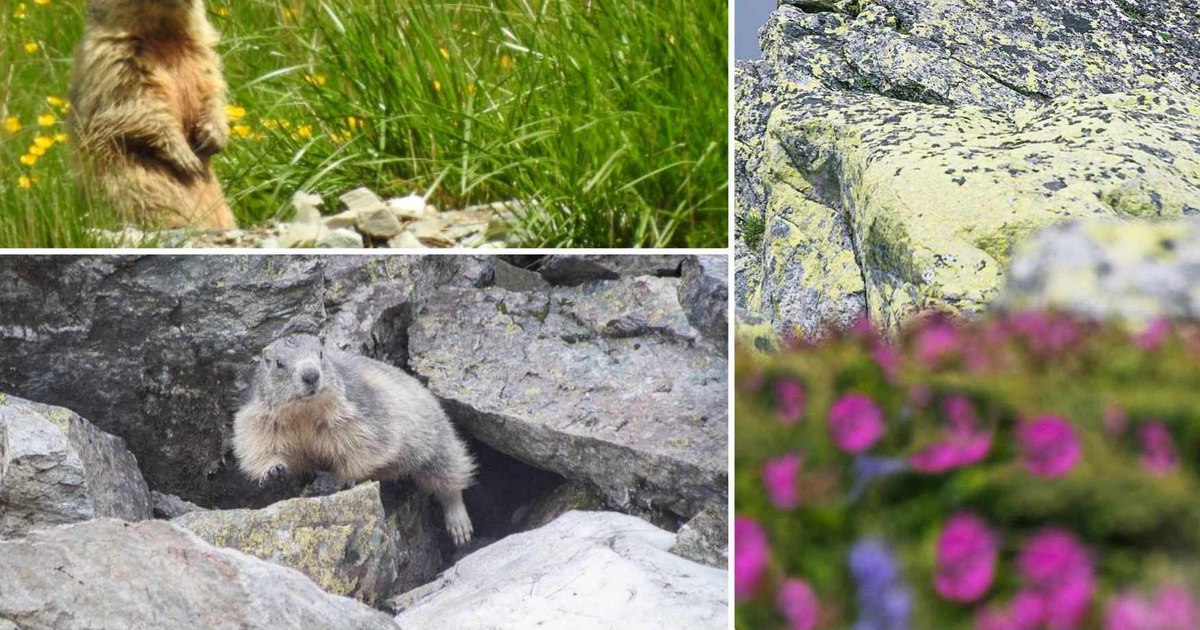
The most admired rodents of the Retezat National Park can be found near the glacial lakes of the Retezat Mountains. Marmots have ruled these lands for decades, but are wary of human sight.
Marmots in Retezat. Photo Lenuta Bogdan – APNR and Lucian Ignat
Travelers who go up to the glacial lakes of the Retezat Mountains have a good chance of meeting the families of marmots that live in the Retezat National Park, but being close to them can scare them.
According to some estimates, the number of marmots in Retezat exceeds several thousand, but they can be observed most often during the summer, in the rocky areas and alpine pastures.
The rangers of the Retezat National Park recommend that tourists arriving in the Retezat Mountains leave their pets at home, and if they cannot do so, keep them on a leash, so as not to disturb the wild animals.
Groundhogs (video Claudia Danau – APNR) they are relatively large rodents (30-60 cm long and 3-7.5 kg in weight), with a heavy body, short limbs, slightly compressed tail and covered with long hairs. They have a massive head, small and rounded ears.
The thickness of their fur is influenced by climatic conditions, and the color varies by species, from yellowish-brown to reddish-brown or dark brown on the back and flanks. They live in alpine areas, in stable or solitary colonies, and are very close to their habitat and do not stray far from their burrows.
Some testimonies show that marmots were encountered in the Retezat Mountains even in the 19th century. They disappeared over time, being hunted for their fur.
“We can only regret that in not too distant times the marmot, the interesting rodent of the alpine depths, disappeared from the fauna of this massif. In 1867, Csato saw marmots on Vasia’s peak. Unfortunately, the danger of extinction and definitive extinction in Retezat also threatens the great birds of prey, the mountain’s phala”. showed, in 1937, the scientist Alexandru Borza.
Marmots in the Retezat Mountains, colonized from the Alps
Retezat National Park became the first nature reserve in Romania in 1935, and over time the scientists who took care of it tried to restore some wild habitats. More than 20 mouflons (European wild sheep) were brought in, but poaching led to their extinction. But the marmots managed to adapt.
In the 70s, several marmot families were brought to the Retezat Mountains. The rodents have been released in the Gemenele Scientific Reserve in Retezat, a strictly protected area where human access is restricted, since the 1950s.
“In 1973, a team from the Natural Monuments Commission of the Romanian Academy introduced 20 specimens of the Alpine marmot from the Austrian Alps. The marmots were released in the Gemenele lake caldera, and nowadays they can be found in all the valleys and glacial caldera from below the Custurii saddle to the Zănoaga lake caldera. The impact that these large, non-indigenous rodents have on vegetation and soil is not yet known,” informs the Retezat National Park.
From the Gemenele Scientific Reserve in Retezat, marmots have spread to other places, many of these small wild ones being observed near the glacial lakes of the Retezat Mountains.
“Among rodents, a new presence in the park is the marmot (Marmota marmota) observed by tourists in the alpine area of Retezat, during spring, summer and autumn. In winter, marmots, like other species in the park, hibernate in burrows”informed the rangers of Retezat National Park.
In the past, marmots in the Retezat Mountains could be seen much less often, and few tourists had the opportunity to admire them.
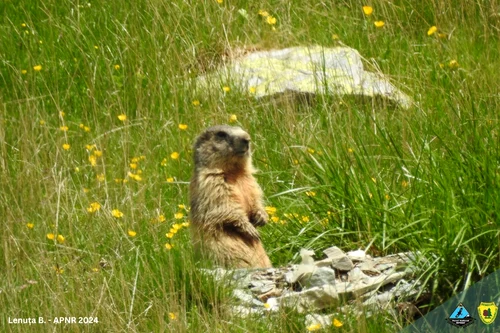
Image 1/5:
Marmots in Retezat Photo Retezat National Park (1) jpg
“Returning to the Pietrele cabin from a study trip carried out in the Reserve, when we were approaching the lower edge of the chimney that exits into the Retezat saddle, we met a family of marmots (Marmota marmota), a male and a female. First I spotted the smaller specimen moving quite quickly among the crowded stones at the base of the slope. It was followed at short intervals by the large, heavy, and well-fed specimen. After crossing the path, the female disappeared. His mate quickly scaled a massive stone, sat down on it and resting on his hind paws and tail, raised the front part of his body nicely, carefully inspecting the surroundings, in a straight line the distance between us and the marmot was at most a hundred meters, so we could look at it carefully“, reported Ioan Orosz, in the Almanah Turistic magazine, from 1986.
The traveler noticed how marmots send warning signals to themselves when they feel in danger or when they detect an intruder. Their hissing can be heard from distances of over a kilometer.
“We stopped so as not to scare her. At one point, one of the group members, dressed in a red hoodie, moved. Immediately the “watchman” emitted the typical marmot whistle and disappeared from the observation place. How beautiful it was, it’s hard to describe. She looked like a real doll with eyes surrounded by darker hair. I did not manage to trigger the camera to have the image of this beautiful, gentle and harmless animal, disappeared for a while from the enchanting landscape of our mountains. Of course, the signal he had given was meant for his guests, to get them out of harm’s way“, related Ioan Orosz, who was on an expedition in Retezat, in 1984.
Wild animals in Retezat
In the past, the Retezat mountains were one of the sought after places for hunting. Thanks to its diverse habitats, natural or slightly modified by human intervention, Retezat National Park is home to 55 species of mammals, twice the number known at the beginning of the 90s.
Since the 1930s, when it was declared a nature reserve, the Retezat kept a rich fauna with large predators, such as the bear, wolf or lynx, but also herbivorous animals, including the black goat, deer and deer or omnivores, such as the wild boar.
Retezat National Park was established on March 22, 1935, by a decision of the Council of Ministers of Romania. The first nature reserve in Romania then stretched over almost 13,000 hectares in the Retezat Massif and included semi-virgin forests, alpine landscapes, caldera and glacial lakes and numerous precious species of plants and animals. Currently, it occupies almost 40,000 hectares, including a large part of the Retezat-Godeanu Massif, but also a small portion of the Tarcu Mountains.
The glacial lakes in the Retezat Mountains are among the great attractions of Romania, and their protection was one of the reasons why scientists requested the establishment of the Retezat National Park. There are almost 80 glacial lakes on the territory of the massif, which make it one of the most attractive nature reserves in Europe. Most of them were formed at altitudes of over 2,000 meters, in places where travelers can reach on foot, on mountain trails, after several hours of walking.
The Gemenele scientific reserve in Retezat, the land forbidden to tourists, occupies almost 2,000 hectares and preserves one of the last intact primary forests in Europe and the only area of ancient mixed forest.
