
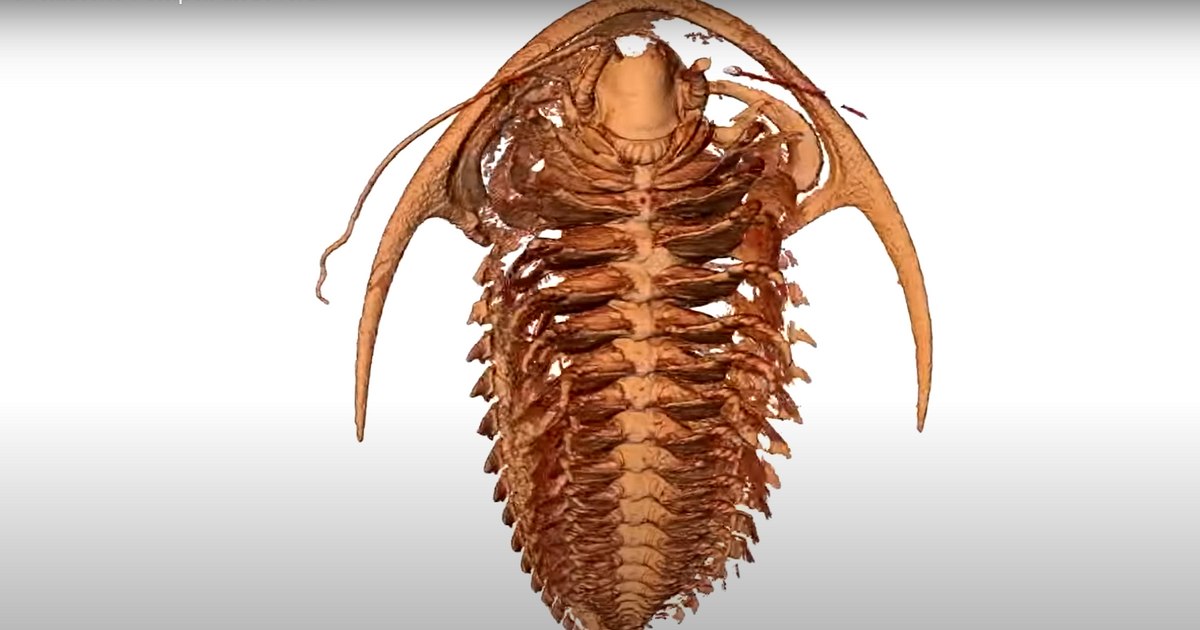
An ancient sea creature has been discovered in a “remarkable state of preservation” by scientists in Morocco. Even though trilobites lived in the oceans around 500 million years ago, the researchers said the animals still look as if they “died yesterday”.
Trilobites from Pompeii PHOTO capture Science X Youtube png
The creatures met their end after being completely engulfed in ash following a volcanic eruption, keeping their soft tissues and other body parts in pristine condition, according to independent.co.uk.
“I’ve studied trilobites for nearly 40 years, but I’ve never felt like I was looking at live animals as much as I did with these. The 3D preservation here is truly astounding” Dr. Greg Edgecombe, a paleontologist at the Natural History Museum of Morocco, told the source.
Trilobites are some of the most studied fossil marine animals, with over 20,000 species identified over the past 200 years.
Dr Edgecombe said the study of trilobites is important because they provide scientists with “one of the most comprehensive data sets” for analyzing the evolutionary history of an extinct species.
Unearthed creatures are also excellent for geologists, who calculate the age of the rocks in which they are found.
Even though trilobite fossils are found all over the globe, well-preserved soft tissue is harder to find because bacteria and other microorganisms speed up decomposition. The scans showed that most of the body parts were well preserved, including the digestive system.
Today’s trilobites, which range from 10 mm to 26 mm in length, have been found in the High Atlas mountain range of Morocco.
Scientists have nicknamed them the “Trilobites of Pompeii” because they met a similar fate to the inhabitants of Pompeii after the eruption of Mount Vesuvius.
Harry Berks, from the University of Bristol, said these details provide “a clearer picture of how trilobites fed”.
“As a scientist who has worked with fossils from different eras and locations, finding fossils in such a remarkable state of preservation in a volcanic setting was deeply exciting”, said Professor Abderrazak El Albani, a geologist based at the University of Poitiers in France.
He said volcanic ash deposits could also be potential repositories for new discoveries of ancient species.
