
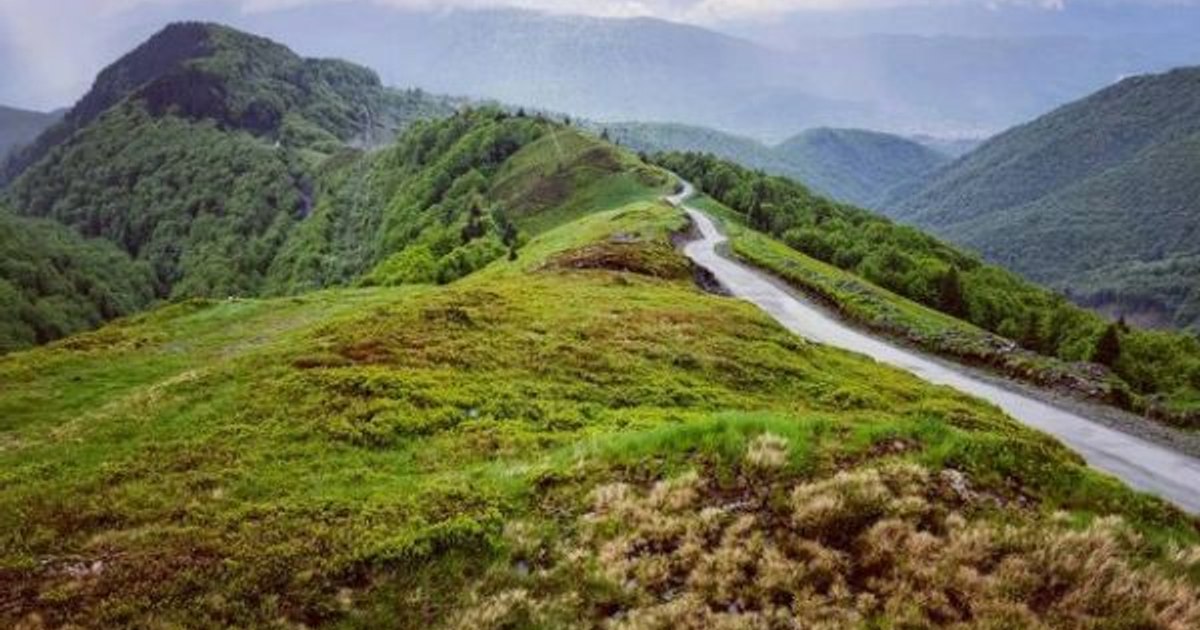
The Jiului Valley in Hunedoara impresses with its relief and numerous natural monuments, but tourists who come to explore it by car may be surprised that the roads they start on end up in the middle of the wilderness, although only a few kilometers separate them from the towns of Gorj.
The road through Pasul Vâlcan. Photo: Daniel Guță
The six cities of Valea Jiului, Hunedoara, together have more than 100,000 inhabitants, one third less than in the early 90s, when the urban region in the south of Hunedoara county represented the largest mining center in Romania.
Mines and mining plants where almost 40,000 people worked three decades ago were closed one by one, and the cities of the Jiu Valley gradually depopulated. Currently, less than 2,000 local people work in mining. But those who remained were overwhelmed over time with promises from the authorities and politicians about the development of the area through tourism.
The residents of the towns in the Jiului Valley have reason to be proud: the mining region crossed by the waters of the East Jiului – springing from the Parâng Massif – and of the West Jiului, which descends from the Retezatul Mic, with numerous mountain streams, their tributaries, is offering relief .
From the mining towns, travelers can easily climb the Vâlcan, Parâng, Retezat and Șureanu mountains, they can venture into the wilderness of the Butăi, Crivadia and Jietău gorges, or they can venture into the Jiului Gorge, and on the mountain roads of the Momârlani ( the inhabitants of the old villages in the Jiului Valley) that pass through the Vâlcan Pass, the Merișor Pass – Babii Hill and the Jiu – Cerna Pass on the West Jiului Valley.
Modernized roads, up to the border of Hunedoara county
Although they have been modernized in recent years, several roads in the Jiului Valley, intended to bring the mining towns out of isolation, stop in the wilderness, at the border of Hunedoara and Gorj counties.
Sometimes tourists orient themselves by GPS applications and thus reach their end, but they cannot continue their journey to the towns of Gorj county.
The Jiului Gorge in Hunedoara remained the main link between the two neighboring counties and, at the same time, the spectacular route of over 30 kilometers through the mountains, crossed by a modern road and railway, which connects the historical regions of Transylvania and Oltenia.
Two other secondary roads to Gorj remained asphalted only until the exit from Hunedoara county, and another road recently entered the construction site, will also stop in the middle of the forest.
The road to Cheile Sohofolului, partially modernized
The modernization works of County Road 672 C, from the Valea de Pesti dam to the border of Hunedoara county with Gorj county, began in the summer of 2024.
The investment carried out by the Hunedoara County Council amounts to 48 million lei, funds attracted through the “Anghel Saligny” National Investment Program, and aims to modernize five kilometers of road, currently paved, starting from the Valea de Peşti dam in Hunedoara, towards Cheile Sohodolului from Gorj county.
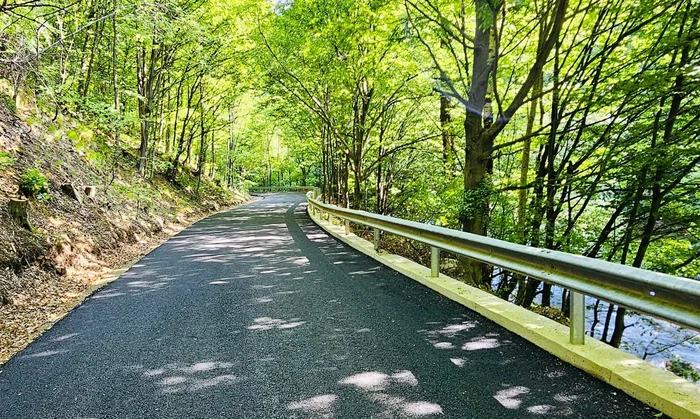
The road through Cheile Sohodolului, modernized on a sector of 5.5 km in Gorj. Photo: CJ Gorj
The county road starts at 672 C has a total length of 37 kilometers, of which 31 kilometers are in Gorj county.
In Gorj, the road is paved starting in the Runcu commune, and from its edge to the Sohodolului Gorge, and recently a sector of over five kilometers of the road entered the construction site, to be modernized.
From Cheile Sohodolului to Valea de Pești in Hunedoara, the route continues on a dirt and stone road, which climbs smoothly, crossing a dense deciduous and mossy forest. The forest road that crosses the Cheile Sohodolului reserve reaches an altitude of almost 1,000 meters, before descending into Hunedoara county, at the Valea de Pești dam.
“The nature reserve, spread over an area of 350 hectares, was declared a protected area by Law No. 5 of March 6, 2000. It represents an area of quays excavated in Cretaceous limestone by the waters of the Sohodol stream, with diversified forms of relief (sinkholes, canyons, , avenues, caves, rocky cliffs), with flora and fauna specific to the Southerninforms the Town Hall of Runcu commune.
With the modernization of the two sectors of the county road, from the Hunedoara and Gorj ends of it, more than 20 kilometers of forest road will remain in Gorj county, which tourists will have to travel if they want to explore the land.
DN 66A gets stuck at the foot of Retezatul Mic
Modernized in the 2000s, the National Road 66A that crosses the West Jiului Valley, with the towns of Aninoasa, Vulcan, Lupeni and Uricani, was paved then on a sector of about 20 kilometers between Uricani and Câmpusel – an old forestry canton at the foot of the Retezat Small.
From Campušel (video), the place at the springs of the West Jiu, located on the border of Hunedoara and Gorj counties, the road is no longer practicable. The road is continued by a forest road that goes up through the Jiul Cerna pass, thus entering the Domogled Valea Cernei National Park.
“Between kilometer 50 and kilometer 59, the road is currently impassable”show the representatives of Domogled Valea Cernei National Park.
In 2019, the National Road Infrastructure Administration Company (CNAIR) put out a public tender for the design and construction of the connecting road DN 66A km 47+600 – 66+204 Câmpu lui Neag – Cerna, which would have added another 20 kilometers to the road modern route between Valea Jiului and Baile Herculane.
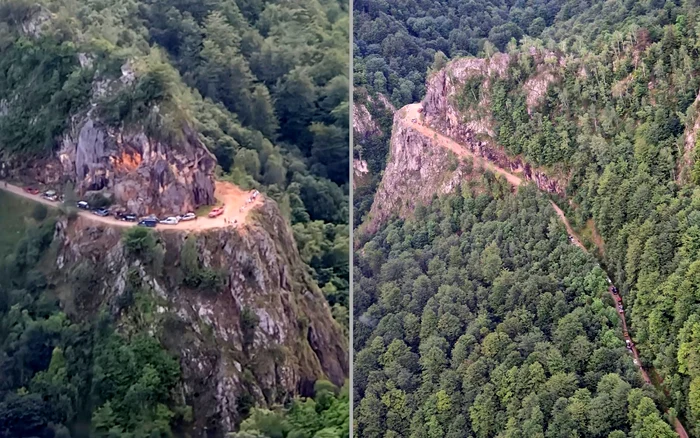
Tourists stuck on DN 66 A. PHOTO: ISU Hunedoara
The construction of the 20 kilometers of mountain road amounted to more than 240 million lei, but the auction was canceled because no builder submitted bids until the deadline for submission of applications to participate in the auction.
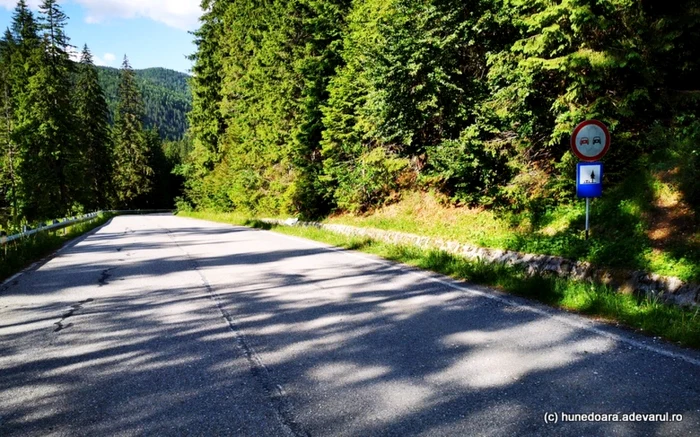
At the end of Hunedoara county, on DN 66A. Photo: Daniel Guță
Since 2019, the project has not been put up for public auction. The construction of the 20 kilometers of road, blocked in the 2000s, after the protests of some environmental organizations, would have linked Valea Jiului, on a new high school, to the counties of Gorj and Caraș-Severin.
The road through Pasul Vâlcan stops at the top of the mountain
In the last decade, eight kilometers of County Road 664, which connects Hunedoara and Gorj counties through the Vâlcan Pass (1621 meters), were modernized, but its asphalting stopped on the mountain, on the border of the two counties, in a place where the monuments dedicated to the heroes of the First World War.
From here, the road called “Transvâlcan” (video) continues on another 15 kilometers of dirt and stone road to the town of Schela in Gorje. Despite the promises, the Gorj authorities did not continue the project to modernize the named road
The Transvâlcan road has several historical landmarks. A portion of it was a Dacian road, which the Romans crossed when they invaded these territories.
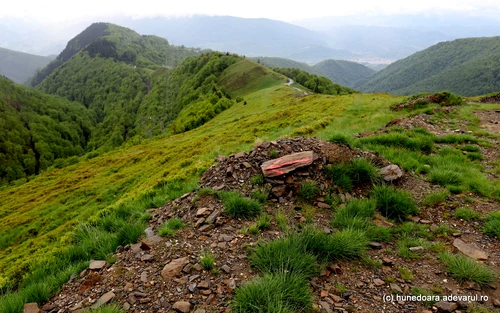
Image 1/11:
the volcano step photo daniel guta (1) JPG
Also, in 1600, Michael the Brave passed through here on his way to Vienna. A legend shows that instead of Poiana lui Mihai, his horse died because of the effort, so Mihai the Brave continued his adventure on foot, through the Vulcan Pass.
An equestrian statue of the mountain voivode, located in the tourist area of the Vulcan Pass, recalls the legend of Michael the Brave. Another legend, promoted by the local authorities in Valea Jiului, says that in Pasul Vulcan there would have been the Carpathian Castle, the mysterious place described by the famous writer Jules Verne.
During the years of the First World War, fierce battles took place in Pasul Vulcan, resulting in hundreds of casualties. On the side of the road you can still see the trenches dug during the war years.
The road climbs steeply from the town of Vulcan, crossing the recreation zone Pasul Vâlcan, where tourists can also reach by gondola.
