
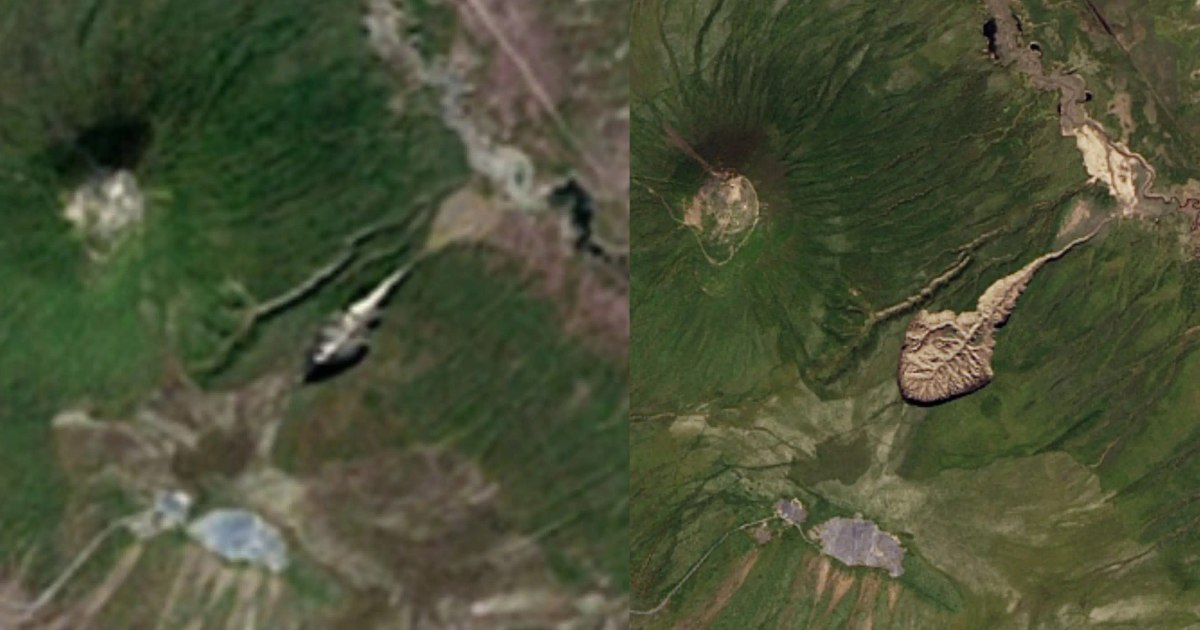
Scientists claim that the “gateway to hell” or Batagai mega-landslide in Siberia is “actively growing” every year. This gigantic formation in tripled its size between 1991 and 2018.
The giant hole in Siberia is expanding rapidly every year PHOTO: sciencealert
According to Science Alert, a giant hole in the ground “break the land of Siberia”, and photos from space show it growing rapidly. It is shaped like a stingray, a horseshoe crab, or a giant tadpole. It started as a sliver, barely visible in declassified satellite images from the 1960s. Now it’s a precipice of sheer cliffs, clearly visible from space.
The hole tripled in size between 1991 and 2018, according to the US Geological Survey.
What is this hole in Siberia?
The Arctic is warming faster than the rest of the Earth, and this is leading to the rapid thawing of permafrost, which is a thick layer of permanently frozen soil—at least, it used to be.
According to experts, the Batagay Crater is not actually a crater. It is the biggest “retrograde thaw collapse” of the world, meaning a sinkhole that forms when thawing permafrost causes the ground to give way, creating a landslide as the soil at the edges collapses into the sinkhole.
There are thousands of meltdowns in the Arctic. But the size “cthe loser” Batagay earned him the title of megaslump. It is named after the nearby town of Batagay.
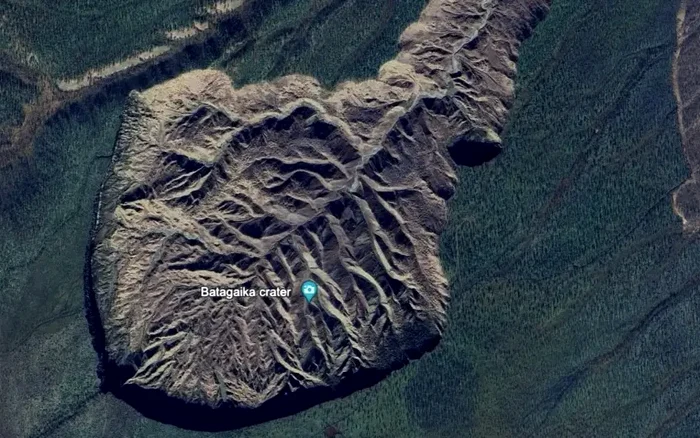
The crater in Siberia is expanding rapidly every year PHOTO: sciencealert
“We’re mostly talking about frozen ground underground, which by definition you often can’t see unless it’s been exposed somehow, like in this megaslump,” says Roger Michaelides, a geophysicist at Washington University in St. Louis.
As the permafrost thaws, all the dead plants and animals that have been frozen in it for centuries begin to decompose, releasing carbon dioxide and methane into the atmosphere. These are powerful heat-trapping gases that cause global temperatures to rise further, triggering even faster thawing of permafrost.
Experts say this vicious circle could have disastrous effects. Permafrost covers 15% of the land in the Northern Hemisphere. In total, it contains twice as much carbon as the atmosphere.
One study has estimated that thawing permafrost could emit as many planet-warming gases as a large industrialized nation by 2100, if industries and countries don’t aggressively control their own emissions now.
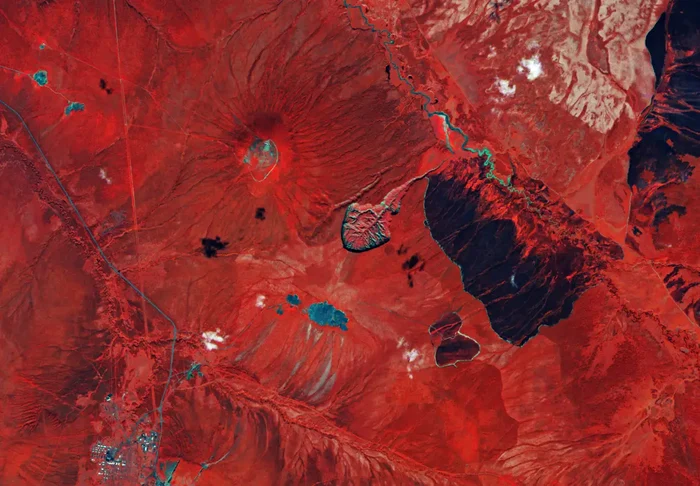
The giant hole in Siberia is expanding PHOTO: sciencealert
“There’s a lot we don’t know about this feedback loop and how it will necessarily play out, but there is the potential for very large changes in the climate system that will occur on very, very fast geologic time scales.”said Michaelides.
In short, thawing permafrost could rapidly exacerbate the climate crisis. But it is still a mysterious process. Studying extreme sites like the Batagay megaslump can help scientists understand permafrost thaw and look into the future.
In a study published in the journal Geomorphology in June, researchers used satellite and drone data to build 3D models of the megaslump and calculate its expansion over time.
They found that about 14 Giza Pyramids worth of ice and permafrost had thawed at Batagay. The volume of the crater increases by about one million cubic meters every year.
“These values are truly impressive”Alexander Kizyakov, lead author of the study and a scientist at Lomonosov State University in Moscow, told BI in an email.
“Our results demonstrate how quickly permafrost degradation is occurring,” he added.
The researchers also calculated that the megaslump releases about 4,000 to 5,000 tons of carbon each year. This amount is roughly as large as the annual emissions generated by the energy use of 1,700-2,100 US homes.
Michaelides said the numbers didn’t surprise him, but they may help inform models of future permafrost thaw and emissions.
“I think we have a lot to learn from Batagaika, not only in terms of understanding how Batagaika will evolve over time, but also how similar features might develop and evolve in the Arctic.”Michaelides said.
