
Due to the high number of nosocomial infections, at the Giulești maternity hospital in the capital, admissions are no longer made. It is the announcement of the medical director of the unit, Dr. Traian Maier, who stated that the situation will return to normal after the ATI ward is disinfected. The Adevărul reporters found out how this procedure is performed, step by step, in one of the largest infectious diseases hospitals in the country, the one in Iasi.
The ATI department of the Hospital for Infectious Diseases in Iasi has only 9 beds. Source: Florin Roșu
Nosocomial infections kill almost 2,000 patients annually, the Minister of Health, Alexandru Rafila, said in 2022. But the number of those who died could be even higher, because there is no national registry to record such situations. And hospital managers don’t report every time either. “Nosocomial infections are a problem of health systems all over the world, not only in our countryDr. Florin Roșu, the manager of the “Sfânta Parascheva” Hospital for Infectious Diseases in Iași, said for Adevărul. The doctor explained to us the reasons for the appearance of these infections, but also what preventive measures can be taken at the level of medical units.
Hospital manager: “New hospitals should be built”
“At the moment, the term nosocomial infection is no longer used. It is called a medical act associated infection. Taking into account the infrastructure of hospitals in Romania, taking into account the fact that in the last decades no new hospitals have been built, indeed, there is the probability that these infections associated with the medical act will still occur”, is the opinion of the manager of the hospital in Iași.
“To lower the rate of healthcare-associated infections, new hospitals should be built first,” consider the doctor. “To respect the intervention and hygiene rules, they are respected as far as I know. We are trained in this sense. We know exactly what we have to do. But despite these protective measures that we take – gown, boots, cap and disposable mask, sterile gloves plus disinfection of spaces, surfaces and air in the rooms – patients can get infected with various bacteria”, says the doctor.
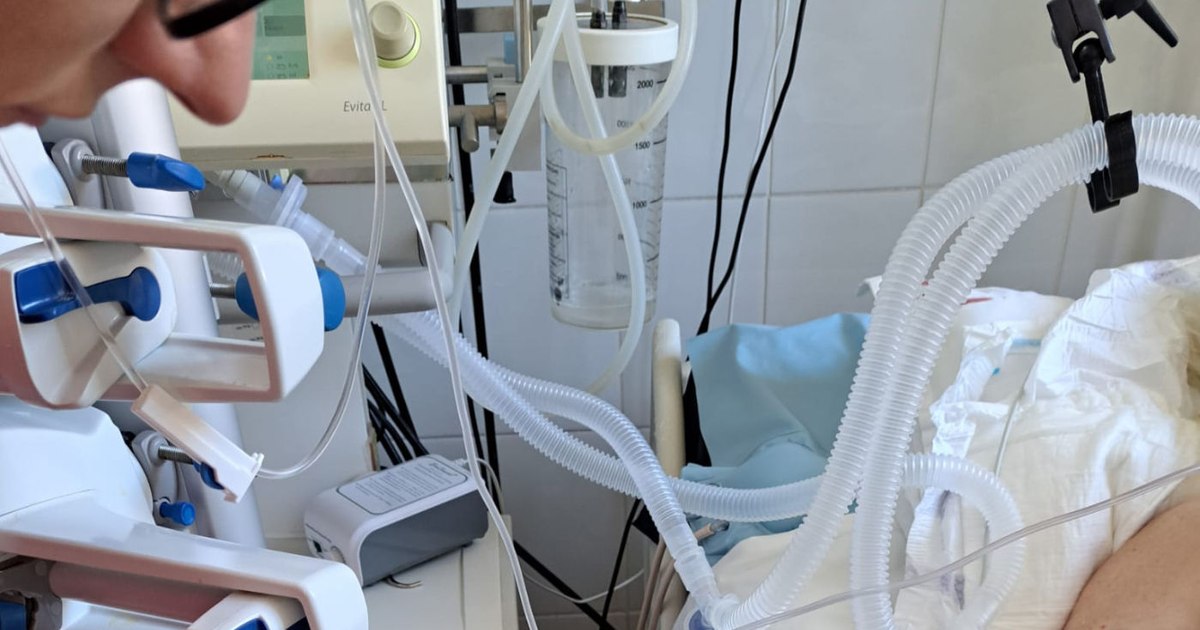
Due to the associated pathology, due to comorbidities and multiple organ dysfunction, patients’ immunity suffers a lot, continues the specialist. And the medical devices they are connected to are the gateway to bacteria that their weakened bodies cannot fight. “In the ATI department, in order to be properly monitored and treated, the patient is fitted with various medical devices, from the simple urinary catheter to a central venous catheter or a dialysis catheter. Then, many patients have respiratory dysfunction and are connected to mechanical ventilation devices. All these devices do nothing but lead to an increase in the risk of infection associated with the medical act”, explains the doctor, one of the reasons why patients get infected with hospital bacteria.
How to disinfect, step by step, the ATI ward of an infectious disease hospital
The manager of the Iași Infectious Diseases Hospital explained to us in detail how to sanitize the space in the ATI ward of the hospital he leads and how to disinfect the patients’ supplies. “In the intensive care unit, disinfection is done as often as needed. There is a procedure from which we do not deviate. Thus, when we identify a germ, the patients are moved to other rooms and the room is disinfected”.
Dr. Florin Roșu told us that the hospital has a register where information is entered regarding the date when the sanitization must start in the reserves and the ATI salon, what this procedure entails and who performs it: “First of all, they are washed with special disinfectant solutions, specific for sanitary units, the surfaces, the medical equipment is washed, everything that is in that space, including the windowsill and the windows. That’s what the nurses do, they know exactly what to do. After all surfaces are washed, we have a machine that sprays other disinfectants and solutions into the air. Everything in the environment of the respective reserve is disinfected. The air in the room and again the surfaces because the sprayed solution finally settles on the objects in the room”.
After this second stage, the reserve is hermetically closed, sealed for 24-28 hours. “There is a poster on the door saying that the reserve is being sterilized and no one is going in there. The information is also entered in the register”, the doctor presents the protocol.
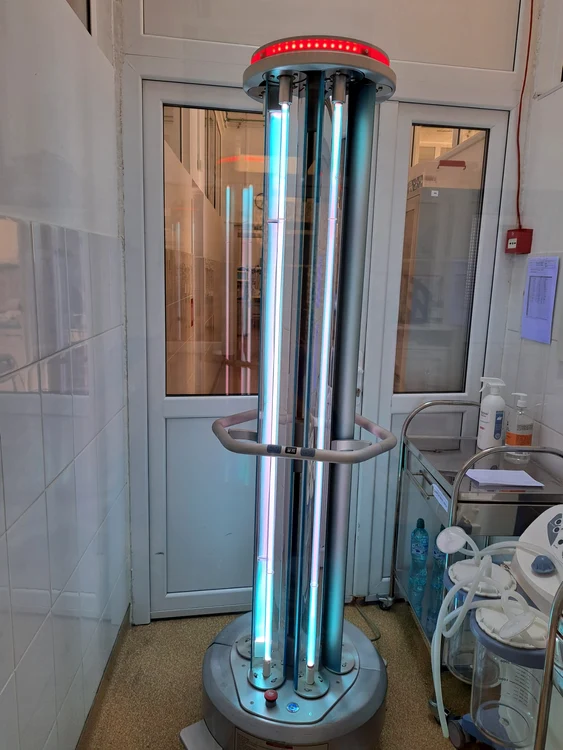
The robot disinfects a room in 15 minutes. Photo source: Florin Roșu
The reserve is opened after one or even two days, and the nurses continue the sanitization process: “This time, wash everything with water only. The sprayed solution and the deposited residues are basically removed. The windows are opened wide, it is very well ventilated, and then, the last step, is the sterilization of the room with ultraviolet rays. We have a robot that emits ultraviolet light. We leave it in the room for 15-20 minutes”.
At the Infectious Diseases Hospital in Iași, a single robot serves the entire ATI department. “We move him from one reserve to another, bring him to the salon, take him back to the reserves,” the manager also said.
Within the medical unit, there is an intensive care unit that has two reserves with two beds each and a larger salon with 5 more beds. “For almost two years I have been trying to turn the ATI compartment into a ward. In this way, we would have 15 beds, instead of 9. We definitely need to expand, because we serve the entire area of Moldova. We have staff, we have specialized doctors, but we don’t have a ward as we would like”, director Florin Roșu told us.
Nosocomial infections stop hospitalizations at the Giulești Maternity Hospital
The Giulești Maternity Hospital in the Capital announced that between April and September of this year, it recorded a significant increase in the number of nosocomial infections among children born prematurely. The medical director of the institution, Dr. Traian Maier, stated that the admission of pregnant women to the hospital was suspended until the disinfection procedure of the ATI section was completed. “Currently, we are treating patients there for conditions that are in the context of prematurity, but we currently do not have the capacity to receive new cases. When there are situations of patients presenting with a threat of premature birth or things like that, they are redirected to other maternity hospitals”states the medical director of the Giulești maternity hospital.
