
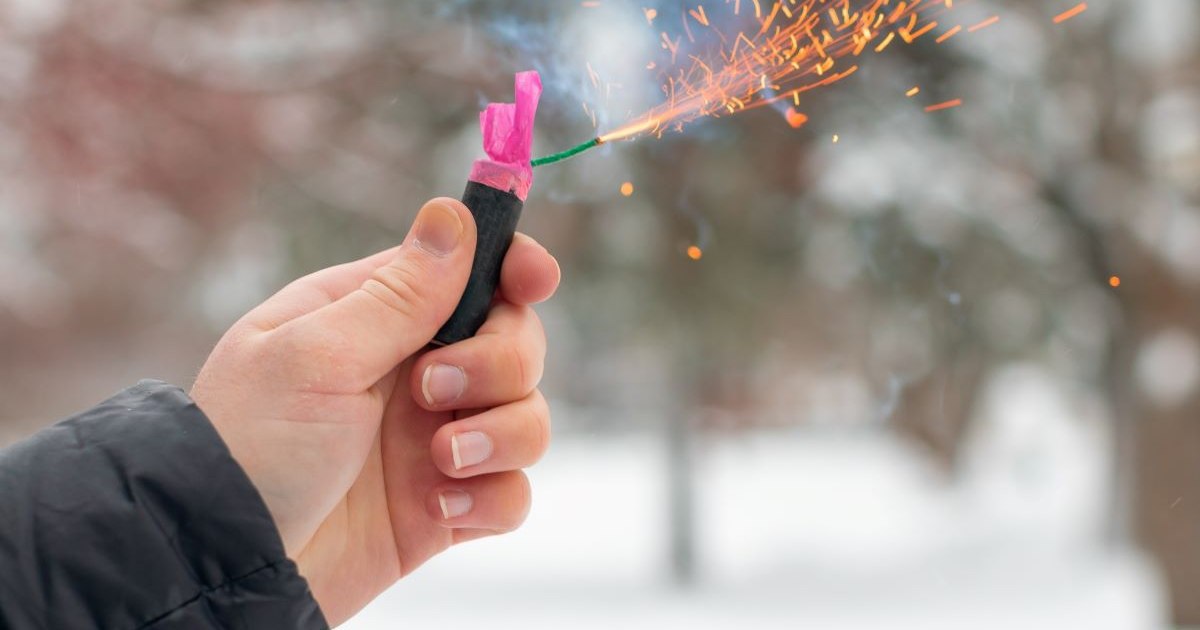
A 17-year-old young man, a 12th-grade student at the “Mihail Kogălniceanu” High School in Vaslui, arrived at the hospital injured by a firecracker that exploded in his hand. We encounter a similar situation in Slatina, Olt county, where three other children arrived at the Emergency Department. “Better not use them! They can take you directly to the operating room and even then you can remain mutilated”, warns doctor Tudor Ciuhodaru.
The explosion of a firecracker can maim you for life. Archive
With the cold season and especially during the winter holidays, more and more patients are presenting themselves to the emergency rooms and emergency departments of hospitals injured in explosions of pyrotechnic materials. There are also many children among the patients. This is why doctors are sounding the alarm. “Until the parliamentarians vote on the Ciuhodaru law, which provides for the teaching of health education and first aid concepts in all schools in Romania, it is good to know that pyrotechnic devices can take you directly to the operating room and even then you can be mutilated. The risks increase when they are used in closed and crowded spaces, by children or by those who have consumed a lot of alcohol. stated the doctor Tudor Ciuhodaru.
He specified that the pathology produced by firecrackers ranges from burns to wounds, open fractures, traumatic amputations or eye injuries. “The most frequent and serious injuries are III-IV degree burns on the hands and face, but also eye injuries, which have not been absent in any year from the traumatic balance.”
The doctor advises those who will not take into account his recommendations at least not to ignore the instructions for the use of these products and the legal norms. “At the same time, we recommend that you go to the hospital urgently and do not delay the resolution of the injuries that, without treatment, constantly lead to the appearance of complications”, the doctor from Iesa also specified.
First aid measures in case of an accident caused by the explosion of a firecracker
But the specialists’ recommendations do not stop there. Doctors also come up with some advice for those who witness an accident caused by firecrackers and crackers. Dan Grigorescu, head of the Department of Plastic and Reconstructive Surgery at the Braşov County Hospital, said that, unfortunately, there are few ways in which the people around the patient can intervene to help him: “Chowever, it is very important in first aid in case of eye trauma that the patient tries not to further traumatize the eyeball. I mean, don’t rub your eyes! A foreign body inside the eye can move and scratch the eye even more. Only if the people around have a mild anesthetic, they can apply it locally to relieve the pain. Immediately, however, it is essential that the patient reaches a doctor as quickly as possible, preferably a specialist”.
What the law said
Such accidents occur every year around the winter holidays, even if the use of pyrotechnic products of this kind is prohibited in public spaces. From a legal point of view, making, possessing, trading, importing, using or any other operation with such products, as well as Class I fireworks and firecrackers, carried out without the right, constitutes a crime and is punishable by imprisonment from 3 months at one year. In the case of contraventions, the fines rise up to 7,500 lei, and for minors under 14, the parents will be responsible, and they will be fined between 100-500 lei.
Persons who meet the minimum age requirement can use pyrotechnic entertainment items, according to Law no. 126/1995, only by taking measures to protect people, material goods, animals and the environment, but not in the following situations:
- between 24:00 and 6:00, with the exception of authorized periods, as well as events of local, national or international interest, based on the approval of local authorities;
- less than 50 m from residential buildings with up to four levels and less than 100 m from those with more than four levels;
- at a distance of less than 500 m from high-voltage electrical installations, from places of storage and delivery of liquid or solid fuels, from gas installations;
- at a smaller distance than that provided by the regulations in force for chemical and petrochemical targets or for other targets that present a risk of fire or explosion;
- in places where there is a risk of landslides, avalanches or rock falls;
- on public roads open to road traffic, on pedestrian alleys and in open spaces with agglomerations of people;
- at a distance of less than 500 m from the forests.
