
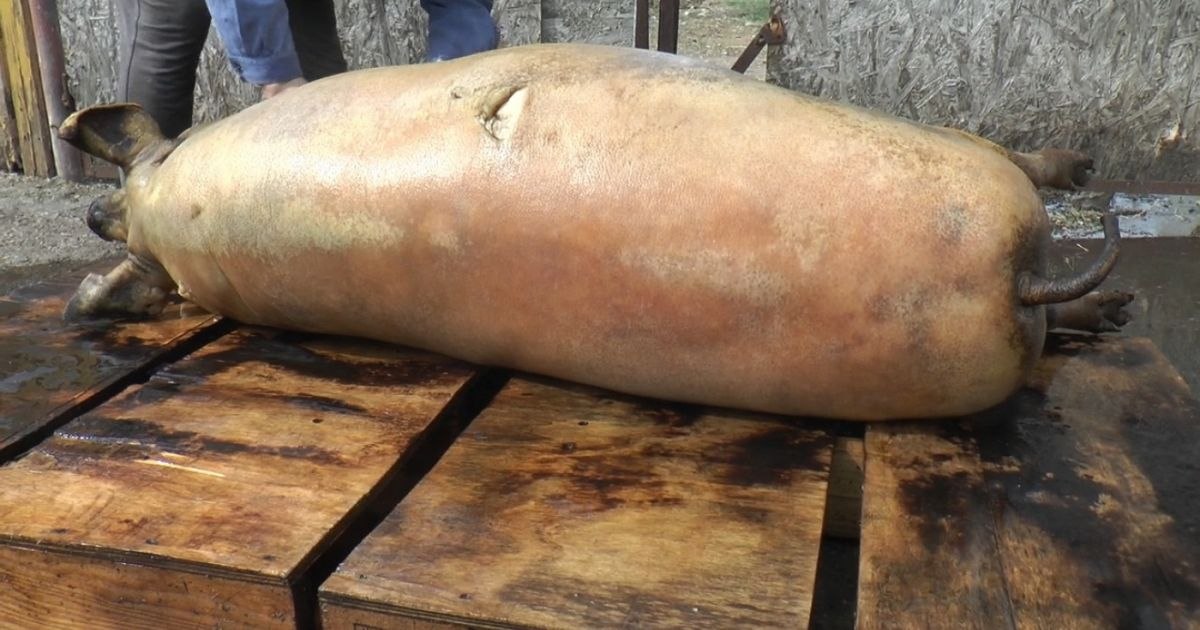
Veterinarians draw attention to the enormous danger to which we expose ourselves if we abandon the trichinelloscopic examination in the case of pigs slaughtered in the household. Animals infested with trichinella spiralis do not show any signs of illness, but in humans the danger is including death.
The meat of the slaughtered pig must be tested PHOTO: archive/Adevărul
The sacrifice of the Christmas pig is still a ritual that Romanians keep. Fortunately, most people also understood the danger of eating meat from sick pigs, so the trichinelloscopic examination to detect trichinella spiralis is widely performed. The cost of this service varies depending on the veterinarian’s office, the price being between 30 and even 80 lei/sample. Although it may seem like a lot, the risk we take if we don’t do it is enormous, says veterinarian Ion Bozgă, president of the College of Veterinarians Olt, for “Adevărul”.
“The examination is very important, because the trichinella spiralis parasite, which lives in the pig’s body, if it reaches humans through meat consumption – a single larva penetrated the human body – triggers the disease. The face swells, vomiting begins, feeling sick. The pig, however, lives with 4 million larvae in it and shows no sign of disease. This issue misleads the owner. The pig is eating, he has nothing, he is healthy”. explained the doctor.
It is the rats that transmit the disease to the pigs. “Especially in the countryside, at households, people give food and don’t stay to guard the pig when they eat. The rat goes and the pig eats it. If the rat is sick with trichinosis, it makes the pig sick. It is only transmitted by eating meat with trichin. (…) The host usually does not cook the meat very well and eats it, especially in steaks, rather in blood. Immediately the larvae reach the stomach, they develop and, depending on the number of larvae that the person consumes, found in that piece of meat, the more there are, the more the disease state can be highlighted in a few hours”. says the doctor.
How great is the danger
In case of infestation, vomiting appears the next day at the latest, and the affected person must go to the hospital for treatment. “One of the great dangers these larvae present is that they settle into smooth muscle, including heart muscle, and perforate. These larvae, to protect themselves, secrete a calcium substance and cover themselves around and perforate the muscle. And that’s how they make a hole in the heart muscle and we can have a heart attack”continues veterinarian Ion Bozgă.
The disease exists and cases are detected every year, draws the doctor’s attention. The last case was a pig bought by a family that has been working in Germany for about 25 years.
“They brought me two samples, they were not good, I went and collected from them and it came back positive. They were leaving for Germany the next day, and I buried him immediately. I realized what education means, they have been gone for 25 years. And they said – we don’t eat before”, a added the doctor.
The specialist insists on the fact that the infested animal does not show any symptoms of disease, and the person who slaughters it cannot have control even if the animal is raised in his own household.
The parasite in the meat dies if it is prepared at a high temperature, for a sufficient time, or if the same meat is frozen at minus 30 degrees Celsius (a condition almost impossible to meet at home), the destruction of the meat being categorically imposed if the trichinelloscopic examination results positive.
What meat we choose for examination
Veterinarians today have high-performance equipment in their offices, says doctor Ion Bozgă, so that if the second condition – the collection of the sample from the area where, in case of infestation, there are definitely larvae – is met, the detection of the disease is done in just a few minutes .
“The examination is done from a piece of 50-100 grams of meat from the diaphragmatic pillar, or, if not, from the intercostal muscles. But it’s best from the diaphragmatic pillar, because if the parasite isn’t there, it’s nowhere. After which the meat can be eaten without any emotion. It’s the exam that we do with the greatest attention and with the greatest fear, even though we have very sophisticated devices, each office has the same devices as those at the veterinary-sanitary laboratory in Slatina. However, it is good for citizens to know how to go to these offices, not to consume unexamined meat”, insisted the doctor.
The examination, although it seems trivial, is not always a simple procedure, and this is because animal owners, not knowing where the sample should be collected, bring pieces of meat from various places. If the pig does not have a massive infestation, says the doctor, there is a risk that it will not be caught.
“In the situation when we have doubts, the sample is sent to the laboratory and another type of examination is done, it takes two hours, it is much more complicated, and it determines whether or not it is trichinosis. That is, it is an exam that has its own risk and emotions for veterinary services. That’s why my colleagues know, I called them, they were trained, they saw samples with trichin at the county laboratory to refresh the picture”, said Dr. Bozga.
The specialists of the National Institute of Public Health explain, in an article posted on the INSP website, what are the symptoms of the disease in humans, stating at the same time that the immunity, in case of passing through the disease, is short-lived, reinfections being possible.
In the first phase, the disease causes nausea, vomiting, diarrhea accompanied or not by fever, abdominal pain, lack of appetite, fatigue. When the invasion of the newly formed larvae occurs in the circulatory system, muscle pain, edema in the eye and face area, itching, neuropsychiatric, respiratory and cardiac disorders, etc. appear.
