
A kindergarten in Botoşani County has been a true benchmark of a German pedagogical system, called the Jena Plan, for over 25 years. Children are taught to become independent, to use their talents creatively and usefully, to get involved in the community and to become useful members of society.
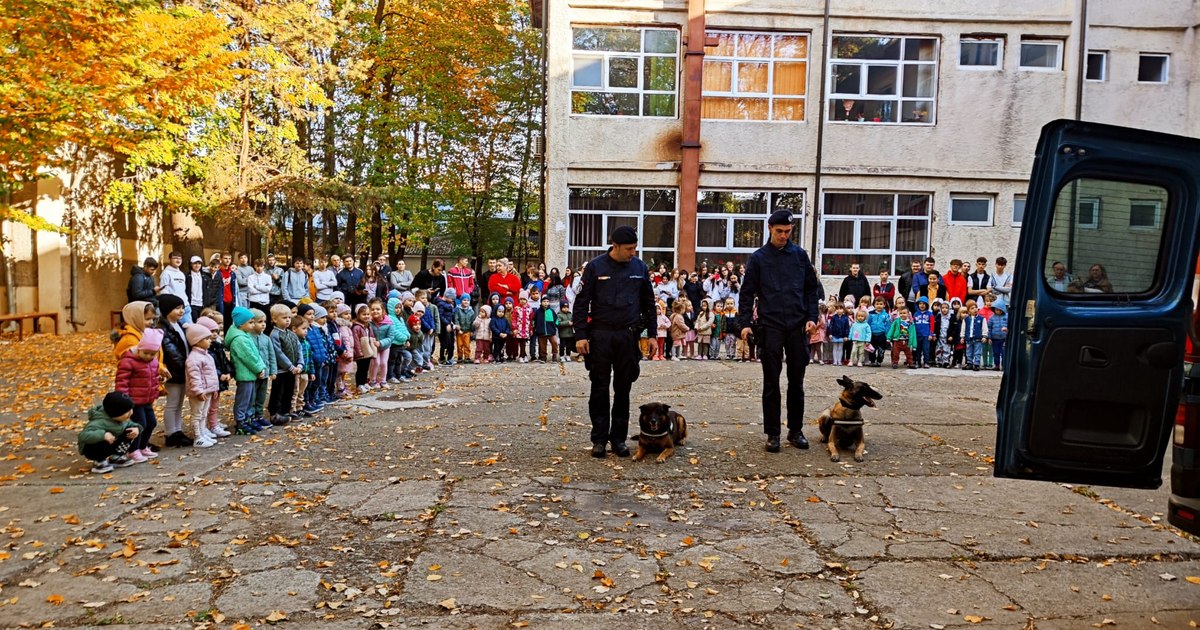
The activity with the Gendarmes at Grădinita Șotron PHOTO Grădinița Șotron
At the beginning of the 20th century, in Europe in particular, an educational reform took place. Practically, the ties with the older educational systems, still haunted by rigidity and formalism, were being broken, and a way was sought to focus the interest of the teaching approach on the student and his real needs: they wanted to find a way to form useful citizens society, able to contribute to its progress. This is how pedagogical concepts such as Montessori, the Dalton Plan and Waldorf emerged. Along with these, one of the most successful educational projects of the new wave was the Jena Plan.
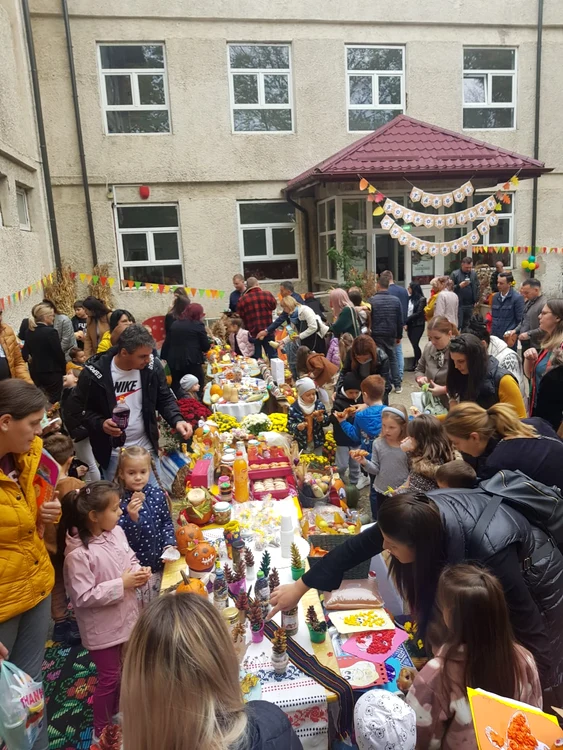
The Sotronei fair
Actually, it is a German educational system, which appeared in 1920 and was designed by the German teacher and pedagogue Peter Petersen. This project was applied for the first time in 1924 at the University of Jena, from where it got its name. All these systems have gained and are still gaining popularity worldwide, being considered viable alternatives to classical education. Among all the educational units that apply the Jena Plan with great success worldwide, there is also a kindergarten from the municipality of Botoșani, in the extreme north of Romania. It is about the “Sotron” state kindergarten. There, the Jena Plan has been applied for 25 years, being a pilot kindergarten for this educational system, the only one in Moldova that applies it. “We have over 25 years of experience. Our kindergarten already has a tradition because we were co-opted in the Jena Plan since 1995. The reason why this educational alternative was chosen is because it clearly supports the family and the community”specifies for “Weekend Adevărul” Adriana Avădăni, a teacher with experience in pre-school education, but also director of the “țtron” kindergarten.
Children educated according to the family model in a modern kindergarten
“Sotron” is a state educational unit, with an extended program, and it is an oasis of greenery and color, hidden between residential blocks. It is housed in a spacious building with modern group rooms, dining areas, places intended for different activities, a doctor’s office, but also a performance hall for the little ones. In the yard of the kindergarten, a special garden is set up, but also a very welcoming play space. The kindergarten was completely modernized and rehabilitated last year, through a project of Botoșani City Hall, through the Regional Operational Program, worth 4 million lei.
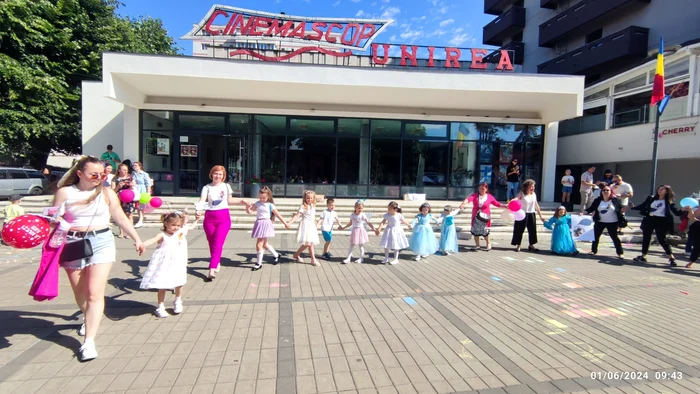
Outdoor activity PHOTO Kindergarten Șotron
For the few groups of preschoolers, this space becomes a real incubator to transform them from small children into model citizens. As the principles of the Jena Plan say, children are grouped according to the family model and learn that they have rights, freedoms, but also obligations. Children are not grouped by age, as in the classic system, with the small, medium or large group, but heterogeneous. That is, in the same group there are children of different ages, from the 3-year-olds, who have just arrived at kindergarten, to the 6-year-olds, who are preparing for the preparatory class. The idea is simple, as in a family, the little ones learn from the big ones, and feel protected, the big ones are responsible for taking care of others and supporting them – just like in a family with several children. “I live according to the family model. The big ones support the little ones, and the little ones copy the desired behaviors of the big ones and adapt very easily to group life”says Adriana Avădani.
Self-evaluation, basic principle
Children are taught respect, independence and initiative. They are actually the principles by which the entire educational system at “Sotron” is guided. Through the activities they do, the little ones develop their creativity and at the same time discover their skills, and once discovered, they are encouraged and developed by the educators. Children are taught to express themselves freely, imaginatively, through play or various activities, but at the same time they learn that individual freedom should not harm that of others. In these micro-communities, of different ages, children also learn self-respect, but also respect for others, how to manage by themselves, with everyday tasks, including dressing, putting on shoes or changing after a midday nap. In short, they learn to integrate into society from an early age. “They learn respect for others, they learn how to take initiative and how to show their skills in the community”adds teacher Avădăni.
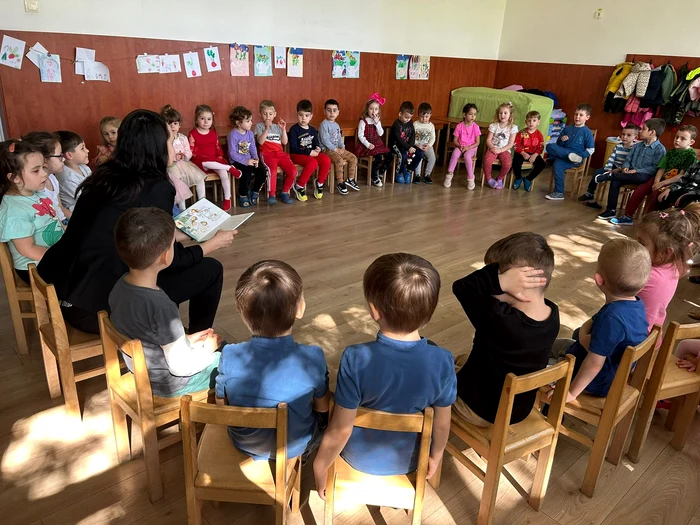
Reading time PHOTO Kindergarten Șotron
Jena Plan children, as educators say, are independent, creative, adaptable, respectful and protective of other community members. Preschoolers are also taught how to self-assess. Through play and activities, children see for themselves what they have learned and what lessons they need to remember after each week. “We recap everything we’ve learned. And it is very important that they learn to self-evaluate, to see what they have learned, what they have retained. In addition, we also figure out what methods we can approach later”says Lavinia Parasca, teacher for preschool education.
“The Jena plan means adapting the child to society”
One of the aims of the Jena Plan educational system is to create core members of the community, involved and active, useful citizens. And the “Sotron” kindergarten successfully applies these principles as well. Throughout the school year, children are engaged in community activities. For example, they are involved in extensive greening actions. In autumn, groups of children went to collect the waste thrown randomly through the “Mihai Eminescu” Park, one of the most beautiful and oldest in Romania, the favorite of the poet who bears his name. Later, preschoolers are involved in waste sorting actions, being taught, for example, to recycle batteries separately.
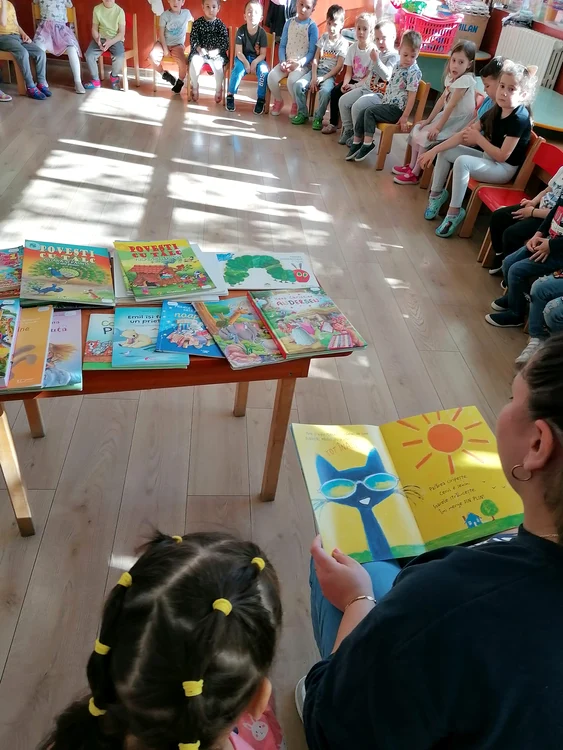
Reading time PHOTO Kindergarten Șotron
Last but not least, the little ones are taught to donate. For example, at “Sotron” there is a week of donated fruits and vegetables, and the children, with the help of their parents, collect healthy food for those in need. The Entrepreneurs’ Fair is organized annually, where preschoolers make different objects or collect goodies with the help of their parents, which they then sell in an open exhibition. They learn the basics of entrepreneurship, but they also do a good deed by practicing generosity, because the fair is accompanied by a campaign called “Toys for other children”.
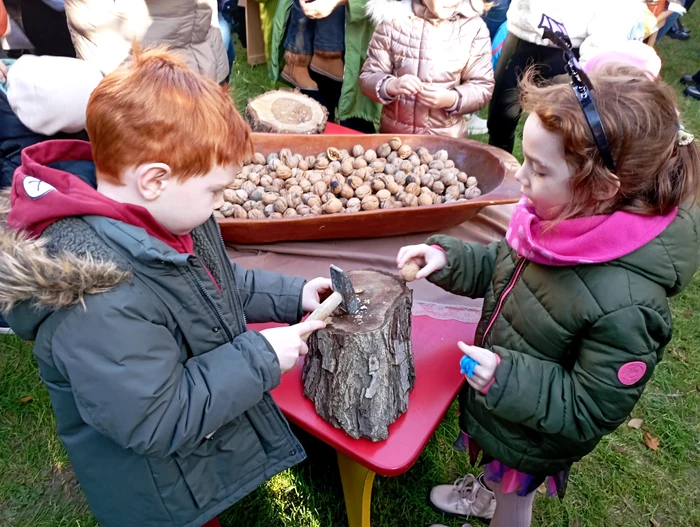
Activities in the yard PHOTO Cosmin Zamfirache
Also within the community activities, children learn about different jobs, about the functioning of different institutions or services, how to give first aid and how to cross the street safely. For example, the little ones from “Sotron” participated in the project “I want to be a rescuer”, in collaboration with the County Ambulance Service, where they learned about this job, what ambulances do and how to give first aid. Then there was the “Little Pedestrian” project, carried out with the support of the Traffic Police, but also the visit of the Gendarmerie. “The Jena plan means adapting the young child to society through partnerships with the community, but also through orientation in the environment. Children learn about jobs, what certain structures or institutions do in society, but also how we should proceed in certain situations. It is a good preparation for life”, says the kindergarten director. The children also take long walks with the teachers, but also small excursions. “For different activities, we took the children to farms, for example. To see through direct experience how animals behave and what their way of life is”explains Avădăni.
More time for family
Another educational goal of the Botošan kindergarten is to bring the family together. This is achieved through activities in which children, parents and other family members are asked to participate. For example, the Autumn Festival is organized, where parents and children are put to work together on the creation of autumn-specific decorations. “The children’s enthusiasm to have them by their side filled our hearts with joy, because the time spent with their parents is the most wonderful”say the representatives of the kindergarten. Parents are involved in many projects of the kindergarten, including “Donate a book”, which aims to create the largest possible library of the educational unit. “Parents are an essential part and we try to bring them together with the little ones to spend time together which is priceless”adds the kindergarten director.
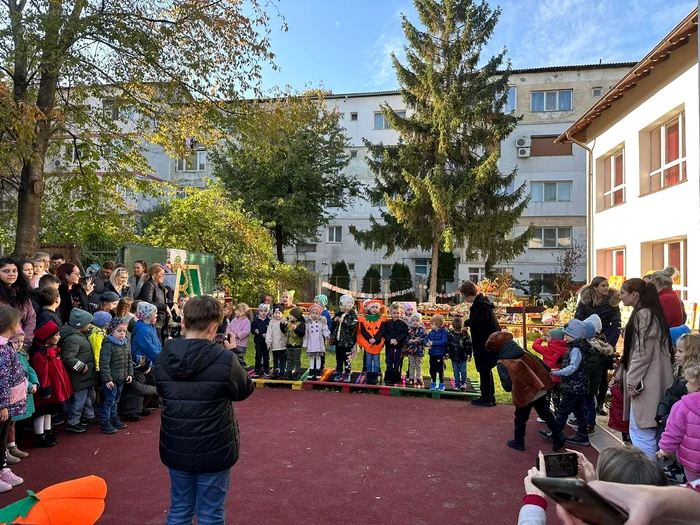
In turn, parents are happy to have an extra chance to spend time and play with their children. “Many times we get busy and put off spending more time with them. And this is how children grow up, but, unfortunately, without us parents spending enough time with them. Here, at the kindergarten, we find many opportunities to reunite with our little ones. We work together, we have fun, we learn from each other. It’s really wonderful”, says the mother of a little girl from “Sotron”.
The garden of relaxation, peace and learning
“Șotron” kindergarten is also part of the GRLI pilot project (Garden of relaxation, peace and learning), in partnership with the Ministry of Education. Practically, a garden has been set up in the yard of the kindergarten, with a generous play space, where children can relax in nature, discover nature by themselves and at the same time have the necessary peace. It is a way of learning and discovering, through one’s own experience, in accordance with the principles of the Jena Plan.
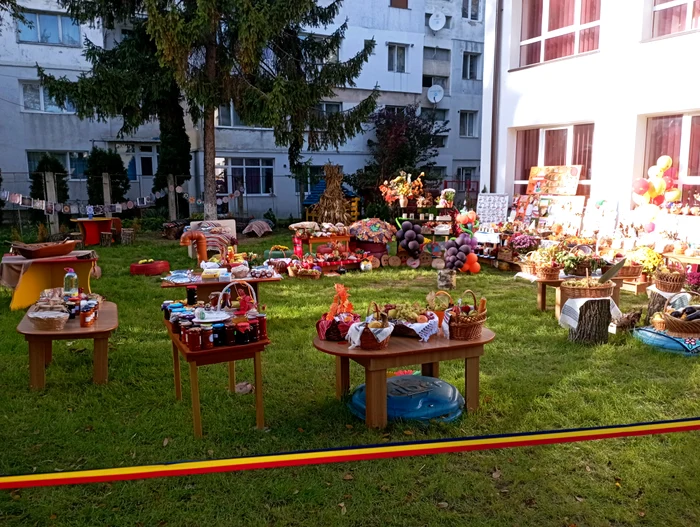
The garden of peace and relaxation PHOTO Cosmin Zamfirache
“Starting from the fact that the educational space in children’s groups is exceeded, the organization of relaxation, quiet and learning centers offered children an opportunity to explore nature with simple but at the same time attractive means. The garden provides an ideal space for movement where children can run, jump and explore, stimulating their curiosity and desire to discover more about the world around them. They learn to work together, share responsibilities and resolve conflicts, thus developing their social skills. The natural environment offers unlimited opportunities for imaginative play, with children inventing stories and games”says teacher Lavinia Parasca. Of course, in these gardens, various festivals for children are organized, in which parents also participate.
Kindergarten humanoid robots
The Botošan institution is also involved in numerous educational projects and partnerships at the European level. Exchanges of experience with other countries take place here, through various educational programs. One of these is “Automatism”, in partnership with Scuola di Robotica Genova and Secondo Instituto Compresivo, Francavilla, both in Italy. Actually, it is about experimenting with a humanoid robot, NAO, which would be purchased and used in the teaching process.
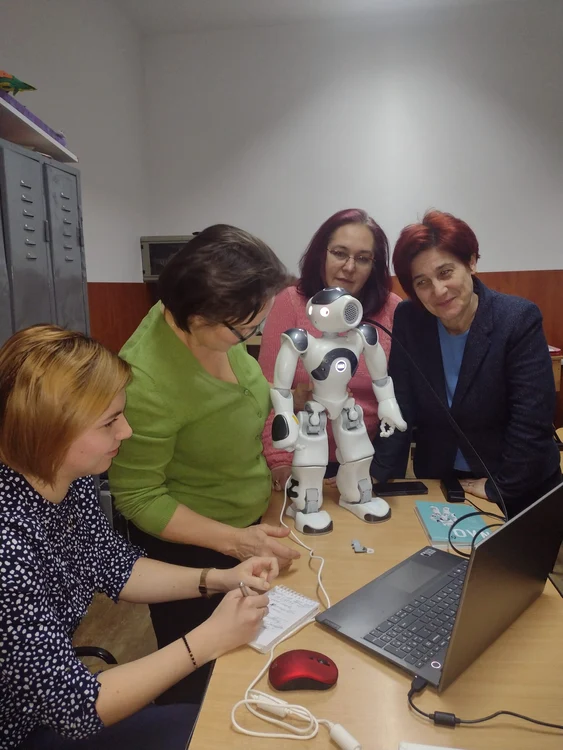
With the humanoid robot PHOTO Kindergarten Șotron
“This project proposed the experimentation of the humanoid robot, NAO, aiming at the use of new technologies in achieving the objectives of inclusive education at preschool, primary and secondary levels. A team of teachers from our kindergarten participated in Genoa, together with the Italian partners, in a project meeting and a training course, where the participants enriched their digital skills and the use of new technologies in the teaching activity, analyzed the results of the research up to this point and together determined the next steps necessary for the successful implementation of this project”says the kindergarten director.
