
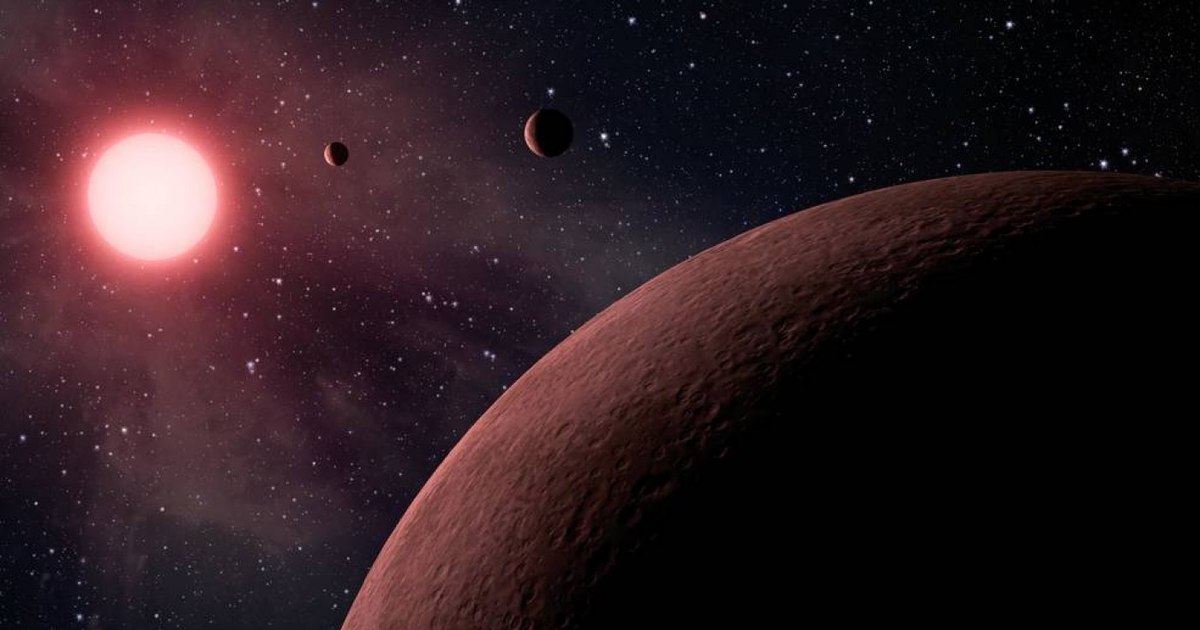
The researchers have detected possible signs of life on a distant planet, K2-18b, on hundreds of trillion kilometers away from the earth, in a discovery that could radically change our perception of the universe and our place in it.
The new information could lead to more discoveries in the future. Photo: NASA
The signal that has aroused reactions in the scientific community is the presence of a gas produced on earth only by simple marine organisms. Its detection was made by the James Webb space telescope, the most advanced cosmic observation tool ever built.
“It is, practically, the most important question we can answer as people-whether or not we are alone in the universe-and we may be about to have an answer,” said Professor Nikku Madhusudhan from the Institute of Astronomy of the University of Cambridge, the coordinator of the research team, quoted by the BBC.
Increased interest over time
Throughout history, humanity has been fascinated by the idea of extraterrestrial life. From the channels on Mars observed by the astronomers of the last century, to the stories with “Plains Fly ”” And green aliens, public opinion was fueled by hope, but also by fear.
However, unlike Science Fiction, the most solid evidence so far does not come from close planets, but from distant worlds, outside our solar system. K2-18b is in the so-called “habitable area”-the perfect distance from his star to support life, similar to the position of the Earth towards the Sun.
More and more advanced technologies
In the last 30 years, astronomers have identified almost 6,000 exoplanets (an exoplanet, or extra -olar planet, is a planet that has orbit around a star other than the Sun), many of them being analyzed with the help of extremely sophisticated tools, capable of detecting the chemical composition of their atmosphere. There it is sought “Biogatures” – molecules that, on Earth, can only be produced by life forms.
The James Webb space telescope has been designed precisely for such missions, but NASA is already preparing the Viitorului Telescope – the observer of the living worlds – which will be able to analyze the land similar to the Earth. Also, in Chile, another giant of astronomy, the extremely large telescope (ELT), equipped with the largest mirror ever created: 39 meters in diameter.
One step closer to the truth
Although the discovery of gas on K2-18B is promising, scientists warn that there are an intense period of checks. There could be other non-biological explanations for the presence of gas, but as data accumulates, and alternative assumptions fall one by one, the probability of life on other worlds, reports the BBC.
“We will not know with certainty that it is about life, but if we see similar signs on several planets, in several systems, we will be able to have an increasing confidence.” Explains Prof. Catherine Heymans, Royal Astronome of Scotland.
As the Internet appeared as a result of small but constant innovations, and transformed the world without humanity to achieve its extent, and the discovery of extraterrestrial life could occur with small steps. But her impact – scientific, cultural and spiritual – could be huge.
