
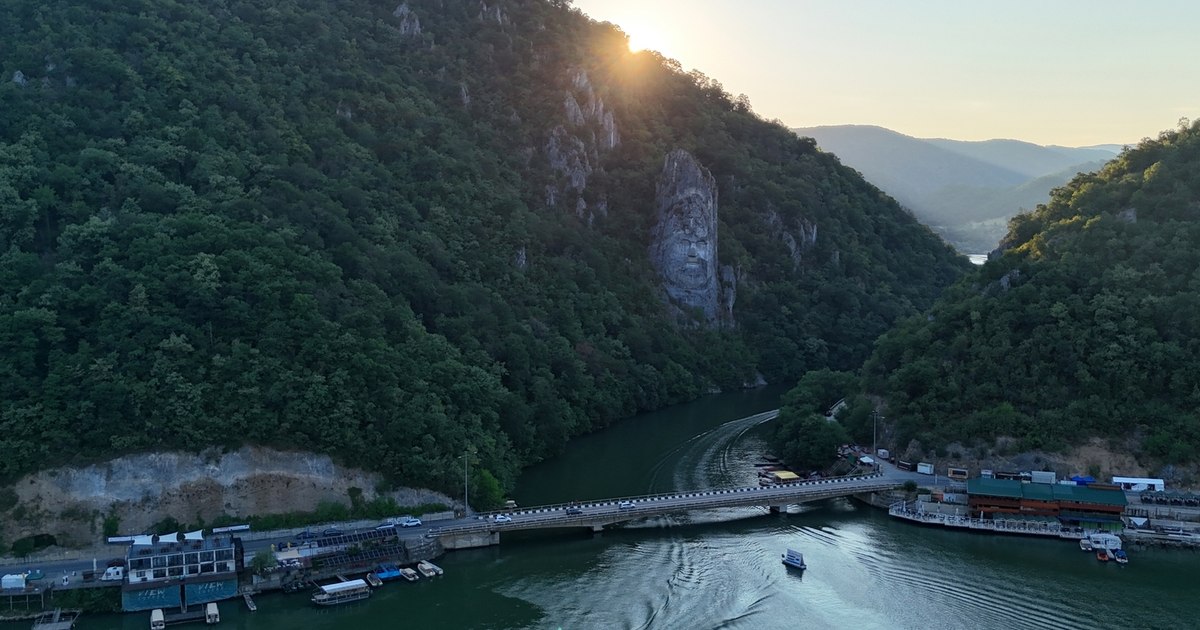
The Danube boilers are one of the most spectacular areas of Romania, and the wild landscape of the gorge is complemented by the huge sculpture that depicts King Decebal. The monument attracts many tourists, but also contestants.
Decebal’s face. Photo: Daniel Guță. TRUTH
Three decades after “Decebal’s face” began to take shape on one of the rocks that rise above the Danube boilers, the monument, over 40 meters high, has become one of the great attractions of Romania.
Unusual Tourist Attraction of Danube Boilers
For many foreigners traveling on the Danube and in the area of Orșova, Drobeta Turnu Severin and the resort of Băile Herculane, Decebal’s face became an unmoved monument.
“The statue is undoubtedly huge – the largest of this kind, so far, in Europe – it has lasted about 10 years to carve the face of the last king in the rock of the mountain that watches over the Danube.
I can only recommend that, if you arrive in the area, you will stop seeing this impressive statue ”, says one of them, in a review on Tripadvisor.
For many locals of the communes in its vicinity, the monument was an opportunity to prosper from tourism.
“In the summer, the pensions in Fășelnița and Dubova are crowded with tourists. Here, a night of accommodation starts from 200 lei, but you rarely find so cheap places if you do not book early, and reach over 500 lei. The restaurants and cafes on the shore also have customers, as well as the tones of food. Here – between Orșova and Dubova – it is the best place ”tells a local from failure, who organizes boat trips.
Image 1/15:
The Danube Daniel Guță Adevărul (53) JPG photo boilers
Many tourists declare themselves delighted by the sculpture that animated the Danube boilers, the place where, in the years of the Daco-Roman wars from the beginning of the second century, the Romans built a suspended road on the rocks, above the river, to ensure their access to Dacia.
The controversies of the sculpture
However, some Romanians notice the controversies of “Decebal’s face”, considering it a massive sculpture, but full of imperfections.
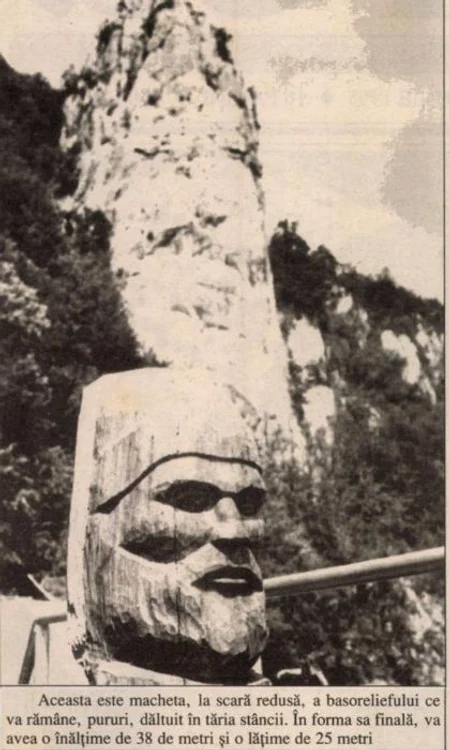
The layout of the statue. Photo: Banat Renaissance, 1995.
„Drăgan Fecit (no made by Drăgan – Iosif Constantin Drăgan, the billionaire who sponsored the work in the 1990s) … a sample of ferocious semidoctism, displayed with a megalomaniac fudulie and a disarming ignorance, displayed at the entrance to the country, as a business card that warns you to give up any nature. The precarious culture of the Romanian “Patriot”, he put the seal of the lack of culture in a grotesque way, precisely on the rock, once wonderful “, It looks one of them.
The unfinished sculpture, different in appearance by the layout proposed in the mid -1990s, the cross stuck in the rock, the shape of the nose and the inscription “Decebalus Rex, Dragan Fecite” under Decebal’s face were often the subject of the comments.
“There is nothing to see. A rich man decided to remind us of the Dacian roots, but the result is a kitsch. For a sculpture that worked for ten years and cost a lot of money, the final result does not resemble King Decebal. See him from the Danube, from the boat, although I stop some cars there, but the perspective is not great ”notes another foreign tourist.
Iosif Constantin Drăgan, credited as a “maker” of the sculpture
Decebal’s face was laid on a rock on the left bank of the Danube, at the entrance to the Gulf of Mraconia, between the localities of Eșelnița and Dubova, about 15-20 kilometers from Orșova. It can be observed from the Danube and from Orșova-Baziaș road (DN 57), which crosses the Danube Clisura.
The works at the monument began in the summer of 1994, being initially coordinated by the sculptor Mario Galeotti, assisted by several climbers.
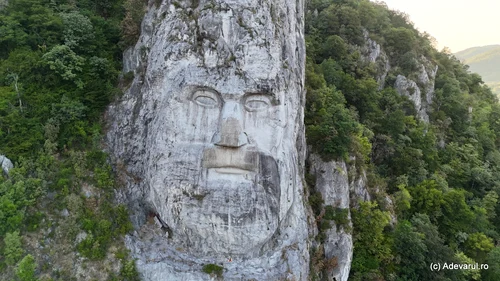
Image 1/15:
The Daniel Daniel Guță Adevărul (32) JPG photo boilers
“Through this place, Emperor Trajan entered Dacia. And here, today, he returns and remains for eternity, as a symbol and pavement, Decebal. His legendary face takes shape in a 111-meter high rock, with a diameter of 180 meters. The bas-relief, when it will be ready, will be 38 meters high and 25 meters marked nothing ‘ – as Mr. Joseph Constantin Drăgan notes in the work “History of Romanians”, 1993, a sign from his goodness and, equally, for love for the eternal history and values of our nationU ”, informs in 1995 the publication of the Banat Renaissance, founded by the billionaire.
Iosif Constantin Drăgan (1917-2008) would have spent over a million dollars for the work, and the financial efforts were rewarded by the rock inscription: “Decebalus Rex – Dragan Fecite”. Fecite is a term used by the artist to put his signature and indicate the origin of the work of art, while the beneficiary or the one who ordered the work had to be mentioned with the term “Direxit”, I attract the attention of the specialists.
But this detail was overlooked in the case of Joseph Constantin Drăgan, the one who assumed the role of founder of Decebal’s face. Passionate about history, Drăgan was the author of several volumes about the ancient history of Romania, the most famous of them being launched in the 1970s, with the title “We, the Thracians. The multimillennial history of the Romanian people”.
The book was well received by the totalitarian regime led by Nicolae Ceausescu, one of the alleged reasons being the proximity of the billionaire who lived in the West by the former communist president. After 1990, some historians challenged and placed Drăgan among the protocronist authors, “obsessed” by the Thracian origins of the Romanians.
Huge efforts for rock sculpture
One of the things appreciated in the monumental sculpture is the effort made by the sculptors – mountaineers in its construction, since 1994. The works lasted over a decade, but remained unfinished.
“Now, on the slope, the mountaineers work. Only they have crushed to face the heights and fight with the strength of the rock. On August 1, AC is a year since working on this unique site, equipped with compressor station, electrogenic groups, pontoon at the base, 800 meters of metal cable Which, at the right time, will be completed with a funicular used for the transport of materials. inform the Banat Renaissance in 1995.
In 2004, when the works were stopped, only a little more than half of the work of planned art was completed. “It would be working for about ten years at this work,” said the sculptor Florin Cotarcea, from Orșova, who in turn coordinated the works, in a documentary about Decebal’s face.
The bas -relief that portrays the king if it has reached impressive dimensions. It is almost 40 meters high, 25 meters wide, four -meter eyes, a seven -meter and four -meter long nose. However, the nose of the king had to be adjusted, because the rock in which the present risks was prejudice. It was dynamit and remodeled, with iron and cement reinforcement.
On the Serbian bank of the Danube, also in boilers, an authentic ancient monument, Tabula Traiana, erected in honor of Emperor Trajan, is ten times smaller than Decebal’s face. The Traiana Tabula guarded a road built by Romanians, in an ingenious way, paying tribute to Emperor Trajan. Another tabula, unearthed in 1969 also on the Serbian bank from the Iron Gates, reminded that the Roman emperor would have made here the first navigable channel on the Danube.
