
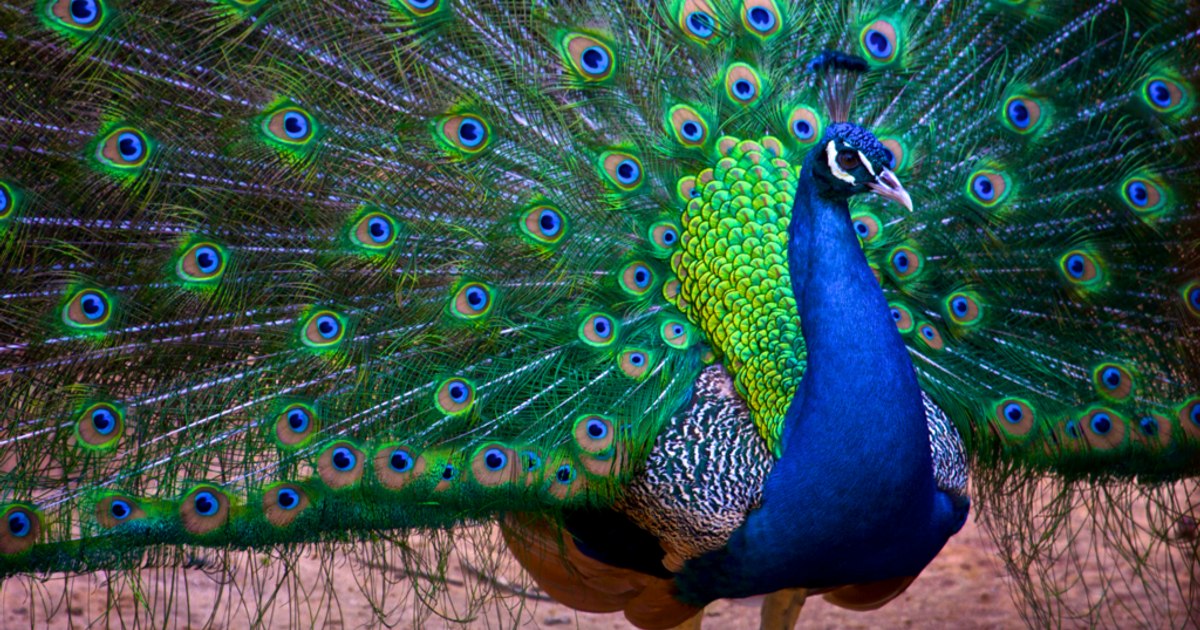
A remarkable discovery in the animal world shows that Pauni can turn their tail feathers into true yellow-green lasers. Researchers have shown that microstructures in colored feathers, after being treated with special dyes and light stimulated, can emit light beams.
The discovery of research changes everything I knew about Păuni / Photo source: Intepti.ro
Light is amplified in an unheard of animals
Unique nanometric structures in the feathers of the Păună could form optical cavities, amplifying the light in an animal. The researchers concluded that peacock tail feathers are able to issue narrow light beams.
A team of researchers from Florida Polytechnic University and Youngstown State University has studied these structures, which can emit a distinct glow after applying a special dye on several areas of the peacock tail.
They found that feathers can emit two different frequencies of laser light from several regions of colored stitches on the tail, according to interestingengineering.com.
The discovery marks a world premiere: Biolaser cavities in the animal kingdom
The researchers claim that this is the first proof of a biolaser cavity in the animal kingdom.
The research team noticed that, after the feathers were colored with a special dye and exposed to an external light source, they issued narrow beams of yellow-green laser light. The study investigated the light emission properties of the beards infused with dye from the Indian peacock peaches (Pavo Cristatus), using high intensities of 532 Nm.
Noted a very constant set of laser wavelengths
The researchers applied the repeated dye on the stains and allowed the feathers to dry. After several watering/drying cycles, in different regions of the same feather, but also on different feathers, a very constant set of laser wave length has been observed.
The team stressed that the feathers required several coloring cycles to emit laser light.
“The eye of a dye -colored peacock feather has emitted laser light from several structural colors. Even the regions in which the visible reflection bands were outside the dye earning area in certain places,” the researchers said. The maximum laser intensity, compared to the wide emission curve, was issued from the green region.
How did Pauni feathers come to issue Laser where a mystery remains
Researchers believe that discoveries show an elegant example of how complex biological structures can support coherent light generation. However, the study does not exactly identify the microstructures that produce lasers.
After obtaining the feathers, the researchers cut off the excess beards and mounted them on an absorbent support. The feathers were infused with common dyes by pipette and allowed to dry. Sometimes coloring has been repeated several times. Then, the samples were stimulated with light impulses and the resulting emissions were measured according to the study details.
The authors could not identify the precise microstructures responsible for leaving; It does not seem to be due to melanin tubes covered with keratin. Coautor Nathan Dawson from Florida Polytechnic University has suggested to science that similar protein granules or small structures inside feathers could function as a laser cavity.
