
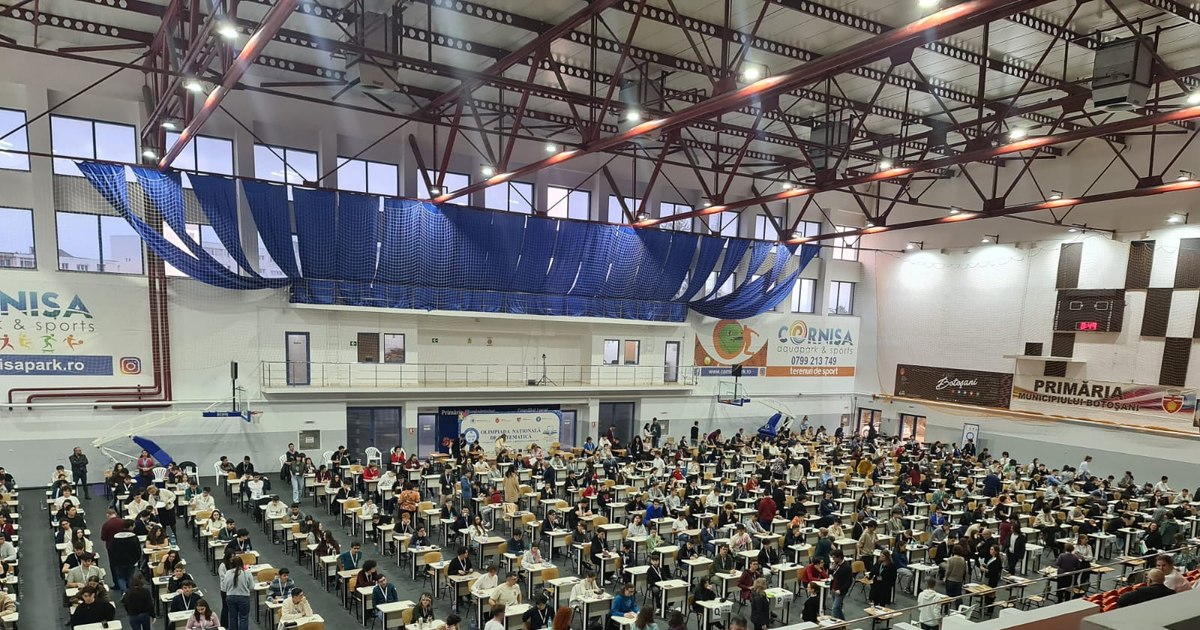
The regulations regarding the conduct of school olympiads and competitions were published in the Official Gazette. That means new rules come into effect. The evaluation of the papers in the written tests can be done digitally. The minimum score for qualifying at the national stage will be 60 points out of a maximum of 100. And before the appeals, the students will be able to see their works. Also, students who are in the hospital will be able to take the tests in the medical unit, with the approval of the school competition organizing committee.
Mathematics Olympiad PHOTO The truth
What are the main changes regarding the organization of the Olympics and competitions
The Ministry of Education has announced what will be different from the way it has been done so far:
- Students will be able to participate in a higher class than the one in which they are enrolled in the school year in which the competition is held, within the same education cycle (secondary/high school), and those included in a form of schooling in the hospital or at home will be able to take the tests of the school Olympiad stages, with the exception of the practical tests, in the hospital, respectively at home, with the approval of the committee responsible for organizing the respective stage of the school competition.
- Depending on the specifications in the specific regulation, school olympiads will also be able to take place in online format, and the evaluation of the papers in the written tests will be digitalized. The method of evaluation of the works (physical/digital) will be provided in the specific regulation of each competition.
- In the perspective of the digital evaluation of the written tests, at all stages of the school olympiads, regardless of the discipline, the results are evaluated by points from 0 to 100, according to the scales.
- The minimum score for qualification to the national stage is 60 points (including 10 ex officio points) out of the maximum score of 100 points (therefore a minimum score of 60% of the maximum possible score is required, compared to the minimum 40% required for qualification in the previous regulations).
- Students have the right to view the work, before submitting the appeal, both at the county stage, as well as at the regional and national stages.
- Clear, non-discriminatory and sufficient tie-breaking criteria for qualifying for additional places at the national stage will be included in the regulations of each competition.
- There are no changes regarding the number of places for the qualification at the national stage.
- The obligation of audio-video supervision of the competition tests within the stages of the school olympiads was introduced.
Another change concerns the classification of stages. Thus, the “Regional projects” category was assimilated to the “Inter-county projects” category. As a result, the categories of after-school education projects are now:
- Nation
- long distance
- county/city of Bucharest
What Daniel David says: I want the standards of the Olympics to be appropriate for excellence; process, as transparent as possible
“Competitions (e.g.: Olympiads) represent the part of excellence in Romanian education. Therefore, if we are to treat it seriously, we must have the standards and procedures at this level, otherwise we distort the meaning of excellence. For my part, I fondly remember participating in Olympiads (including the national phase in biology) and I am always happy when I see the interest of students and teachers in school competitions. Therefore, I want the standards to be appropriate to excellence, the process, as more transparent and non-bureaucratic, and the rewards should come mainly as a result of an intrinsic motivation (you get rewards because you like to learn and you are performing), not extrinsic (you don’t learn to get rewards)”, the Minister of Education sent.
Daniel David also added that:
“The development of skills at the level of school and extracurricular competitions must not distort the acquisition at a functional level of all the eight key skills that we aim for in the educational process, therefore, the Ministry organizes extracurricular competitions and school competitions at the middle school and high school level, without, however, prohibiting the organization of extracurricular competitions and at the level of primary education (where the foundations of the key skills are laid), depending on the options specific to educational communities. In this framework, performance and excellence will permanently have a supporter in me!”
