
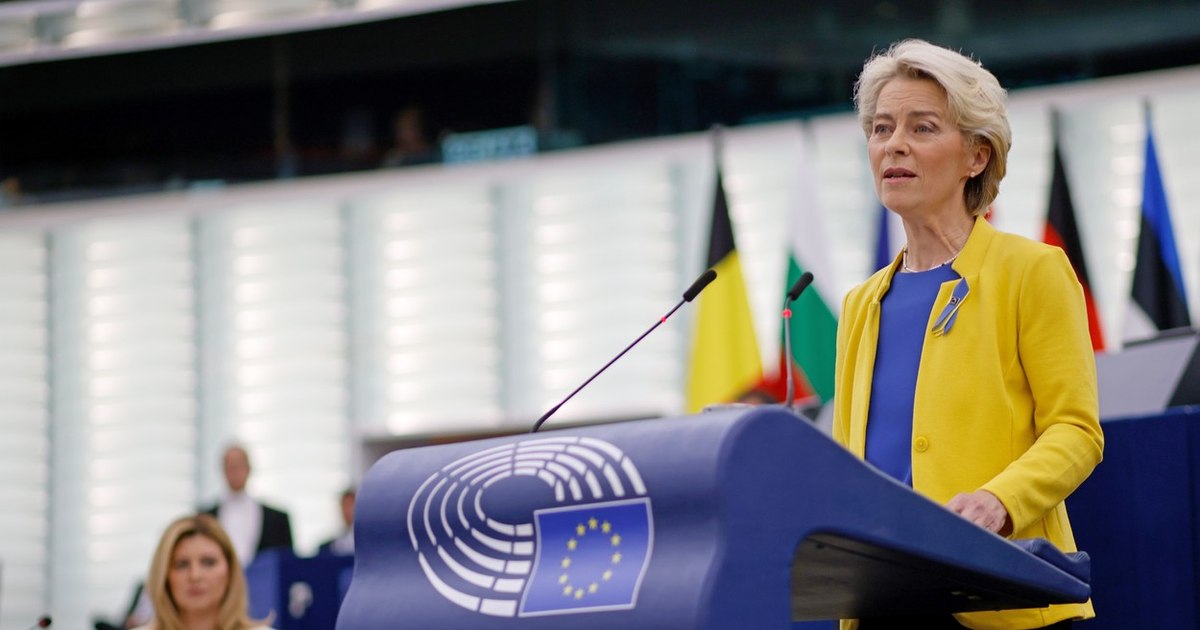
The European Parliament has already rejected several no-confidence motions, and recent attempts to drum up support for the dismissal of the Brussels executive have fallen short of the threshold needed to remove Ursula von der Leyen. While the main coalitions still secure a majority in the plenary, signs of discontent — also fueled by intense debates over the EU-Mercosur deal — show that tensions remain high. Vice-President Victor Negrescu explains that the recent votes and discussions reflect the will of the MEPs to send a clear signal to the Commission, but that the adoption of a motion of censure remains, for now, difficult.
MEPs voted last week to refer the EU-Mercosur deal to the Court of Justice of the European Union, securing a narrow majority to demand an assessment of its compatibility with EU treaties. However, although the agreement caused political disputes in the Parliament, the motion of censure submitted by the European Patriots group against the European Commission failed to attract enough support, having previously been rejected with clearly higher votes than the opposition.
The Minister of Agriculture, Florin Barbu, recently pointed out that the Mercosur agreement will not be applicable until the decision of the CJEU, emphasizing that, if its implementation is forced, things could degenerate. “Without the decision of the CJEU and without the vote in the European Parliament, I am convinced that things will degenerate at the level of the European Commission and I am sure that Mrs. Ursula will have a motion of censure in the European Parliament”. said Florin Barbu.
The European Commission already faced a no-confidence motion at the beginning of the year, even on the subject of Mercosur. The last of a series of 3 other motions submitted last year, all at the initiative of the extremist groups in this forum. The mandate of the European Commission, however, is supported by a majority of S&D, EPP and Renew, a group that recently warned that the dismissal of the Commission President would weaken the EU’s ability to act coherently amid rising tensions with the US.
The signals given by the European Parliament
However, signs of dissatisfaction came most often from the group of European Social Democrats (S&D), which, through the voice of the president, Iratxe García, pointed out since the vote for the installation of the Commission that it is not a “blank check”. Trust between Democrats and pro-European forces is more damaged than ever, she points to the first no-confidence motion rejected last year, claiming that the EPP is playing a double game.
Victor Negrescu, vice-president of the European Parliament and of the European Social Democrats, explains to “Adevărul” that the current European Commission “she is aware of the fact that she has already faced many censure motions”but noting that “these were initiated by extremists and so far the arguments presented there have been populist in nature. They did not offer solutions to those problems. In fact, when these extremists filed motions of censure, at no time did they express their willingness to assume certain responsibilities or a certain role in the European Union. They only filed the motion to create a scandal, without arguments.”
“I do not see a motion in the immediate future that will pass according to the procedures. There is this risk that I am convinced that the European executive will seek to avoid”, explains the MEP.
However, he points out that the European Parliament has achieved its objective regarding the subject of the Mercosur agreement: “Now, I believe and hope that the European Commission has understood the signal given to the European Parliament with the Mercursur agreement. When decisions are made, there must be a real consultation of the member states and the European Parliament and those interested in the subject, that this dialogue must be carried out in advance, before the adoption of some decisions and that, indeed, the European Parliament aims to protect the interests of the citizens and the member states. Moreover, the European Parliament is the only institution elected directly by the citizens and in the context this is the role of the European Parliament. Moreover, on the subject of Mercursur it was demonstrated that, although the decision was taken by the governments of the member states, together with the European Commission, a European institution corrected these problems”.
MEPs sanctioned in the European Parliament
Following the last censure motion against Ursuley von der Leyen, the introduction of sanctions for EPP (European People’s Party) MEPs was also reported in the public space. The information was not released in the public space in Romania by the two Romanian MEPs (PPE/UDMR) sanctioned, Loránt Vincze and Iuliu Winkler, but by Gheorghe Piperea, representative of the European Conservative Reformist Group (CRE/AUR).
“No fewer than 12 MEPs, members of the European People’s Party (EPP), including two from Romania and 7 from Hungary, were sanctioned for the way they (didn’t) vote on the censure motion against Ursula von der Leyen. Both Romanian MEPs from the UDMR (Vincze and Winkler) were sanctioned for abstaining from voting. Among the sanctioned are all 7 MEPs from Peter’s party Magyar, Orban’s opponent. Some were sanctioned because … they were absent from the vote.” the MEP wrote on Facebook.
The regulation of the European Parliament stipulates that a group can submit a motion of censure with 72 signatures, i.e. one tenth of the deputies who make up the European Parliament, two months after the previous one. To pass, however, a two-thirds majority of the votes cast is needed, representing the majority of the members that make up the Parliament.
