
You have probably heard many times that Romania is at the bottom of the PISA tests. But what are these tests? Find out from the material what skills they test, when they are claimed and by which students, and what the models look like.
What are PISA – Program for International Student Assessment standardized tests
The PISA tests are standardized international assessments organized by the OECD (Organization for Economic Co-operation and Development) for almost 30 years. They are supported in more than 80 countries in the world and represent a comparative study.
The tests do not aim at memorizing information, but at students’ ability to think critically and to understand, analyze and apply the knowledge acquired at school in concrete contexts, close to everyday situations.
The assessment focuses on three main areas:
- Reading/reading – understanding and interpreting texts
- Mathematics – mathematical reasoning and the application of logic
- Science – understanding scientific phenomena in everyday life
The results obtained in the PISA tests provide authorities and education specialists with essential information about the strengths and weaknesses of the education system in that country. The data can be used to formulate educational policies, to improve teaching methods and to reduce discrepancies between different categories of students. It also fosters the exchange of best practices between nations.
When are the PISA tests given in Romania. Which children take the exams
PISA tests are organized once every three years, in the same period for all participating countries. The last such test took place in 2025, which means the next one is scheduled for 2028.
15-year-old students participate in the PISA tests. The age was not chosen by chance. In most participating countries, at age 15 students are nearing the end of upper secondary school or have just completed it. The selection of students is done randomly, from several schools in the country, to ensure a fair representation.
The PISA tests aim to highlight whether students can correctly interpret a text, solve practical problems using mathematical reasoning or explain scientific phenomena encountered in everyday life. Through these skills, the assessment shows to what extent young people are prepared for continuing their studies, future integration into the labor market and adaptation to a constantly changing society.
PISA test models
The OECD has published a set of items from the 2022 maths test. Some examples of exercises are as follows:
The students were presented, in a table, with the average distances between the Sun and the planets, in astronomical units (1 au – 150 million kilometers). Based on the given distances between three planets and their position relative to the sun, they were asked to determine which three planets were in the correct order.
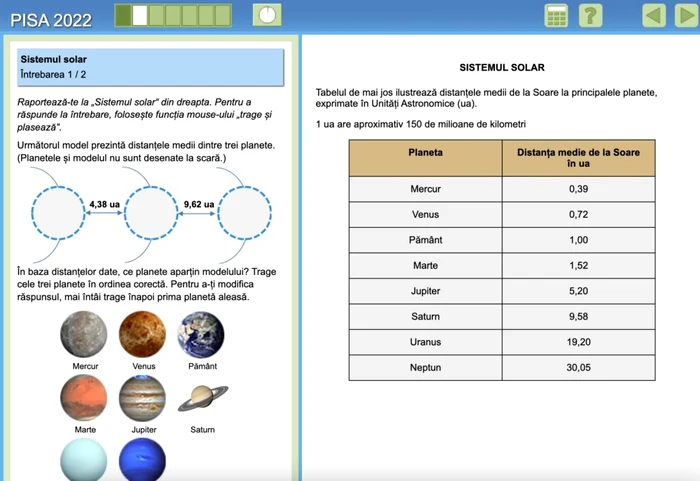
The correct answer is: Jupiter, Saturn, Uranus. This was considered a Level 3 item (on a scale of 1 to 6, where level 1 is the lowest level), so of moderate difficulty.
In another exercise, students were given the same data set regarding the distances between the Sun and the planets, in astronomical units (1 au – 150 million kilometers). And they were asked to choose, from four answer options, the distance between the Sun and Neptune, calculated in kilometers. The students also had to convert the astronomical units into kilometers.
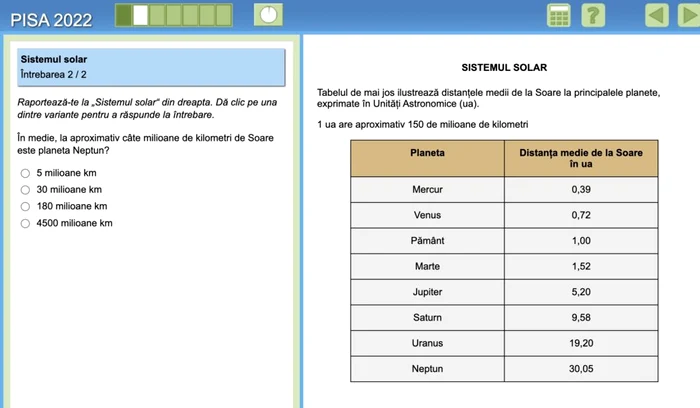
The correct answer is: 4,500 million km. This was considered a level 2 item.
For the first time in 2022, PISA also included a creative thinking test, designed to measure students’ ability to generate and evaluate original ideas. This test contained 32 tasks that asked students to create, explain or improve ideas in a concrete context. Examples:
- Save the Bees – Proposes ideas for bee conservation.
- Wheelchair Accessible Library – Find solutions for making a library accessible
- Space Comic – Create a visual mini-story about space
You can find more models and exercises on the OECD website.
What are Romania’s results in the PISA tests
During the participation in the PISA tests, Romania was as follows:
- PISA 2000: 34th place out of 42 participating countries
- PISA 2006: place 47 out of 57
- PISA 2009: 49th place out of 65
- PISA 2015: 48th place out of 72
- PISA 2018: 47th place out of 79
- PISA 2022: 45th place out of 81
Even if the results in 2022 seem gratifying, the bad part is that at the level of the European Union we were in second last place. Testing since then has shown that:
- almost half of the students (42%) do not understand what they read
- only half (51%) make mathematical connections
- 56% can recognize the correct explanation of familiar scientific phenomena.
