
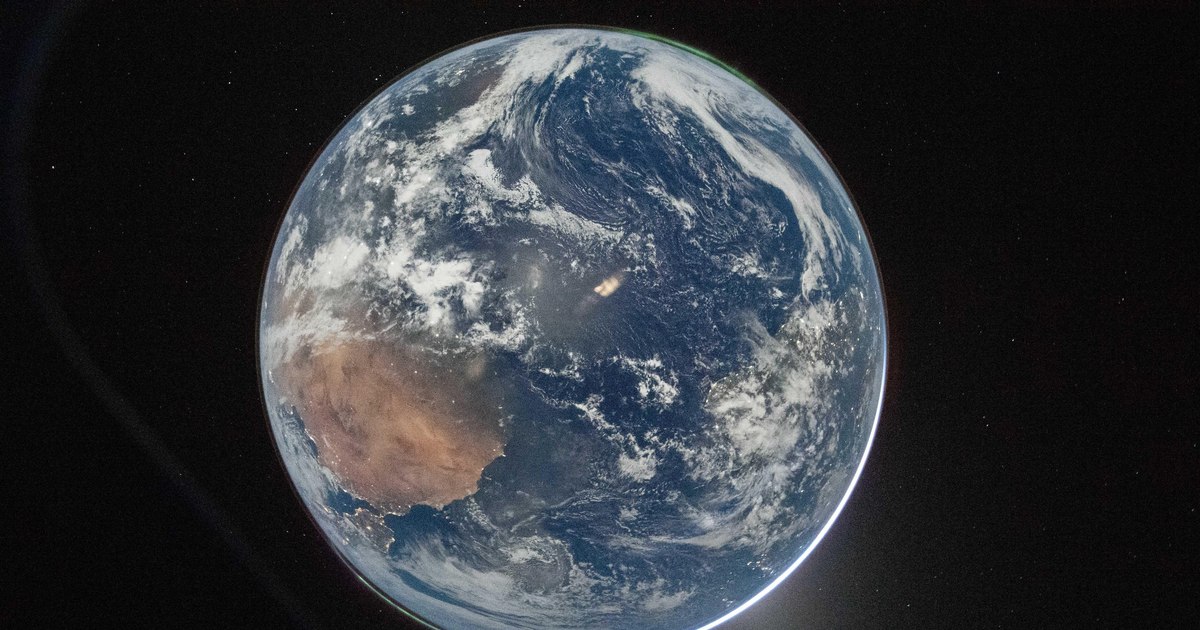
The four astronauts of the Artemis 2 mission set a new distance record from Earth on Monday, surpassing the performance of the Apollo program. The team is going to fly over unknown regions of the Moon and its hidden face for several hours.
The previous record of 400,171 km, set by the Apollo 13 mission, has been surpassed, NASA announced. The astronauts in the Orion capsule — Christina Koch, Victor Glover, Reid Wiseman and Jeremy Hansen — would reach more than 406,000 km from Earth during the flyby around the Moon, according to Agerpres.
“The control room is full of lunar glee today, I imagine you are too”crew communications officer Jenni Gibsons relayed to them from NASA’s control room in Houston.
Christina Koch, a veteran space explorer who made history by becoming the first woman to fly on the moon, revealed that the Artemis 2 astronauts are now “stuck to the portholes” to admire the natural satellite of the Earth.
“A Historic Day”
The four astronauts will not go to the moon, but their flight was still a first, because never in any of the Apollo lunar missions (1968-1972) were there female astronauts, black astronauts or non-American astronauts on board.
“It’s a historic day”Apollo 8 and Apollo 13 pioneer Jim Lovell told them Monday morning in a posthumous message recorded months before his death in 2025.
“Welcome to my old neighborhood”he told them, expressing his pride “to pass them the baton” and even giving them a tip: “I know you’ll be very busy, but don’t forget to enjoy the view”.
The mission commander, American Reid Wiseman, presented during a live broadcast the Apollo 8 mission emblem, which the Artemis 2 mission crew took aboard the Orion capsule.
In the entire history of space exploration, no Russian or Chinese astronaut has ever ventured beyond 400 kilometers from Earth, the distance to Earth-orbiting stations. Only the probes returned to observe the Moon.
The lunar observation period will last almost seven hours and will begin at 18:45 GMT (21:45 Romanian time – ed.). The moon will be fully visible through the porthole of the Orion capsule.
The moon will appear to the astronauts as large as “a basketball held at the end of one arm”said Noah Petro, director of NASA’s Planetary Geology Laboratory.
The preparations lasted two years
The four crew members have been preparing for more than two years, practicing recognizing geological formations and accurately describing them to scientists on Earth, especially the brown and beige hues of the lunar surface.
Astronauts will fly behind the Moon and discover its hidden face, the one never visible from Earth. They will probably see “regions of this hidden face that none of the Apollo astronauts could observe”, explained Jacob Bleacher, director of NASA’s science exploration department.
Their lunar flyby will also allow them to witness a solar eclipse – the Sun disappearing behind the Moon – and a sunrise and sunset from Earth behind the Moon.
If this mission and the next one next year go well, NASA plans to send astronauts to the moon in 2028.
