
You used the phone for two years without any problem. You protected it, you charged it regularly, you didn’t drop it. And yet, a few weeks after the warranty expired, it started behaving strangely—random restarts, battery draining within hours, overheating, or in worse cases, the black screen in the morning without any warning. Coincidence? Possible. But not always.
The reality in service is more nuanced than the popular “programmed obsolescence” conspiracy. There are several well-documented technical mechanisms that explain why modern phones fail exactly within 2–3 years. And yes, some of these mechanisms are directly related to design decisions made consciously by manufacturers. Phone repair cases after contact with liquids are a classic example: the phone perfectly resisted water in the first year, and in the third it oxidized internally from the steam in the bathroom – because the seals are not designed to last forever.
But oxidation is not the only problem. And not the most common either.
The modern phone is a permanent thermal compromise
Herein lies the fundamental difference from any other personal electronic device. A laptop has fans, heatpipes, physical space for heat dissipation. A phone has none of that.
The processor sits next to the battery. The fast charging module generates heat directly in the case. Everything is soldered compactly, without airflow. And the user uses the phone for more and more demanding tasks: 4K filming, gaming, TikTok several hours a day, hotspot, GPS navigation in the car in July.
Under these conditions, the internal components are constantly operating close to the thermal limit for which they were designed. It doesn’t break down immediately—but it does degrade. Microscopic soldering is tiring. NAND memory accumulates errors. PMICs (power management circuits) work under constant stress. The CPU may gradually lose contact.
The problem with all these flaws is that they don’t appear suddenly. The phone works seemingly perfectly until the day it goes into bootloop, loses signal, or won’t turn on at all. And that day comes, statistically, after two or three years of normal use. That is, exactly after the warranty.
Fast charging: the biggest daily stress on the battery
Phone marketing in recent years has made charging speed a major selling point. 67W, 90W, 120W, even over 200W on some models. “0–100% in 18 minutes” sounds good on a poster. Technically, it means high temperatures, accelerated chemical stress and faster degradation of Li-Ion cells.
A battery does not like heat. Does not like fast cycles. He doesn’t like to stay at 100% all the time. And it certainly doesn’t love the combination of gaming + fast charging, which is probably the most aggressive thermal scenario possible for a phone.
Many users charge their phone two to three times a day. In the morning in a hurry, at the office, in the car. In the evening with the phone on the thick case. In two years, a battery that has gone through hundreds of such cycles can reach 70–75% of its original capacity. At that level, the autonomy decreases noticeably, the phone starts to heat up more easily, and the operating system can become unstable — especially if the battery also has voltage peaks.
Changing the battery in time—before it reaches critical condition—can extend the life of a phone by years. It is one of the interventions with the best benefit/cost ratio, if done correctly and with a quality battery suitable for the model.
IP68 does not mean waterproof for life. And that matters more than people think
The IP68 certification is real and useful. But it has a limit that the manufacturers mention in the terms and conditions, not in the advertisements.
Seals age. They are affected by heat, minor shocks, accidental opening or the simple wear and tear of time. A phone bought in 2022 may be perfectly water resistant in 2022. The same phone in 2025 may accumulate internal oxidation from steam in a bathroom or condensation from a bag in winter.
Internal oxidation is treacherous because it is not visible from the outside. The phone seems intact. But inside, fine traces on the board were compromised, contacts corroded, sensitive modules accumulated moisture. Symptoms appear later: intermittent signal loss, microphone problems, instability on charging, screen artifacts.
Worse, the warranty doesn’t cover liquid damage — no matter what it says on the box about IP68. This limitation is one of the most common sources of frustration in service.
Serialized components and ultra-compact design: repairability has decreased dramatically
Modern phones are built for thinness and performance, not repairability. The display is completely glued. The battery is fixed with aggressive adhesive. Components such as Face ID, the fingerprint sensor or the main camera are serialized — that is, cryptographically linked to the motherboard. Replacing them with hardware-identical parts may result in lost functionality or permanent warning messages.
This does not mean that repairs are impossible. It means they are more complex and in some cases more expensive than a few years ago. A simple display replacement on a high-end iPhone or Samsung flagship requires specialized equipment, not just a screwdriver and a YouTube video.
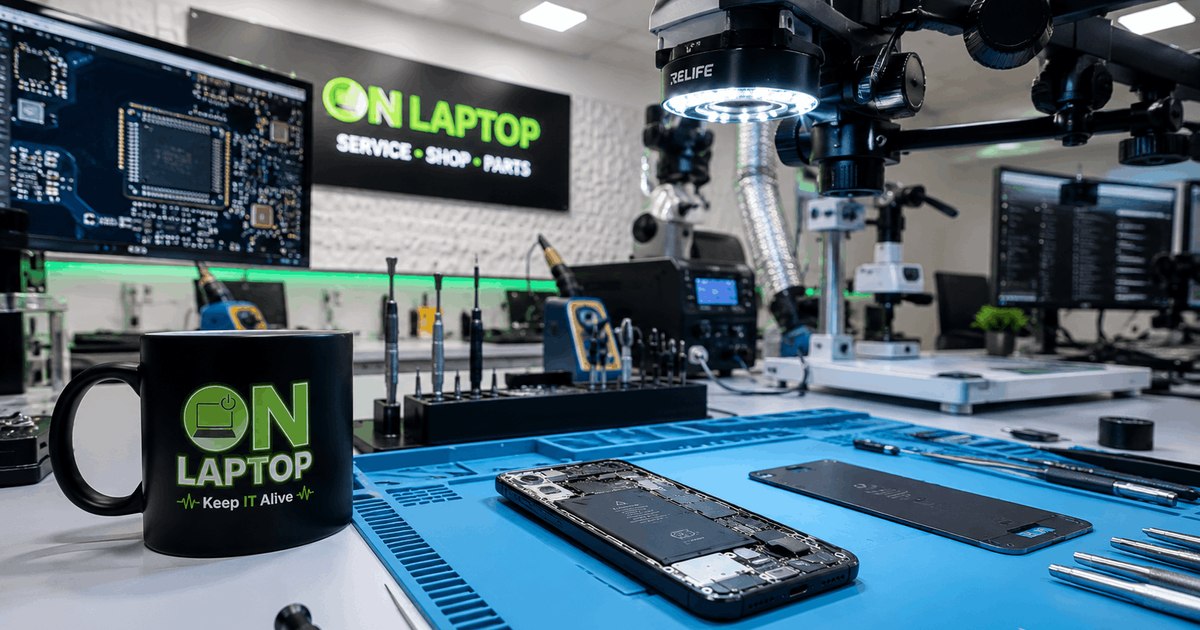
At OnLaptop, we frequently see phones brought in after the owner attempted a repair at home or at a service center without the necessary equipment. Sometimes the initial problem was minor; after an inadequate intervention, it becomes much more complicated. Proper diagnosis before any intervention is not an optional step—it’s the only way you can make an informed decision about what’s worth doing and what’s not.
Latent manufacturing defects: They exist, they are more common than it seems
Sometimes the phone doesn’t fail because of your usage. It fails because it left the factory with a problem that wasn’t immediately apparent.
In service there are well-known series with recurring problems: memory modules with addressing errors, PMICs with unstable behavior at temperatures, modems with progressively degraded reception, touchscreens with dead zones that appear after a few months. These flaws don’t activate at the command of an internal calendar — they activate when the accumulated stress exceeds a certain limit. And that limit is reached, statistically, after about two years of normal use.
The result is that the user has the impression that the phone “knew” that the warranty had expired. In reality, the defect exists latently in the design or in the production line. The warranty covered the period when the problem had not become visible.
Signs that your phone already has an ongoing problem
Many serious defects are preceded by symptoms that users ignore or attribute to an update:
· Excessive heating without heavy use — may indicate a power issue or an abnormal background process
· Battery suddenly dropping from 30% to 5% without warning — classic sign of cell degradation
· Random restarts, especially at medium loads — may indicate instability on the board or battery with voltage spikes
· Mobile signal that fluctuates without having moved from the location – damaged modem or antennas
· Heating when charging even with slow charger — possible oxidation on the charging plug or power management issues
· Screen with unresponsive lines or areas — thermally damaged display or connector
None of these symptoms automatically mean that the phone is unrecoverable. But none should be ignored. The longer you delay diagnosis, the more likely a fixable problem will become a motherboard-compromising one.
What you can do concretely to extend the life of your phone
There are no miracle solutions, but there are some habits that make a difference in the long run:
· Use fast charging selectively. If you’re not in a rush, slow charging puts significantly less stress on the battery. On many phones you can disable fast charging in the settings.
· Do not combine heavy gaming with charging. It is the most aggressive thermal combination for any phone, regardless of brand.
· Avoids passive overheating. The phone in the car in the summer, in direct sunlight or under the pillow at night accumulates temperatures that degrade both the battery and the surrounding components.
· Change the battery preventively. At 80% health or below, the battery no longer protects components from voltage spikes. Replacing it before it becomes critical is much cheaper than a board repair.
· Don’t ignore small symptoms. An isolated restart can be a crash. Three restarts in a week is a signal.
When the repair is worth it and when it is not
Not every repair makes economic sense. A phone with a severely compromised motherboard, extensive oxidation, or serialized components that are no longer functionally replaceable may reach an area where the cost of repair exceeds the residual value of the device.
But many situations that seem serious at first glance are, after diagnosis, much simpler. A degraded battery causing system instability can be mistaken for a board problem. An oxidized charging connector can simulate a software defect. Without a proper diagnosis, you can’t know what you’re dealing with.
Before making the decision to buy a new phone, a serious technical diagnosis — not a quick glance, but a check with a laboratory source, thermal analysis and component-by-component testing — can clarify whether or not the device has a useful life left. Sometimes the answer is that it’s not worth it anymore. Sometimes, an intervention of several hundred lei can extend the life of the phone by two years.
An informed decision is always better than one made out of frustration or the pressure of a shelf of new phones.
Why does the phone break right after the warranty expires?
It is not deliberate programming in most cases. The 2-year warranty roughly coincides with the time when normal battery wear, accumulated thermal stress, and component fatigue begin to become apparent. Latent manufacturing defects are also activated during this interval. The coincidence is real, but the mechanism is technical, not commercial.
Is it worth repairing a 3 year old phone?
It depends on the defect and the specific model. A battery or display replacement on an otherwise functional phone can be very cost effective. A motherboard repair on an entry-level model can exceed the value of the device. Correct diagnosis is the only way to answer this question for your specific case.
Does IP68 mean the phone is permanently protected against water?
Not. The IP68 certification is valid in laboratory conditions and for a new device. Seals degrade over time, are affected by heat and minor shocks. A phone several years old can accumulate internal oxidation even without direct contact with water — steam, condensation and humidity are enough.
What symptoms indicate a serious problem with the phone?
Repeated restarts for no apparent reason, sudden battery drops from a high percentage to a very low one, excessive heating during normal use, intermittent signal loss and abnormally behaving screen are signals worth checking. Ignoring them doesn’t make the problem go away—it usually makes it worse.
