
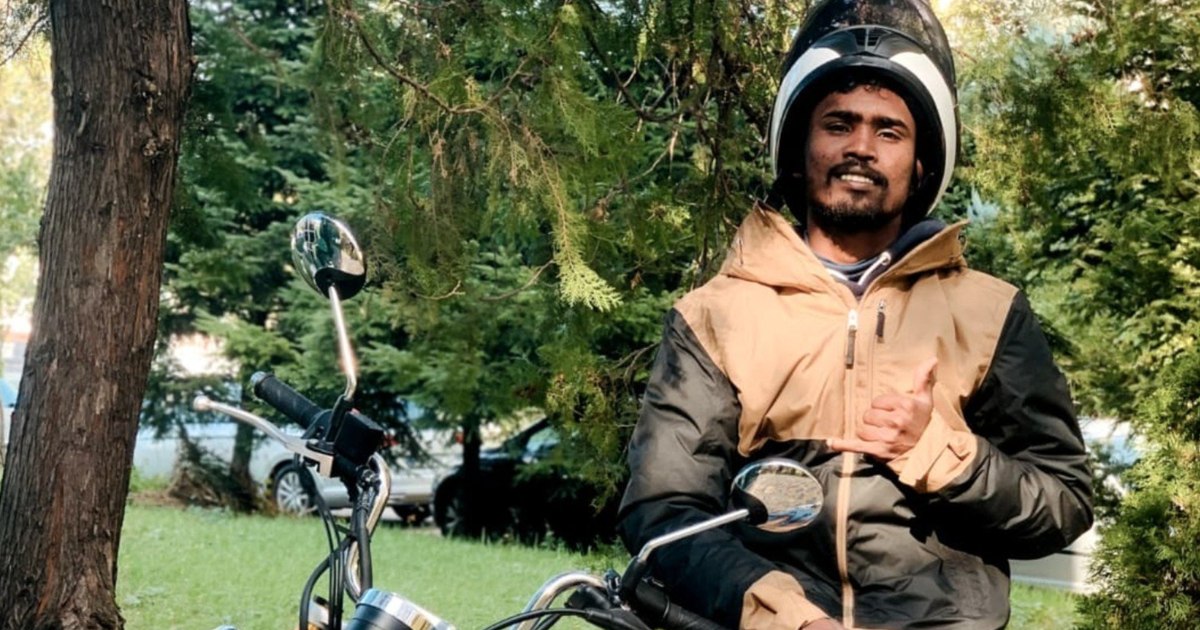
A fundraising campaign for a young man from Sri Lanka, left without a leg following a road accident in Bucharest, has gone viral on social media. In just a few days, hundreds of people shared the appeal and donated money to Iran, a 23-year-old food delivery man.
Beyond the personal drama, the case brings to light a lesser-known reality about the tens of thousands of Asian workers who have arrived in Romania in recent years: many of them start their journey already burdened by debts.
According to the description of the campaign published on the 4fund platform, Iran comes from a Sri Lankan fishing family and took out a loan of almost 5,000 euros to finance his move to Romania for work, with a monthly interest of 100 euros. He did not get to work for more than two months in Romania, so the burden of the money that must be returned now falls on him and his family, in a country where the average salary barely exceeds 200 euros.
Campaigners say one of the first questions he asked after the operation was whether he would be able to get a prosthesis and whether he would have a chance to find a job to pay off his debts.
Romania has become dependent on Asian labor
In recent years, the shortage of personnel in construction, logistics, HoReCa, agriculture and delivery services has led Romanian employers to massively turn to workers from outside the European Union.
Official data show that Romania has annually approved tens of thousands of work permits for citizens from Nepal, Sri Lanka, India, Bangladesh, Pakistan or Vietnam. In big cities, their presence has become common. We meet them on construction sites, in restaurants, in warehouses or on the bikes and scooters of delivery companies.
Loans of thousands of euros for a job in Europe
For many South Asian workers, obtaining a work contract in a European country is an investment in the future of the whole family. In practice, this investment often comes with considerable debt.
International organizations that monitor labor migration have repeatedly reported that many workers pay commissions to recruitment agencies, administrative costs, document fees, plane tickets and other expenses associated with the relocation process.
In some cases, the sums reach several thousand euros, a huge value compared to the incomes in the countries of origin. To cover them, many take out loans from relatives, financial institutions or local lenders.
Companies that recruit foreign workers demand the review of the project that imposes guarantees of 200,000 euros
Thus, before the first salary, some of the foreign workers already have debts that they have to repay month after month.
What happens when an accident occurs
In theory, foreign workers who have legal employment contracts benefit from health insurance and the rights provided by Romanian legislation. In practice, however, a serious accident can cause problems that go far beyond the medical aspect.
If the person is no longer able to work for a long period of time or has to return to the country of origin, the income disappears, while the financial obligations remain. For families who depend on remittances from abroad, the impact can be devastating.
In the case of Iran, it is friends and countrymen who offer immediate support. According to the campaign description, they bring him food, buy medicine, talk to doctors and help him with translations.
“We don’t know how the medical system works, nobody explains it to us. Now we have learned and we have all registered with a family doctor”is one of the messages included in the appeal for donations.
A problem that is talked about too little
Specialists in labor migration draw attention to the fact that the situation of foreign workers should not be analyzed only through the lens of the shortage of personnel in Romania.
Beyond the numbers on work permits and the needs of companies, there is also the issue of the costs borne by workers to get to Europe. In many Asian countries, the phenomenon of indebtedness for migration is well documented and represents one of the greatest vulnerabilities of workers.
When wages are lower than expected, layoffs occur, or medical problems arise, debt can become unmanageable.
The Iran campaign became emblematic of a larger reality
At the time of publication, the campaign had raised almost €3,000 of the €6,500 target. The money would be used to pay off the loan taken out for going to work and to give the young man the opportunity to start a new job after returning to Sri Lanka.
But the success of the campaign also says something else. For many Romanians, it was probably the first time they learned that behind the delivery man who brings the food to the door may be a person who borrowed thousands of euros for the chance to work in Europe.
Iran’s story is an individual one. The phenomenon it brings to light, however, is much broader and concerns thousands of foreign workers who today contribute to the functioning of the Romanian economy, while trying to pay their debts and support families thousands of kilometers away.
