
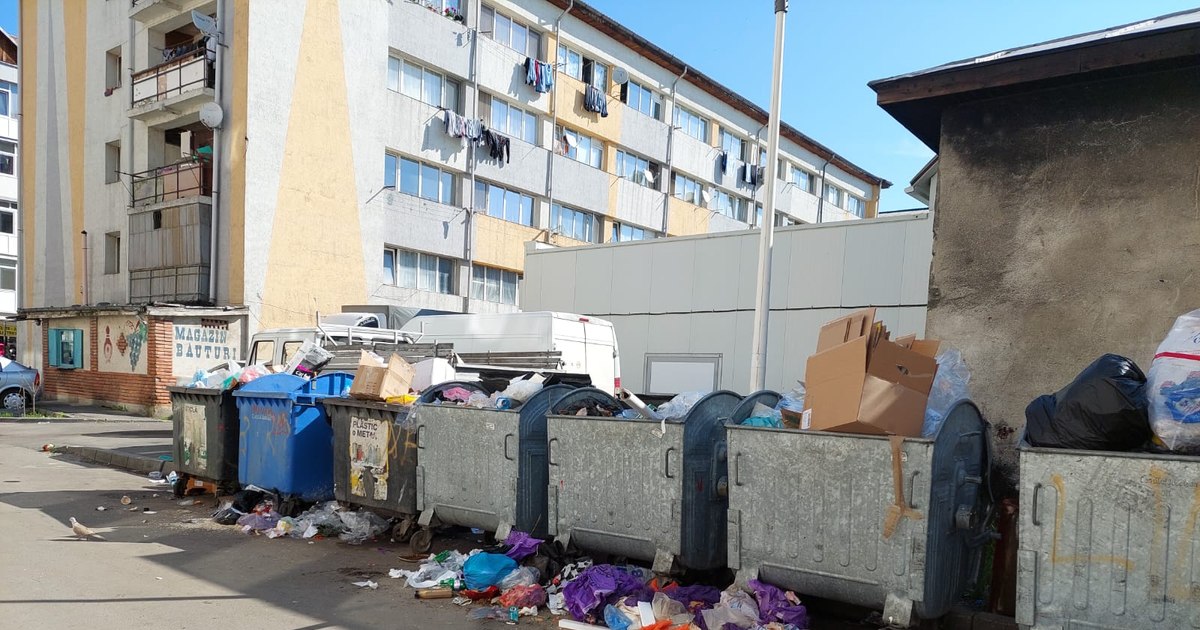
The subject of removing garbage from the blocks of Bucharest has constantly returned to the public space, for over a decade, but the discussion has long passed from the technical area of the administration to the social one, where the reactions are strong, contradictory and often tense. In the absence of a unitary implementation and a calendar clearly felt by the citizens, every new administrative stage generates the same question: who wins and who loses from the change of the waste collection system?
Over time, frustrations related to infrastructure, bureaucracy, urban comfort and the ability of the authorities to complete major projects have gathered around this topic. And the comments appearing in the public space show how polarized the discussion has become.
“Mega-eyelashes” fitted but not working and suspicions of waste
Some of the backlash directly targets the way selective collection projects have been implemented in some sectors. An Internet user criticizes the situation in Sector 6, where collection systems were allegedly installed that did not become operational.
“Ciucu, when he was mayor in Sector 6, installed some mega bins with bins for selective collection, which are still closed. The old bins are still used, in which the garbage is thrown in a heap. Are they waiting to implement the system in the whole city in order to let it go everywhere at once or was it just a scheme to siphon some more money from the budget? Remains to be seen”he said.
Another participant in the discussion criticizes the “speed” with which such projects are implemented in Romania: “So a project started in 2021 is not ready in 2026 and the world is still defending them… Jesus!!! Why did Ciucu promise that in the fall of 2024 it will be ready then?”.
Bureaucracy and bottlenecks in the sanitation chain
There are also voices that explain the delays by the complexity of the administrative process and tenders. “Because the installation of the bins is ready. The problem is different: after you install them, you have to have an operator to take the garbage. You need several stages: treatment, sorting, storage and collection (random order). And for each you need an auction, sequentially (you can’t auction for collection if you don’t have a place to store). And the city hall has gone through all these steps and they have already made the last auction. The problem is that it is disputed and it is going through the courts. In short, bureaucracy is a nightmare and it is no coincidence that no sector has been able to sign a new sanitation contract since 1999, as if“, he writes.
Amid these technical explanations, some of the public discussion becomes emotional and ironic. Another Internet user writes that the people of Bucharest can do nothing but wait, because “at the speed at which these people from Romania are working, until the appeals are resolved, they will change the lashes a few more times, because they are starting to degrade”.
The practical problems of gene-free collection
In addition to administrative discussions, there are also concerns related to everyday life in the absence of eyelashes, in which the people of Bucharest show their skepticism about the implementation of such a project.
“They got rid of that bin and when we asked to replace it they gave us one like the old bin without sorting (fee/fine) or three smaller sorting bins with no fee/fine. I’m aware that’s the direction, we have to recycle otherwise it’s littered…everything we put in the bin doesn’t magically disappear. But I’m very curious how it will be in high-rises with a single elevator… all day long they will walk around taking the trash”, write another.
Where will be located the first 62 modern underground garages, in Sector 6 of the Capital. List of addresses
Criticisms related to hygiene and social impact
Some of the harshest backlash concerns the social and health consequences of removing eyelashes. “There will still be bugs and smells, old people won’t be able to go out as easily as they walk 5 meters to the toilet, and they will keep their trash in the house/balcony. The sick, the disabled, the same. If the elevator is being repaired, everyone who lives on the upper floors will keep their trash in the house… The garbage bags are extremely thin, there will be mess in the elevator and on the stairs… Adult and children’s diapers will stay outside in the heat for a few days until the garbage is picked up… There will also be a scandal on the location of the bins, those on the ground floor and the 1st floor will not want either the smell or the noise at the window lor”, points out another internet user, noting that urban discomfort could be redistributed from inside the blocks to the common or outside space.
Another concern is the lack of necessary infrastructure in a high-density city like Bucharest.
“I’m very curious how these will do for multi-apartment buildings, especially in areas where space is tight. At my scale there are 60+ apartments and we have no green space or parking. Where do you put these bins and how often do you have to empty them?“, writes a participant in the discussion.
Arguments in favor: the normalization of external collection
There are also opinions that support the change, comparing the situation with other cities:
“Leave it, sir, it’s good. In other cities, too, the garbage bins in the blocks have been abandoned and no one stinks anymore… Just as those old people can go to the bank in front of the block, so they can also take the garbage…”
“After the whole country takes measures to remove garbage from blocks of flats, in Bucharest it takes decades just to move in that direction?… Bucharest should be the first to adopt good policies for citizens… The head fish stinks.”
What does the “new” strategy provide, 11 years after its first publication
Beyond the public debate, removing eyebrows is not a new idea. The first coherent plans appear since the Sanitation Strategy of the Municipality of Bucharest adopted in 2015, which provided for the gradual transition from block bins to a selective collection system outside.
Controls at landfills, after the wave of fires during the summer. The Minister of the Environment: “We don’t recycle as much as we should”
The major problem was the uneven implementation and lack of complete infrastructure, which resulted in the maintenance of the mixed system.
Currently, the Capital City Hall has put into public debate a new sanitation strategy with a horizon of 2033, which resumes the objective of eliminating nuisances and integrates it into a larger system of modernization: extensive separate collection, reorganization of logistical flows and the introduction of the “pay as you throw” principle.
The strategy envisages not only the abolition of garbage pipes in the blocks, but also a change of the system: extended separate collection, the introduction of the “pay as you throw” principle, collection at night in certain intervals and the modernization of street cleanliness.
According to the project, the genas do not disappear suddenly, but in stages, by transforming them into collection points or by replacing them with external infrastructure.
The major difference to the 2015 strategy is that the new document seeks to link the removal of the nuisance to a wider package of operational and financial measures, including changing the way waste is charged and modernizing collection logistics.
In essence, it is no longer just about “closing the garbage”, but about replacing the entire waste collection model in Bucharest.
However, at the moment the strategy is still in the public debate phase, which means that it does not produce binding effects and may undergo changes before the final adoption.
