
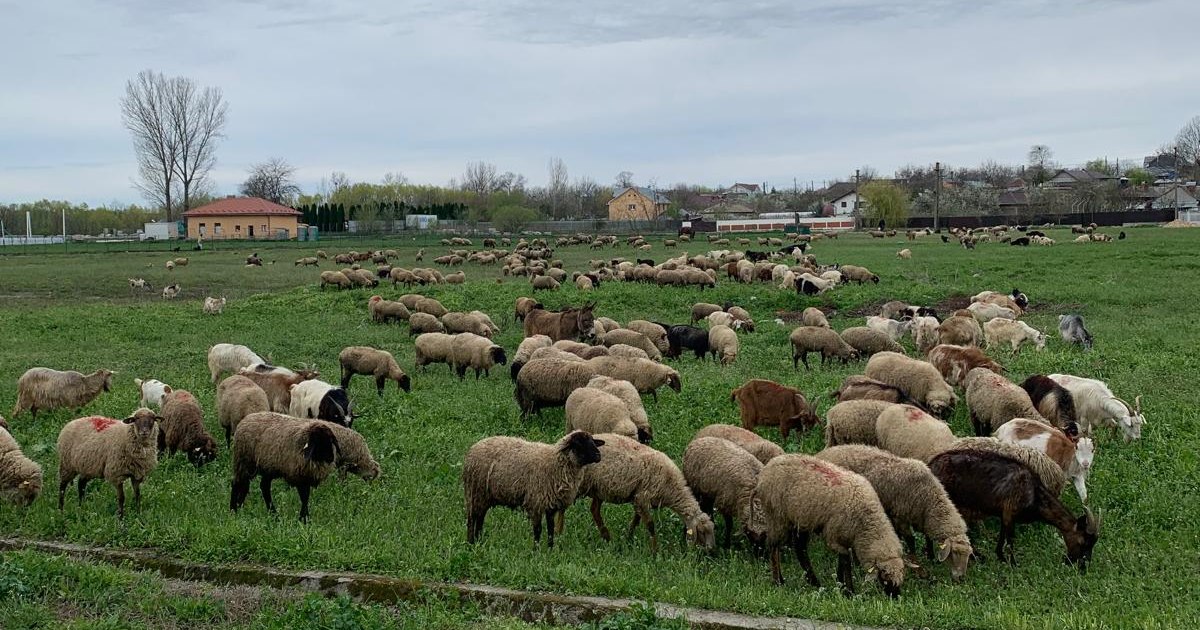
Sheep breeders in Romania are asking the authorities for urgent measures to convince Brussels that our country remains a reliable supplier and that the measure to ban the export of animals, both to EU countries and to third countries, is far too harsh, with the potential to destroy the sector.
The confirmation of an outbreak of plague of small ruminants in a sheep farm in Mureș county has led to a situation that may cost sheep farmers in Romania their livelihood. The outbreak was confirmed in the first decade of June 2026, and since then things have taken such a serious turn that representatives of animal breeders say a social crisis may be born.
After the outbreak of plague of small ruminants, ANSVSA established protection and surveillance zones. The European Union reacted quickly and required Romania to stop transporting sheep and goats to the other EU member states, the measure being initially foreseen until July 31, 2026. A second, much more severe decision followed on June 18, by which the European Commission maintained the ban on sheep and goat deliveries to the EU member states, but also imposed bans on exports to third countries (the Middle East, North Africa). etc.), extending the restrictions until December 31, 2026. These drastic measures target not only the county of Mureș, where the outbreak occurred, to which protection and surveillance areas are added, but the entire territory of Romania.
From the export champion in the EU, to the total ban
Acting Minister of Agriculture Tánczos Barna contested the decision, calling it “deeply disproportionate” and arguing that there is only one outbreak, localized and under control, and the application of restrictions at national level is affecting a sector which in 2026 has become the largest exporter of sheep from the EU to non-EU markets.
According to ANSVSA, in the first ten months of last year, Romania exported approximately 210 million euros worth of sheep to third countries, and for 2026 the data showed an increase of approximately 40%. This year, more than 1 million head have already been exported, our country occupying the 2nd place in the European Union in terms of herd (the number has exceeded 10 million heads) and the 1st place in the EU for the export of live animals to the extra-EU space.
Sanitary measures must protect the health of animals, but without unnecessarily affecting the competitiveness of Romanian farmers, the minister claimed, requesting ANSVSA to urgently present to the Government and the European Commission a credible plan to combat the disease, so that the restrictions are limited to the affected areas, and exports can be resumed as quickly as possible.
“Traditional foreign markets are not easily won and do not recover quickly if lost”
The Sheep Union, the association that represents the interests of the majority of sheep breeders in the country, reacted promptly, asking the state institutions (addresses were sent to the National Veterinary Sanitary and Food Safety Authority – ANSVSA; the Ministry of Agriculture and Rural Development – MADR; the Ministry of Foreign Affairs – MAE; the President of Romania) for firm interventions.
“Traditional foreign markets are not easily won and do not recover quickly if lost. Each week of blockade can cause foreign buyers to turn to other supplier states, affecting in the long term the credibility of Romania as a trading partner”, drew the attention of the heads of the association.
The measure imposed by the European Union and for now not effectively attacked by the Romanian state could block the entire sector, producing huge economic losses and affecting thousands of breeders who have nothing to do with the outbreak in Mureș.
Transhumance from Valea Sebeșului, in a documentary event. 13 years of the life of a family of shepherds from Loman
“MEPs are also with us, who have already asked questions. If we manage to do something, on Tuesday, Wednesday, at least on September 1, to lift the restrictions, that would be good. If not, it will be another year of huge losses for the sheep. It doesn’t even matter at what price, but let’s give them, because if we enter the winter with them, we have to take care of them, give them food, and you have nowhere else to go. Little is consumed in the country. Out of 10 million, come on, one million a year. Without export, we have nothing to raise sheep, because more than 100,000 shepherd families live from iteffectively. However, if this occupation also falls, these people all become social cases. I clearly told them not to joke anymore”, attracts the attention of Constanța Ștefan, the president of the țara Loviștei Association, an association affiliated to the Oierilor Union.
The sheep also identified several solutions that they proposed to the authorities to consider, including:
– the regionalization of the measures, so that the restrictions are applied only in the affected area;
– resuming exports as quickly as possible for farms located outside the restricted areas;
– granting compensation and financial support to affected farmers;
– the involvement of the Ministry of Agriculture and ANSVSA in negotiations with the European Commission to reduce restrictions.
What else can be done
Currently, the veterinary authorities continue to monitor farms in the outbreak area and apply the bio-security measures provided for by European legislation. On the part of the sheep sector, pressure is being exerted, in parallel, to obtain a regionalization of the restrictions, so that exports are no longer blocked at the national level, but only in the area where the disease evolves.
The main stake is the regionalization of restrictions, a measure requested both by the Ministry of Agriculture and by farmers’ organizations. The authorities are trying to convince the European Union that the restrictions can only remain in the protection zone, the surveillance zone and, possibly, in the counties with epidemiological risk, so that farms in Dobrogea, Moldova, Banat or Oltenia, located hundreds of kilometers from the outbreak, can continue to export.
It is equally true that Romania will have to demonstrate that it has the capacity to manage the risks, and if no more secondary outbreaks occur in a certain period, to be able to request a reassessment of the situation.
One of the reasons why the European Commission imposes severe restrictions is the lack of certainty regarding the movement of animals. The authorities must demonstrate that all animals are identified, that animal movements are recorded and that animals from affected areas have not reached other counties.
Sheep farmers, tempted to sell Easter lambs for export. “It’s a hard decision. Romanians want more and not much”
For these reasons, much stricter controls are carried out to prevent illegal trade, with ANSVSA warning that unauthorized shipments represent one of the biggest risks.
Beyond the appeals of the organizations and the public positions of the decision-makers, what will convince the European authorities are the concrete documents – updated epidemiological reports, the results of epidemiological investigations, laboratory analyses, measures applied in the field – to be presented to the European experts for a possible modification of the restrictions.
What the farmers are asking for, and the Romanian authorities can help them, is for the state to adopt real support measures to limit the economic effects already felt. It’s about compensation for slaughtered animals, compensation for the loss of contracts, state aid, etc.
And diversifying exports could be part of the solution, so that if the export of live animals remains restricted, processed meat can be exported. Stimulating the growth of domestic consumption, which has been tried before (see the “Choose the sheep” program), without success, could be targeted again as a measure to help the sector.
