
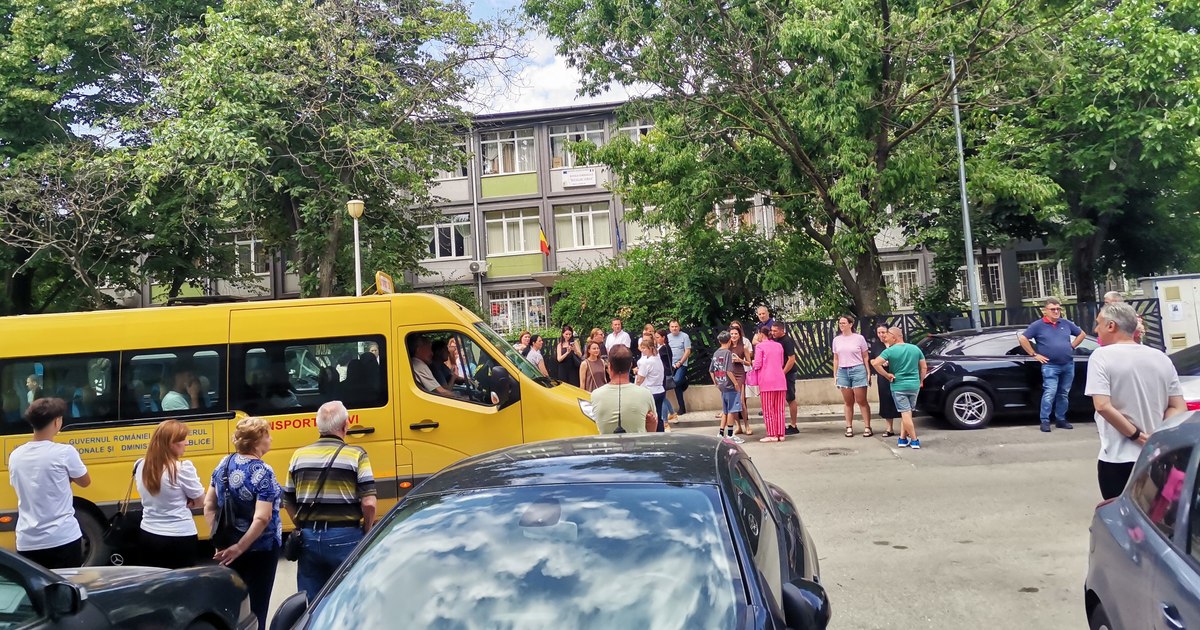
On Monday, June 22, 2026, more than 143,000 eighth-grade graduates took the Romanian Language and Literature test, the first test of the 2026 National Assessment exam. There were also 4,551 absentees throughout the country, and four students were removed from the exam.
Although most students said that the subjects didn’t cause them much trouble, they won’t bring many 10 marks either, says Prof. Ionela Mircescu, for “Adevărul”.
“Balanced subject, well structured and adapted to the training level of secondary school graduates” says Romanian language and literature teacher Ionela Mircescu, from the “Ioniță Asan” Caracal Theoretical High School. In an analysis for “Adevărul”, Prof. Mircescu specifies that the supporting texts were accessible. On the other hand, the teacher does not expect many very high marks, because there were also elements of finesse, which are mastered by students who have studied constantly throughout the years of secondary school.
“From the perspective of a teacher of Romanian language and literature, I believe that the subject proposed for today’s test within the National Assessment exam was a balanced one, well structured and adapted to the training level of secondary school graduates and in full accordance with the previous models proposed by the Ministry of Education and Research. The requirements sought the evaluation of essential skills provided in the school curriculum, from receiving and understanding the message in the text, to correct and coherent expression in the text. The supporting texts were accessible and gave the students the opportunity to demonstrate both the ability to understand the information and the ability to formulate reasoned answers”, said the teacher.
The two supporting texts, “Paper Birches” by Veronica D. Niculescu, author also studied in class, says Prof. Ionela Mircescu, and “Agutoki. Travel impressions in Papua New Guinea” by Carmen Strungaru, had developed requirements that were easily solved by the children, because they understood their message.
What the students had to write
In exercise 1 – fill in the dotted spaces with information from text 1 – “One autumn evening, the chief printers bring a turtle”, information was found in the very first sentence of the supporting text. “The turtle was brought to the editorial office by the head of the printers, one autumn evening.”
In exercise 2, “Vladimir has the job of…”, the correct answer is “B – proofreader at a newspaper”.
In exercise 3, “In the village, the floor of the houses is made of…”the correct answer is “C – bamboo trunks”.
In exercise 4, “The author finds the taste unpleasant…” – the answer is “D – coconut milk”.
In exercise 5, where the students had to tick true or false, the requirements were clearly formulated on the two supporting texts and did not raise problems for the students, so they had the values - “true, false, false” and then “true, false, false”.
In exercise 6 – “specifies a feature of the narrative textual pattern” – a fabric of the narrative textual pattern constitutes it “the presence of the characters and the objective narrator.” A suggestive sequence of this feature represents it “reporters quickly got bored, the head of the printing house also disappeared” or “when he was about to turn off the light and go home, Vladimir bent down and grabbed the cold shell with two fingers.”
In exercise 7, the students had to specify in a minimum of 30 words an element of content common to the two supporting texts, such as “the forest”“nature”“the communion of man with nature”then exemplifying with relevant sequences from each text.
Thus, in the first supporting text –“Vladimir cares for injured or distressed animals, such as the turtle, osprey and gray heron, which he then releases into their natural habitat.” And it is supported with the sequence – “then there was a gray heron brought to the newsroom’.
In the second supporting text, “the author observes with interest the vegetation and the habit of the locals, discovering coconut trees and cocoa trees, during her journey confessing: I look at the plants and listen to the sounds of nature”.
In exercise 8, the students had to answer the question “Do you think that the gifts received should be valued, no matter how simple they are?”. “Justify your answer to the given question in 50% words, using text 2”. Therefore, the students should have expressed their opinion regarding the issue under discussion, supported the answer and exemplified with a sequence from text 2, as they had specified in the requirement.
A possible answer would have been: “I believe that the gifts received should be valued no matter how simple they are, especially since the value of a gift is not given by its price, but by the feelings with which it is given. Thus, in text 2, the locals offer the author coconuts and cacao fruits, wanting to make her happy, thus sharing even a part of their lives with her, representing a gesture of generosity, hospitality: “I receive, indeed, not one, but two yellow-orange cacao fruits and some leaves that I want to keep”.
National Assessment 2026 has started. What to do as a parent: “It will remember how you behaved, not the grade”
In exercise 9, a common value would have been “love”, “man’s concern for the speechless”, “goodness” and they could associate the supporting passage with a text studied in class or read as additional reading. It could be “Wonderful Grove” by Mihail Sadoveanu, “The little girl who didn’t like his name” written by Elif Şafak, presenting later with a relevant sequence from the two literary works for the mentioned value.
Regarding the grammar part, B:
– In exercise 1, the diphthong was found in series C – the bird and winter;
– In exercise 2, in the fragment “it’s neither sweet nor sour, but rather salty-willow, plus something else hard to define, I’m starting to wonder to myself how I’ll last the whole month.” the word “something” was formed by composition, “ce+va”, and “sinea” – by conversion became a noun from a reflexive pronoun.
“Here I think some of the students fell into that trap, considering it a derived word, but there is no such answer”explained the teacher. The correct option was D – composition and conversion;
– In exercise 3, “a young man stops by a coconut tree, hugs the trunk with his arms and thighs and, in a few movements, he is up”, indicates that the young man reaches the top – answer option “D – very quickly”;
– exercise 4 – Antonyms are found in the sequence “A – Then they go down as if they were in an elevator and the tourists get into the SUV.” being the antonyms “go down” and “go up”;
– In exercise 5, there could have been some problem, Prof. Mircescu points out, as the students had to specify the morphological value of some underlined words, such as, for example – “ia- – personal predicative verb”, “mele – possessive pronominal adjective” (it is not a possessive pronoun because it is given in gender, number and case with the definite noun “hands”), and “un” from “a liter of milk” – is a simple cardinal numeral. “If the value is also specified, so much the better, if not, even the simple cardinal numeral is scored”, says the teacher;
– In exercise 6, the requirement was to make a negative sentence in which the predicative verb “to say” to be used in the more than perfect tense, as, for example, “you hadn’t told the truth.” “I know some of the kids took one
National Assessment 2026 topics published on social media during the exam
They also had to recognize an affirmative sentence in which the common noun “frog” to be in the genitive case. The correct form is “frogs”: “the frog’s jump impressed me”, “the frog’s food”…;
– In exercise 7, transcribing any three subordinate clauses from the given sentence: “when spring came” – circumstantial of time and “the turtle made eyes again” – time circumstantial in relation to coordination by junction with the first sentence; “where could” – attributive subordinate clause. “I know there were some problems here too, the kids took it as circumstantial, but there was no such thing,” attracts the teacher’s attention. “May they live 100 years” – direct complement, “without any man ever bothering her again” – circumstantial mod.
Students received one point for correctly transcribing each sentence and one point for specifying the type of each transcribed subordinate clause;
– In exercise 8, specifying the correct form of some words, “I would like to tell Maria that I only have one big wish, that (with two “e”), to travel (the verb in the infinitive is always written with a single “i”), together with my daughter”.
In the second topic, the students had to summarize text 1 in 100-150 words.
The word limit set at 100-150 is a novelty, previously it was 80-120, which is to the advantage of the children, the teacher mentioned, because the students often exceeded this limit. “In conclusion, I believe that today’s subject followed the principles of a modern national examination, relevance, balance and focus on skills.
More than the verification of specific knowledge, it aimed to highlight the students’ ability to understand, interpret and use the Romanian language effectively, the fundamental objective of the study of the subject during secondary school education, and the high grades will certainly be given to students who have prepared constantly and seriously studied the subject of secondary school”. Prof. Ionela Mircescu concluded.
