
The dismissal of the Bolojan Government through a no-confidence motion pushed Romania into a new period of political instability, at a time when the pressures on public finances are increasing. With an interim cabinet at the Victoria Palace and no clear majority to undertake the necessary measures to reduce the budget deficit and close the PNRR, the uncertainty is also beginning to be reflected in investor perception.
Economist Radu Crăciun, former president and general director of BCR Pensii, warns that international rating agencies are carefully following developments in Bucharest, and any signal suggesting the abandonment or delay of fiscal consolidation could lead to a downgrade of the country’s rating. Such a scenario would translate into higher financing costs for the state and, ultimately, effects felt by the population and the business environment.
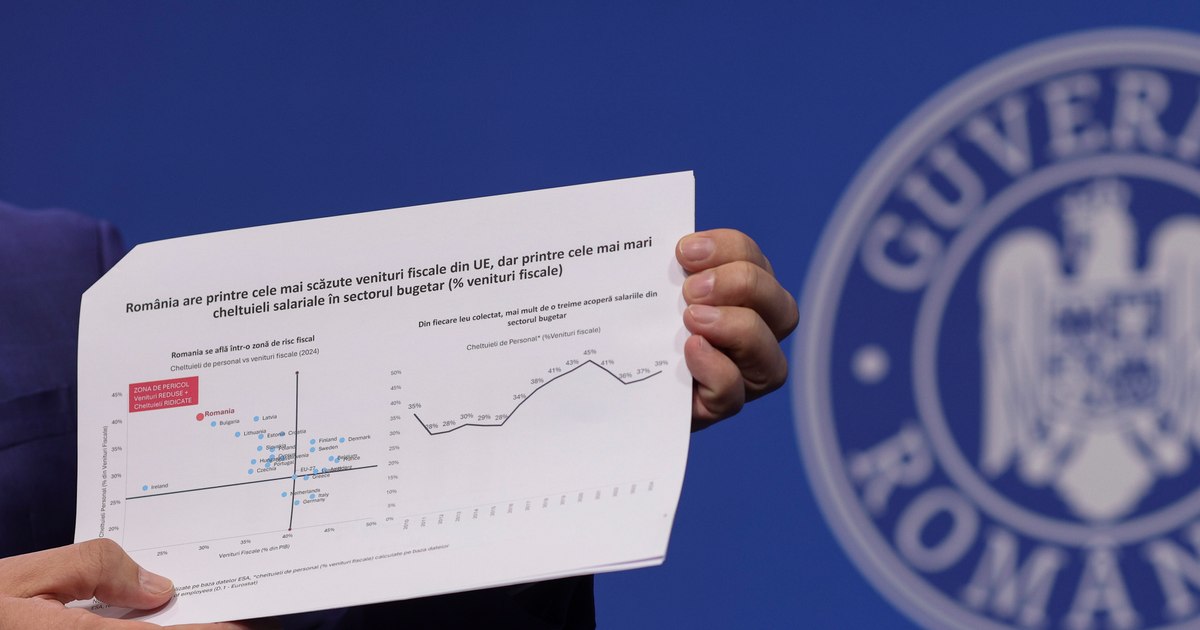
After the fiscal slippage in the 2024 election year due to which the budget deficit approached vertiginously close to 10%, Romania is now in a difficult process of fiscal adjustment, assumed both in the relationship with the European Commission and in relation to the financial markets. In this context, the future government will be judged primarily by its ability to continue reducing the budget deficit and to present credible projections regarding the evolution of public finances.
According to Radu Crăciun, the rating agencies are primarily interested in the results and the realism of the fiscal estimates, not necessarily in the instruments used to achieve the objectives.
“In order to maintain Romania’s rating, it is very important that the already existing trend of reducing the budget deficit is maintained. Regardless of the government, at the moment there will be statements, not even measures, that suggest either that the process of reducing the budget deficit will be stopped or that it will be reduced, but based on unrealistic fiscal projections, the rating will be reduced, without a doubt. The financing of Romania’s debt will also be signaled to investors as having a high risk. Nota bene, the dosage between the increase in budget revenues and the decrease in expenses will be at the discretion of the future government. For the rating agencies, the results and, I repeat, the realism of the fiscal projections” Radu Crăciun, economist and former president of BCR Pensii, told Adevărul.
Romania pays higher interest rates than Serbia
The economist points out that Romania already bears higher financing costs than some states with a weaker rating. In his opinion, this situation is the result of an inconsistent fiscal policy, which generated imbalances in economically favorable periods and subsequently imposed adjustment measures in difficult times.
Crăciun recalls that the large fiscal corrections made after 1989 were implemented, as a rule, under the supervision of the International Monetary Fund, while the current adjustment is managed exclusively by the Romanian authorities.
“We have to say that Romania already pays, unfortunately, higher interest rates than countries with a lower rating, such as Serbia for example. This is the consequence of the inconsistency of the fiscal policy that Romania has shown in the last decades. The lack of rigor meant that, in good moments of the economy, we had large deficits, and precisely in difficult economic moments we then had to “tighten the belt” to reduce the deficits. Normally, it should have been In fact, it is worth noting that, in its post-December history, Romania has made fiscal adjustments of the magnitude of today only under the coordination of the IMF, using “shock” approaches. It is the first time that we are trying to make such an adjustment on our own, in a gradual way, and it should not be surprising that, in the absence of the traditional “scapegoat”, which was the IMF, today political tensions are at their peak. Crăciun explained.
Romania’s rating, improved from “negative” to “stable” by the JCR agency. Nazare: “Romania managed to moderate its budget deficit”
What effects would a downgrade have?
A possible downgrade of the country’s rating would not only have a symbolic meaning. The impact would quickly be seen in the financing costs of the state, through the increase in interest and budget expenditures related to the public debt. In addition, the additional pressure on the budget could impose new adjustment measures with direct effects on the population and companies.
The most vulnerable would be, according to the economist, government securities issued in foreign currency, where the share of foreign investors is higher.
“In the event of a possible downgrade, I expect that the interest rates at which Romania is financed will increase, but not by much, because, as I said, they are already high. I also expect that government bonds denominated in foreign currencies will have a stronger negative reaction than those in lei, the share of foreign investors being higher there. The consequence will be an increase in interest expenses at the budget level, which will require even more painful economic adjustments, both for population as well as for companies”warned the economist.
Early elections could increase uncertainty
In the event of the organization of early elections, a scenario increasingly debated after the failure of the investiture of the Vestea government, the economic risks could increase further. Electoral campaigns are frequently associated with promises of spending and popular measures, Radu Crăciun points out, and such a context could raise questions about the fiscal discipline of the future executive.
Radu Crăciun believes that the rating agencies will not necessarily wait for the election results to react to possible negative signals.
“In the case of early elections, the risk is that, during the electoral campaign, the parties’ promises will be unrealistic. This would bring a high degree of unpredictability related to Romania’s fiscal path, and something like that would be difficult for the rating agencies to overlook. I don’t think they will wait any longer to see who will win the elections.” Crăciun pointed out.
Valentin Lazea, the chief economist of the BNR, explains Romania’s entry into recession and the debt trap that costs us billions. X-ray of a crisis
The debt will continue to grow, even in the scenario of a successful fiscal adjustment
The economist also draws attention to a frequent confusion in the public space: reducing the budget deficit does not automatically mean reducing the public debt. Even if the fiscal consolidation process continues as planned, the debt will continue to grow, but at a slower pace.
According to the economist, in the coming years Romania could reach a level of debt in relation to GDP almost double that recorded 4 years ago. In 2022, Romania recorded a public debt of 48.1% of GDP, while this year it could reach, according to OECD estimates, 61.5% of GDP.
“As I was saying, it is important to stay consistent on the path we are on today. The approaches may differ from government to government, but the end result must look the same: a decreasing deficit. Because I would like to draw attention to the fact that the plan to reduce the budget deficit will not lead to a decrease in the external debt. Let’s not make this confusion. The external debt will continue to increase, but, preferably, at a slower and slower speed. But even so, there is a good chance that in 3-4 years we will reach a level of debt compared to 4 years ago. So the situation is very serious and should not be treated lightly. A gradual but rapid adjustment of the deficit is the best antidote to a general collapse of the standard of living.”concluded Radu Crăciun.
