
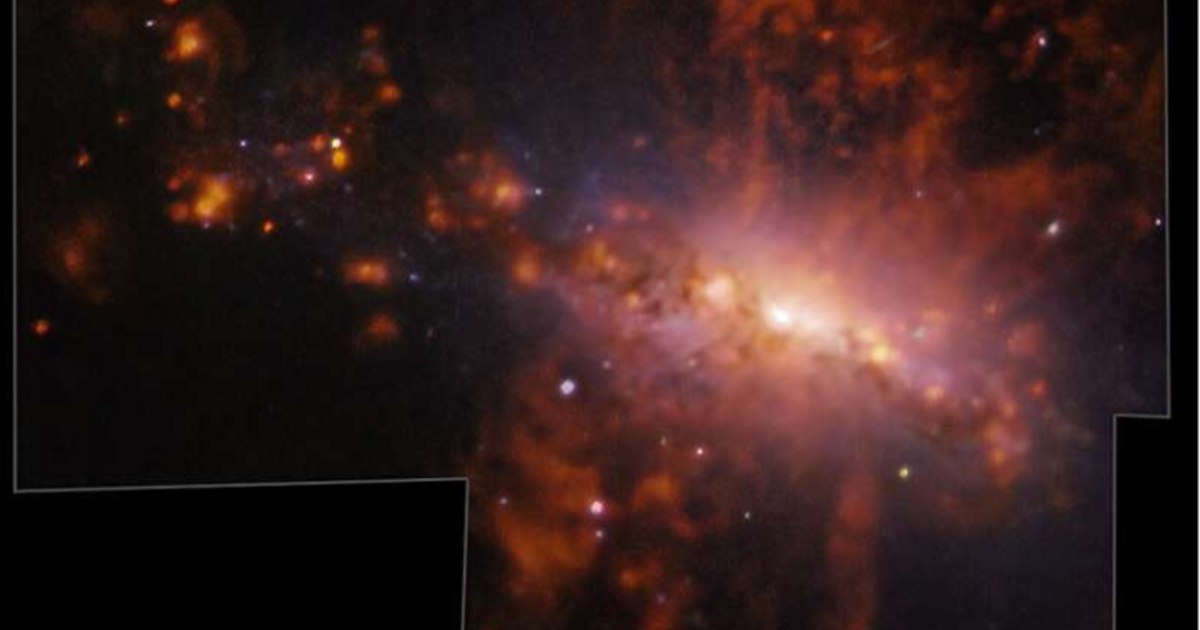
Scientists have created the first high-resolution map of a gigantic galactic explosion, which provides information on how the space between galaxies is polluted with chemical substances, informs DPA, quoted by Agerpres.
Galaxy NGC 4383. PHOTO phys.org
While studying the galaxy NGC 4383, located in the nearby Virgo Cluster, astronomers spotted a stream of gas so large that it would take light 20,000 years to travel from one end to the other.
Their discovery was published Monday in the journal Monthly Notices of the Royal Astronomical Society.
Adam Watts, lead author of the study and a member of the International Center for Radio Astronomy Research (ICRAR) at the University of Western Australia, said that the gas flow was the result of powerful starbursts that occurred in the central regions. of the galaxy.
“Gas flows are very difficult to detect”
The gas ejected into space has a mass equivalent to more than 50 million suns.
“Very little is known about the physics of gas flows and their properties, because gas flows are very difficult to detect. The ejected gas is quite rich in heavy elements, which gives us a unique insight into the complex mixing process between hydrogen and metals in the escaping gas“, said Professor Watts.
In this case, scientists detected oxygen, nitrogen, sulfur and many other chemical elements.
Gas flows regulate the rate and length of time that galaxies can continue to form stars. The ejected gas can pollute the interstellar space within a galaxy, as well as between galaxies, forever.
With the help of the data transmitted by the MAUVE program, led by two researchers from ICRAR, Barbara Catinella and Luca Cortese, a high-resolution map was created.
“The data obtained exceeded all our expectations”
MAUVE is a large-scale program that takes place at the Very Large Telescope (VLT), managed by the European Southern Observatory in northern Chile.
“We designed MAUVE to investigate how physical processes, such as gas flows, help stop star formation in galaxies. NGC 4383 was our first target, as we suspected that something very interesting was happening there, but the data obtained exceeded all our expectations. We hope that, in the future, observations made by the MAUVE program will reveal the importance of gas flows in the local Universe, in great detaile”, said Barbara Catinella.
