
The Romanian air conditioning system market enters the 2026 summer season with a baggage of uncertainties that few previous summers have brought together: a visible contraction in demand, surprisingly competitive device prices, but installation costs that erode a good part of the advantage gained in the showroom. Industry sources, active both in equipment distribution and in the technical services segment, outline the picture of a sector in a fragile balance after two years marked by volatility.
A peak year that left deep traces
The inevitable reference of any discussion about this market remains the summer of 2024. Temperatures that frequently exceeded 40 degrees Celsius – sometimes as early as the first decade of June and until the end of September – generated an unprecedented demand for air conditioners. Split units and multi-split air conditioning systems quickly ran out of stock, deliveries took weeks, and licensed installers were working with waiting lists of up to two months. The market reached a record volume, both in terms of value and quantity.
Inevitably, this explosion of consumption created a saturation effect. A significant part of households that did not have air conditioning and could afford it solved their problem in 2024. This reality spoke already from 2025, when the market began to contract by about 20% compared to the previous year – a large but predictable correction for those who followed the financial indicators.
Will the contraction continue in 2026?
If 2025 marked the first stage of the adjustment, 2026 brings, unfortunately for the HVAC industry, the prospect of a continuation of this downward trend. The visible slowdown in the economy, problems in the labor market and general buyer caution translate into more selective demand. The first months of the year confirmed this trend: sales activity was timid, with volumes below the historical average of the January-April periods, traditionally specific to the start of construction projects and interior renovations.
The B2C market – i.e. direct sales to household consumers – follows a well-defined seasonal pattern, with a peak concentrated in the months of June-August. Only with the first warm days does the interest of buyers accelerate, a characteristic behavior that makes the year-end estimates depend to a large extent on how the summer will behave from a meteorological point of view. For now, the picture is far from the euphoria of 2024.
Appliance prices – a relative surprise
Paradoxically compared to what the average consumer might anticipate, the prices of air conditioners are, on average, comparable, even slightly lower than the prices of the summer of 2025. Market information indicates that an important part of the models – from the monosplit units of 9,000 BTU, with energy consumption class A+++, to the equipment of medium capacity of 12,000-18,000 BTU – can be sold today with discounts of 3-8% compared to the prices practiced a year ago. Very few brands, or the range of premium products, can still register increases, but modest ones, of the order of 2-4%.
This dynamic is all the more remarkable as the leu has depreciated slightly against the euro in the period since the summer of 2025 – which should normally have been reflected in higher prices for imported products. Compared to the dollar, on the other hand, the leu remained relatively stable, which partially offset the effect on certain categories of equipment. Distributors preferred to absorb some of the currency pressure in their own margins, aware that demand no longer has the elasticity of the boom period.
A relevant episode from the end of 2025 was the buy-back campaign launched by one of the big players in the market – an offer through which customers could hand in old appliances, regardless of brand and condition, in exchange for a substantial voucher (even a 2000 lei discount) applicable to the purchase of a new inverter air conditioner. Although the financial terms were attractive, market sources tell us the offer failed to generate the expected momentum, confirming that the problem does not lie in the price of the device, but in other structural factors.
Assembly – the hidden cost that changes the equation
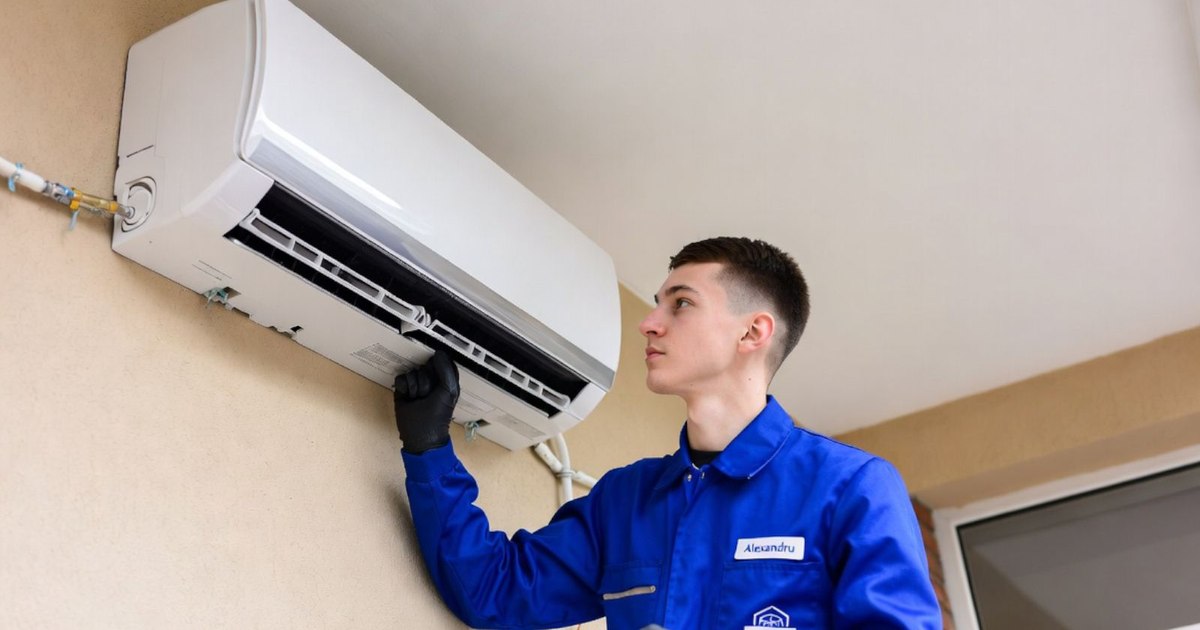
This is where the big issue of the 2026 season comes in: the price of the installation service. If the price of appliances has stagnated or fallen slightly, air conditioning installation packages have continued to rise in price, under the cumulative pressure of inflation in the service sector and, above all, the chronic shortage of authorized technicians in the field.
The installation of an air conditioner requires personnel certified in the handling of refrigerants (in accordance with EU Regulation No. 517/2014 on fluorinated gases), knowledge of electricity and the ability to correctly assess the route of the pipes and the configuration of the space. The number of available specialists has not increased at the same rate as the accumulated demand in recent years, and salaries in the industry have risen considerably.
Specifically, for an entry-level appliance with a cooling capacity of 9,000 BTU and a shelf price of 1,500-2,000 lei, the cost of a standard installation package – which includes labor, wall supports, 3-meter refrigeration pipe, drain siphon and crossing a wall up to 30 cm – can reach 1,200-1,300 lei today. In other words, assembly can even represent 70-80% of the price of the device itself – a ratio that, two years ago, was significantly more favorable to the consumer. Given the price increases, specialist firms are anxiously awaiting the summer, as customers will have no fear of resorting to improvised solutions – obviously much cheaper.
At the upper end of the range, the situation is more balanced: for a multisplit air conditioning system with one outdoor unit and two or three indoor units, the total price of the installation can reach around 2,000 lei, which would represent 20-25% of the cost of the equipment – a more reasonable percentage, but still increasing compared to the references of 2023-2024.
Conclusion: The final price may be higher than a year ago
The message that the market sends to the attentive consumer is apparently contradictory: the price of air conditioners is stagnant or even slightly decreasing, but we will pay more than last summer if we consider the complete package – air conditioner plus installation. This reality risks being ignored by buyers who only compare prices from online offers without factoring in the cost of installation.
For those who have already purchased an inverter type air conditioner in the last 2-3 years that is operating within optimal parameters – a COP (coefficient of performance) of 3.5-4.5 in cooling and a SCOP of 4.0-5.0 in heating, according to the data sheet – there is no clear financial justification for replacement at this time. The market seems to have internalized this conclusion. The summer of 2026 will confirm whether and to what extent a new wave of extreme temperatures can change the calculations.
photo https://grok.com/
