
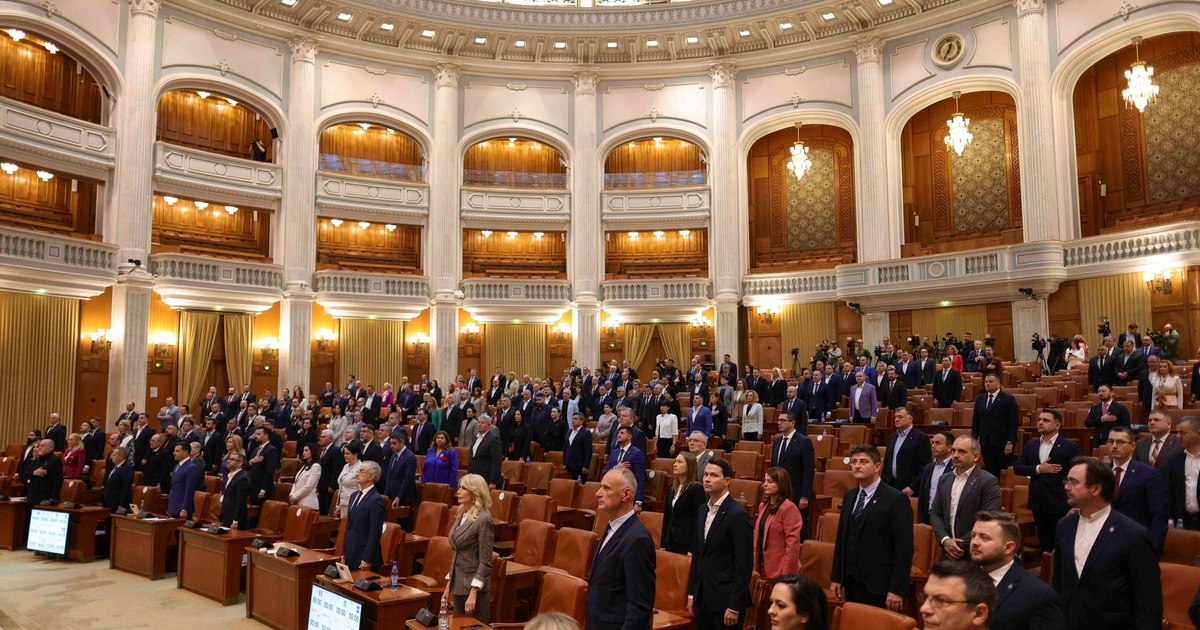
The lack of a clear majority and the negotiations for the formation of the new government bring to the fore a dangerous scenario for Romania’s stability. Without a solid parliamentary majority clearly assumed, political parties vote bills solely on the basis of momentary interests. In an analysis for “Adevărul”, political consultant, Cristian Andrei – director of the Political Rating Agency, warns that a minority or technocrat government, lacking stable support, risks becoming a simple tool in the hands of toxic behind-the-scenes alliances.
After the collapse of the coalition between PSD, PNL, USR and UDMR, anarchy seems to have taken over the Romanian Parliament. On Tuesday, in the Senate, PSD, AUR and UDMR divided their leadership of the Romanian Cultural Institute. Also on the same day, USR and AUR supported a bill for the election of mayors in two rounds, but the initiative was rejected by PSD, PNL and UDMR votes. Then, USR, PNL and AUR voted to eliminate the surcharge on part-time contracts.
Who is in power? Nobody knows anymore
The first and most important risk of parliamentary fragmentation, argues Cristian Andrei, is the blurring of the border between power and opposition, a phenomenon that can fuel political instability and create a favorable ground for populist and extremist discourses.
“The main risk is that people no longer understand who is the power and the opposition, and this gives rise to political chaos, populism, extremism. This idea that we could have in Bucharest a kind of “Brussels” politics, with many parliamentary groups that negotiate anything according to an agenda and that can cross ideological boundaries and everything is on the table – is dysfunctional and absurd in a Romania that is moving towards tribalization, with huge social and political faults. Romania is now moving towards large political blocs, not towards a politics of niches”, he shows..
Beyond the visible chaos in the plenum, Cristian Andrei warns that, behind the apparent fragmentation of the Parliament, the risk of informal alliances is taking shape, built outside of publicly assumed political commitments and without a clear responsibility to the electorate.
“The risk is that under the fragmentation of the Parliament, toxic, less visible alliances will actually be born, which take major decisions in plenary, or which end up actually imposing key people in positions – but who do not take responsibility as such. A leadership from the shadows, irresponsible, is the darkest scenario for Romania”. emphasizes Cristian Andrei.
Parliamentary outlawry could ruin the country’s finances
In the context in which Romania is under the excessive deficit procedure of the European Commission and has assumed the reduction of the budget deficit to 6% of GDP this year, the adoption by the Parliament of populist measures, without clear sources of financing, represents a major additional risk for the stability of public finances. In 2008, in the context in which Romania was rapidly moving towards the economic crisis, the Parliament, also then dominated by the PSD, adopted a 50% increase in teachers’ salaries, despite the opposition of the prime minister at that time, Călin Popescu Tăriceanu.
“There is also this risk of parliamentary outlawry, in which, without any responsibility towards the leadership of the country, decisions are made for the sake of the image, without head and without tail, without a program, without a direction, without assumption. In fact, the bigger problem is the lack of assumption of power, of responsibility, which leads to chaos in society”. explained the political consultant.
A month after the dismissal, through a motion of censure, of the government led by Ilie Bolojan, the only options outlined following the consultations at the Cotroceni Palace are a technocrat government or a minority government, both considered fragile in relation to the current parliamentary configuration. In other words, explains Cristian Andrei, such a cabinet would be obliged to constantly negotiate with the parliamentary groups, in order to avoid the blocking or substantial modification of its initiatives in the legislative process.
“A technocrat, independent or minority government will constantly negotiate with the factions in Parliament, otherwise it has no way to resist. It has no way to follow an agenda against Parliament. That’s why long negotiations are needed beforehand, an assumed majority in Parliament, otherwise such a cabinet is just an illusion”. the political consultant pointed out.
The big problem, explains Cristian Andrei, is that such a cabinet will only be able to control certain decisions, in no case the entire parliamentary activity.
“The problem is that such a cabinet will be able to control only certain chapters and agreed decisions, but not all the Parliamentary activity, where other agreements can also sneak in. It will be the perfect ground for parties to play the game: both in power and in opposition – to claim to support the government, but to attack it permanently in Parliament. The power of such a cabinet would be limited. Cabinets of this kind are actually cabinets with political support”. concluded Cristian Andrei.
