
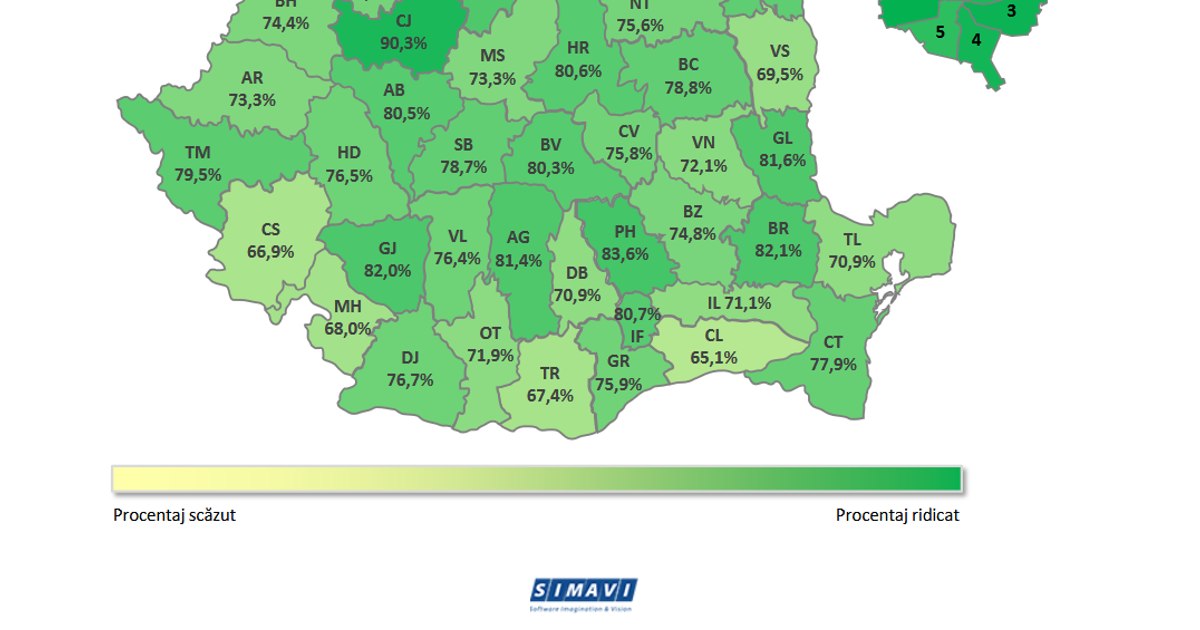
The final results of the National Assessment 2026 were published on Wednesday, July 8, and the data centralized by the Ministry of Education reveal a deep gap between the urban and rural environments, but also between the economically developed counties and those left behind. Of the 143,251 candidates present, 113,316 (79.1%) achieved averages greater than or equal to 5, while 29,935 (20.9%) remained below the passing threshold and only 7 candidates managed to achieve an average of 10.
While in the Municipality of Bucharest the pass rate is 92.2%, and in counties such as Cluj (90.3%), Prahova (83.6%), Argeș (81.4%) and Timiș (79.5%) the results are above average, in less developed counties such as Călărași (65.1%), Caraș-Severin (66.9%), Teleorman (67.4%) or Vaslui (69.5%), the passability is much lower.
The differences between rural and urban are striking. More than a third of secondary school graduates from rural areas failed the exam (36.30%), while in urban areas the percentage is three times lower (11.54%).
Secretary of State: “I wouldn’t make an absolute comparison between children, but between schools”
The Secretary of State in the Ministry of Education, Sorin Ion, declared for “The Truth” that many students from rural areas actually attend schools in cities, and the purely geographical comparison is, in his opinion, reductive.
“In this discussion, we are not talking about a comparison between rural and urban children, but about the schools themselves. Many students from rural areas actually attend schools in cities, which is clearly visible in the number of students in peri-urban localities, where parents, going to work in the city, often take their children with them, and if there is also the possibility of an after-school, the programs overlap even better. Therefore, I would not make an absolute comparison between children”he reported.
Asked how he then explains the gap between rural and urban schools, the Secretary of State explained:
“It is true that there is still a discrepancy between schools, which we are trying to compensate for through various programs run by the Ministry, such as the National School Dropout Reduction Program, which is not only aimed at preventing dropouts, but also at providing additional training, and we hope its effects will become visible over time, although the difference still remains evident.”
Sorin Ion rejected the idea that austerity would be the main factor behind the gap that makes a student from the city three times more likely to pass the National Assessment than in the countryside, citing a comparison with the previous year.
“If austerity measures were the cause of the poor results of schools in rural areas, then we should compare with last year’s results, from the period when these measures did not exist, but no significant difference is observed, and at the general level we do not even register a worsening of results, on the contrary, at the baccalaureate, we even see a slight improvement in rural areas, so I cannot identify a single factor that explains the persistence of discrepancies”he added.
The Secretary of State put some of the blame on the attractiveness of the city for teachers, noting that teachers are more attracted to cities, where they find more opportunities.
“I dreamed of St. Sava, now I only hope for a good high school.” What students say before the final results in the 2026 National Assessment
“On the other hand, we can consider, for example, the teaching staff, who are rather attracted to the urban environment, where they find more opportunities, as opposed to the rural one, so that there are teaching staff who commute from rural to urban, but much less often vice versa, which obviously contributes to the existence of a difference between the teaching staff as well”the state secretary reported, state secretary Sorin Ion concluded.
Elena Trifan (sociologist): “Rural schools are underfunded”
Sociology researcher Elena Trifan strongly contested the Secretary of State’s position, arguing that the gap has much deeper roots and is the result of chronic underfunding policies that have affected rural communities for the past 16 years.
“The differences between economically developed areas and those that remain behind are very visible, but I do not think that this phenomenon is only due to the justified reluctance of teachers to teach in rural areas. In fact, not only teachers leave these communities, but all those who pursue higher education, and to return to an area with few possibilities you need at least an additional financial incentive”explained the researcher.
Elena Trifan emphasized that rural schools have been underfunded for many years, and the problems did not appear with the recent austerity measures, but have been deepening since 2010.
“Rural schools are usually underfunded, and I’m not just referring to the current austerity measures, but to all such policies since 2010, which have disproportionately affected these institutions, starting with the closure of some schools and the dismissal of teachers, without the situation being subsequently remedied, but on the contrary, now leading to mergers.
Even when school buses have been purchased, they depend on local funding, and in general, the situation of schools is closely related to the financial resources available in each locality, so you can’t wonder why teachers are not motivated to teach in villages, when the school does not provide basic conditions, such as heating in winter”said Trifan, giving a concrete example from his own experience.
“In my village, only next year will be the first with a thermal plant in the school”
The researcher drew attention to the fact that, although some investments in the countryside come from European funds, accessing them is extremely difficult for local administrations with limited human and financial resources, and the pace of investments is much too slow to reduce the gap.
The final results of the National Assessment 2026. Almost two thirds of the appeals brought higher marks
“Some investments have appeared through the rural environment, but these most often come from European funds, which are difficult for rural administrations to access, and in my village, for example, only the next school year will be the first with a thermal plant in the school.
Therefore, the responsibility cannot be attributed exclusively to the desire of teachers to teach in urban areas, especially since the Executive, through its measures, only reduces any motivation for people to stay in the countryside, and in the absence of decent living conditions, it is natural for them to leave”Trifan explained.
Elena Trifan emphasized that the same discrepancy is found between big cities and small cities.
“The same discrepancy between grades is also found between small and large cities, because school funding is determined by local resources, and counties with large urban centers and the highest level of development are precisely those that register the best promotion environments and have usually absorbed the most European funds.” the researcher also reported.
Finally, Elena Trifan sounded the alarm on the need for coherent and well-financed public policies, targeting not only the curriculum, but also the infrastructure and social support for students and teachers in rural areas.
“There is a need for massive investment in schools, linked to teacher salary increases, but also social grants for students to support them to go to school, because without these measures, I don’t see how we can significantly reduce school dropouts, nor how we can reduce the gap between developed and lagging areas”concluded Elena Trifan.
