
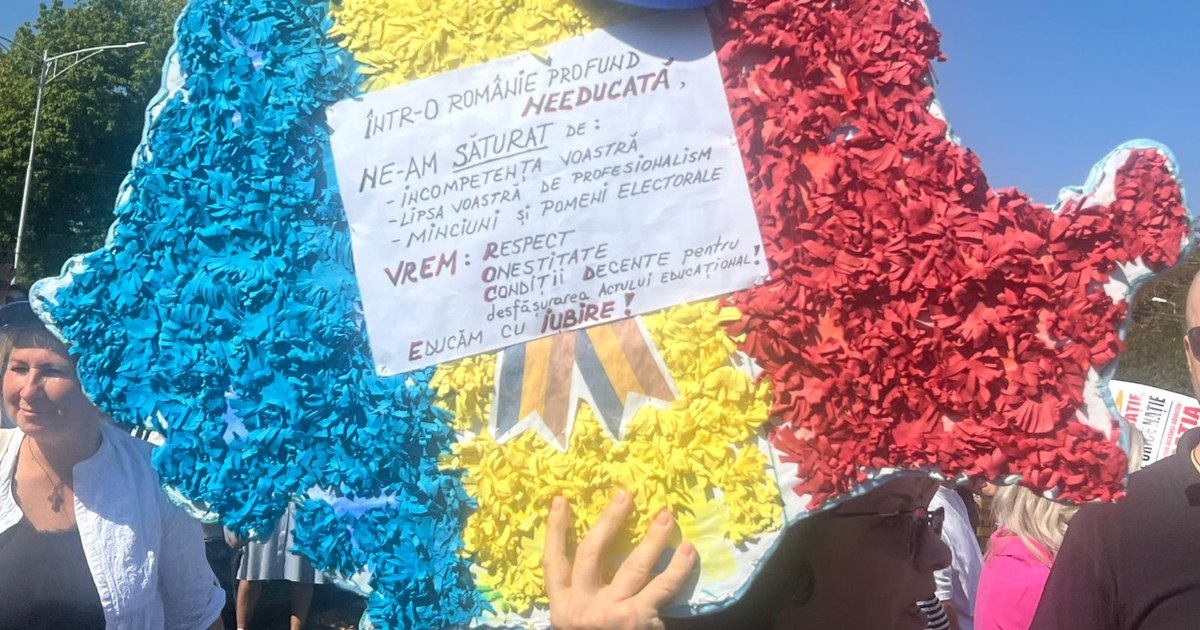
The non-granting of the teaching career bonus is the newest dissatisfaction of pre-university teachers. A county leader started correspondence with the European institutions to find out why the teachers do not receive the 1,500 lei.
The year 2026 started with bad news for pre-university teachers. After in 2025 the didactic norm was increased, schools were merged, the number of students in the class increased, the amount of holiday vouchers decreased and the ceiling from which they are granted decreased, etc., the teachers learned that, from 2026, if they have a net salary higher than 6,000 lei, they no longer benefit from the almost 350 lei/month (maximum amount that can be collected, but which decreases depending on the number of working days), food allowance.
Moreover, in January the cards should have been loaded with the amount representing the teaching career premium (for teaching and auxiliary teaching staff)/professional career premium (for administrative staff). The premium is worth 1,500 lei, and from this money the teachers could purchase goods to use in teaching or pay for various training courses.
The premium is granted from European funds, and the ministry that runs the mechanism is the Ministry of European Investments and Funds (MIPE). January passed, the cards were not fed, so the questions began. This is how they found out that in order to be able to continue granting this bonus, a new amendment to the legislation is needed, to be brought into line with the Education and Employment Program 2021–2027 amended by the Romanian authorities in December 2025 and for which amendments the approval of the European Commission is expected. Simple approval is not enough, as it is also necessary to amend GEO 58/2023 for correlation.
All these answers were obtained by the leader of the Argeșean Pre-University Education Union (SIPA) “Muntenia”, Adrian Voica, who started a correspondence with MIPE. He sent a request to the ministry, during January, after the teachers were told that the European institutions no longer give their consent for granting the premium, asking the representatives of the ministry to send the document in which these details appear. Recently he also received the answer, which is unsatisfactory.
“We received the official response of the Ministry of Investments and European Projects (MIPE) to our request regarding the existence of documents issued by the European Commission services that would have changed the rules for financing the teaching career bonus. After a careful analysis, the conclusion is clear: MIPE, by replying to our address, did NOT present any European Commission document as we clearly and imperatively requested. In our request, we explicitly asked for: a copy of the document issued by the European Commission services that would have established the ineligibility of the scheme from GEO 58/2023; or any official act that would condition the financing”says Voica in a post on his account on a social network, in which he informs the union members of the results of the approach.
The response received from MIPE does not contain any attached document, does not indicate a registration number of an official communication of the European Commission, does not refer to a formal decision of the European Commission and does not invoke a suspension, a financial correction or an official rejection from the EC, states Voica. Instead, it is limited to the description of the internal normative framework, the mention of “dialogues” and “conditions” and the generic statement that “the services of the European Commission have emphasized the impossibility of financing”, the leader of the college also announces.
“In European Law, such findings are not made verbally and are not informal”draws Voica’s attention. The teacher leader from Argeș summarizes the reasons cited by MIPE and concludes that “the problem is one of internal legislative and procedural alignment, not a ban imposed by the European Commission”.
“I have already notified the European institutions”
The leader Adrian Voica stated, for “Adevărul”, that following the answer received from MIPE, a new approach has begun, to find out whether the European institutions or the Romanian authorities are the ones who oppose the granting of a right won in 2023, following the large-scale strike. Moreover, in the answer received from MIPE, it is also mentioned that the conditions under which the money can be spent will also change, when these premiums are granted, so that 1,000 lei out of the 1,500 will be used to pay for training courses.
“From the Federation (n. ed. – FSLI) we were told that the Ministry sent, the Ministry of Investments and European Funds, that it does not want the European Commission and that the rules will be changed, with some training courses. I said show the proof. And if the evidence wasn’t shown, we wrote a letter to the ministry, which ministry takes us to task. (…) I have already notified the European institutions. We have already sent the European Commission to present us with the situation, because we have to find out too, right? As in the situation with the magistrates, let’s find out that in fact the European institutions were saying something completely different. With us, when you don’t want to and can’t be blamed, it’s Brussels”explained Voica.
The ministry wants to change the program and allocate an important part of money, hundreds of millions of euros, “to certain companies that would do the future professional training”, says Voica, and MIPE lets us believe that it is the decision of the European Commission. “Actually, they say
The teachers were previously instructed to use the money on certain elements necessary for the teaching activity, without being required to pay for the courses. “I don’t need courses, because during the pandemic the Romanian state didn’t give me a laptop, didn’t pay my electricity, didn’t give me a mobile phone, and during the pandemic, when online courses were held, I also invested in electronic devices and blackboards and everything possible. Then I did an act of charity for the Romanian state and supported education by buying from our own funds everything we needed to run things. Including routers bought the colleagues. Everyone spent out of pocket, no one paid that money to the teachers”, Voica pointed out. In addition, there is a Didactic House in each county, an institution that conducts courses.
The teachers want a general strike
During this period, education union federations are consulting their members to find out what protest measure they support to ask the government to reverse the austerity decisions already taken in this sector. Every day new reasons for protest are gathering, and the situation is close to boiling over. The teachers agree with the general strike, says Adrian Voica, however “I agree with the general strike during the exams”.
Another proposal made to the teachers, which is also being talked about in this period, is to go on strike during the simulations of the national exams (March 16 – 18, 2026 – written tests for the EN VIII simulation; March 23 – 26, 2026 – written tests for the simulation of the baccalaureate exam). Although they are important activities, they can also take place with a smaller number of staff, therefore the impact would not be the expected one, appreciates the leader of SIPA “Muntenia”. The decision will belong to the majority.
